

 ChatGPT
 Claude
 Perplexity
 Grok
Grok
The standards of office communication has been seeing a competition between cloud telephony v/s traditional PBX(Private Branch Exchange). For a long period of time, traditional PBX remained as the only source for communication in office or elsewhere. But with time and new innovations, the shift slowly moved to cloud telephony. The field saw many cloud telephony service providers in India, but Bonvoice has withstood every passing time to emerge as the best cloud telephony service provider.
Some still hold onto old ways of communication because it feels familiar and thereby comfortable. So, let’s understand what is cloud telephony and what is traditional PBX or landline, the major differences and what will be suitable for your business to thrive.
In short, a traditional PBX is an on-premise hardware system that routes calls through landlines whereas cloud telephony works entirely over the cloud or internet. The major difference lies in their infrastructure.
Cloud telephony is a cloud based alternative for your traditional phone system. It operates entirely over the internet, which is hosted by the providers’ secure cloud servers. So unlike investing a huge amount of money in traditional hardware, by using a cloud telephony service your business can eliminate all those costs as it entirely works through the internet. Also this unified communication solution brings all your channels of communication like SMS, email etc.. under one platform.

While the basic foundation of cloud telephony is VoIP, they are both different. VoIP or voice over internet protocol helps to convert the voice into data packets over the internet. While cloud telephony is a whole platform built on VoIP technology.
Understanding Modern Cloud Telephony
Cloud telephony services have become an essential component of modern business operations, empowering companies to make and receive calls from any location with an internet connection. Here are some major features:
Interactive Voice Response
After acquiring a professional number the another step is to manage the calls that rush through every hour, even when you are busy. This is where IVR or Interactive voice response changes the game in your business strategy. So what is an IVR?
IVR is often termed as auto attendant, which is the automated menu that greets the callers with options like, Press 1 for sales, Press 2 for queries, Press 3 for billing etc…
What happens in a scenario that lacks an IVR?
For small to mid range enterprises, the major challenge they face is to handle the call volume. Often they lose customers because they couldn’t reply or take the call due to their busy phone systems which leads to customer frustration and thereby churns. Also even if the staff picks up the call they will be drained too soon of their productivity which can instead be used on their tasks effectively.
IVR handles this call volume without requiring you to hire a full-time receptionist as staff. It acts as an infinitely scalable filter.
24/7 Professional Call Routing
The most essential need of a call routing system is to handle calls effectively and the greatest benefit is that they work 24/7 regardless of the hour. This helps to give your business a feeling of standard and customer – centric.
With implementing a call routing system you can:
- Direct sales to sales : if a customer is asking a query regarding a product and its specification the system can directly route it to the sales team member.
- Support to support: if the customer has some concerns over a product or service they can be directed to the support team to solve the issue.
- After hours information : if a customer is seeking information which is after the working hours of the company or institution, the system can provide essential information like hours of operation or a link to an online FAQ before offering to take a message, solving simple queries without staff intervention.
So therefore, an effective IVR doesn’t just route calls, it screens and prioritizes them, giving your team a critical head start.
Advanced Call Routing
Through a basic call routing system we can handle all the calls without getting anything missed. But advanced call routing systems add an intelligent layer to this process by passing the call to the appropriate agent who deals with the specific section of the query. This system definitely impacts the efficiency of your business by increasing your first call resolution rate.
Intelligent call routing ensures that it uses its predefined logic to transfer the call to match the customer’s need with the agent’s capability. Imagine an IT firm, where a call related to a software issue is directed to x and a call related to network setup is directed to y. This ensures a skill based routing thereby reducing customers frustration and ensuring their ease of use. Also this feature allows the queries after your working hours to be routed to an on call manager or a voicemail box thereby ensuring every call is answered and customers expectations are met.
Call Analytics and Reporting
The difference in using a simple traditional landline system and a budget friendly call management system is in the data it provides. This helps small business enterprises to make data driven decisions and strategize accordingly.
What does call data reveal?
Your phone system provides you with continuous and real time market data that you might have been overlooking. Basic call analytics and reporting provides insights like:
- Missed calls: the data of time and duration it took.
- Peak hours: shows data of when customers are trying to reach your service often.
- Call duration: shows data of what kind of calls or what issue related calls took more time.
- Agent performance: Measures the average handle time and first call resolution period of each employee.
Analysis of this data helps you to move beyond merely reacting to calls and strategize your business efficiently.
CRM Integration
A crm integration is like building a smart pathway which helps to connect your crm system with other important business tools and software. As a first step the system collects customer data from all available sources and puts it in a central space. This is called the single source of truth. Without such an integration process, there will be data silos because the customer information will be scattered in different places and the employees will find it hard to deal with the problem in front of them.
This integration uses API to make the system connect with each other and share the important data, which gets automatically updated in the other. As a result productivity is boosted, the employee gets an all around information of the customer and thereby the business gets to make better decisions.
Benefits of choosing Cloud telephony service
The first and foremost benefits lies in ease of use. Cloud telephony service providers in India are keen to facilitate a seamless flow of communication for your business. Some of the benefits to look out for are:
- Reduce Customer Wait Times: Customers don’t like to wait in line for service anymore. With the help of the automated IVR system you can easily handle initial queries, instantly routing the call. This results in improvement of service quality by using a good cloud telephony service provider.
- Improve First-Call Resolution (FCR): Customers expect to solve their problems quickly. Intelligent IVR routing and self-service ensures the customer connects to the right agent, leading to average handle time and faster resolution of issues with our cloud telephony service provider.
- Boost Call Center Efficiency: By automating routine tasks and simple queries, the cloud telephony platform reduces the workload of employees thereby allowing them to focus on more productive tasks that will enhance their efficiency.
- Enable 24/7 Self-Service Support: Customers can get access to essential information and complete their queries any time of day, which ensures 24/7 customer support automation from the cloud telephony solution platform and superior convenience to the customers.
- Handle High Call Volumes Smoothly: During peak hours or festive times, your customers will not have to wait for the call to be answered. The scalable hosted telephony platform of the service provider can effortlessly manage such high call volume handling, which ensures every customer call is answered professionally without interruption of service.
- Build a Professional Business Image: A well-designed IVR for business presents a polished, competent professional business image in front of every caller. Our reliable and accurate interaction automation makes your system highly organized. This helps to increase customer confidence in your brand.
- Multiple Department Routing: The multi-level IVR menu ensures that the customers are quickly directed to the right department according to the need of service he or she puts forward. This helps to reduce multiple transfers which might cause irritation and frustration to the customer. For example, if the customer is in need of a sales department he or she is directed to them rather than the need to interact with other departments.
- Better Lead Management and Tracking: The IVR system analyzes the query and urgency of the situation and then routes the call to the sales representative with the highest chance for conversion. The lead management system thus ensures no lead is missing thereby boosting conversion rates with a good IVR service provider.
- Quick Setup: By opting us as your IVR service provider, we ensure a quick setup of IVR because the SaaS-based IVR system is entirely cloud-based. This reduces the need for complex hardware. This ensures you both time efficiency and cost effective solution.
What's next for Cloud Telephony?
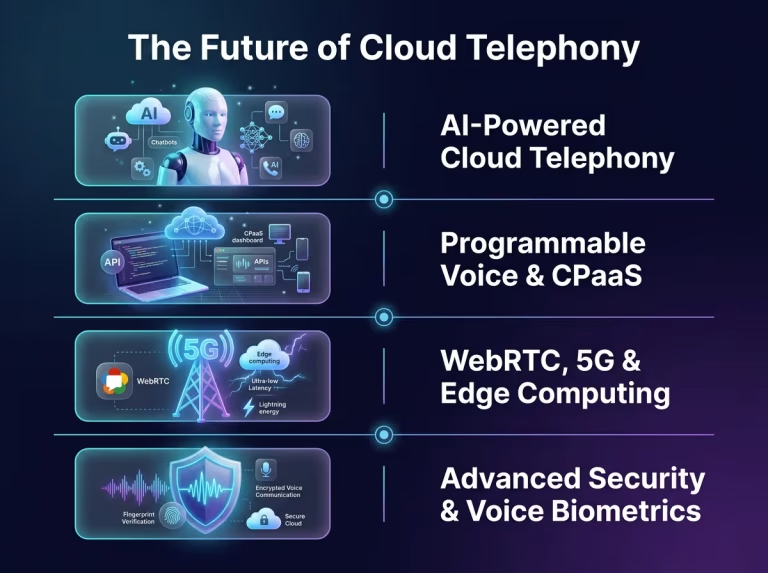
Now, let us look at some of the trends in the field of cloud telephony that can elevate your business to the next level in accordance with the changing times.
AI- powered Cloud telephony
The field of cloud telephony has seen many changes and with the arrival of AI-powered solutions like AI sentiment analysis and AI receptionist or what is called more commonly as AI voice bot, the field is moving at a fast pace. With the help of AI sentiment analysis in cloud telephony, you can understand the emotional tone of your customer. It uses Natural language processing or NLP, and machine learning to identify and understand the emotional tone of the person on call. Earlier it used to be only for text based reviews but now with the new versions in sentiment analysis software, it can go deep into analyzing the subtle nuances of the tone like acoustics, paralinguistics and context.
Beyond looking for angry words in a human speech, now the IVR solution looks for change in volume, speed and pitch which is the acoustics of the tone, jitter or long pauses which is paralinguistics and even sarcasm in tone which is done by analyzing the context. This will help your employee to get a clear picture of who they are going to handle in real time beforehand.
Oftentimes, customer relationships fail when they do not feel heard enough.
The first cause is emotional blindness of the agent who walks to the call in complete unawareness about the situation of the customer. The second major cause is delayed identification. Most companies often depend on a QA (quality assurance) team for analysis after a long time. In this much time, the angry call records of the customer might give you a nudge on what happened but it might be too late for retaining them. The other important cause of customer relationship failure is actually the pre-recorded script. The customer who dials the number might be in actual frustration and when he or she meets with a typical general recording it will only lead to more frustration. So, AI sentiment analysis in cloud telephony can be a savior for businesses in such situations.
A voice AI agent is also known by a few other names which are ai voice bot, ai call agent etc.. It is a conversational software entity that combines abilities like speech recognition, emotional intelligence, and natural language processing to interact with humans via the medium of voice. Voice AI agents are advanced and AI-powered systems that can conduct human-like conversations over simple phone conversations or applications. What used to be a robotic greeting while customers called, is now replaced with the help of large language models or LLMs that helps it to understand the nuances and interruptions in a conversation. It can execute complex tasks like automating customer support, outbound sales calls, and appointment bookings thereby ensuring reduced workload for employees. By making use of voice AI, modern businesses can conduct their business operations smoothly without increasing their employee strength.
Bonvoice stands as the leading cloud telephony service provider in the market by combining the use of advanced AI and robust telephony. While many tools focus on one or the other, Bonvoice offers a unified AI + Telephony + Automation feature set. With Bonvoice, you are not just analyzing call data records but decoding the human experience and emotion behind every call.
AI- powered Cloud telephony
CPaaS (Communications Platform as a Service) essentially takes an entire enterprise global phone network and converts it into customizable software building blocks. Instead of an enterprise buying rigid phone software, their developers use clean code commands (APIs) to build voice calling directly into their proprietary business tools. This technology powers modern app-based delivery and ride-sharing operations: when a driver taps a button to call you, the software bridges the call through a temporary, cloud-hosted proxy number. This completely masks both personal phone numbers to preserve privacy, while keeping all communication safely contained inside the business application framework.
WebRTC, 5G, and Edge Computing
This trend focuses on completely eliminating the frustrating lags, echo delays, and choppy, robotic audio that often plague internet calling. Thanks to a built-in browser technology called WebRTC, employees can run their entire enterprise phone terminal natively inside a standard web browser without downloading any external apps or plugins. At the same time, global 5G cell networks dedicate a virtual “priority lane” exclusively to voice packets, preventing them from lagging behind other heavy internet traffic. By combining this with edge computing which processes digital voice data at local neighborhood servers rather than shipping it to data hubs oceans away, calls connect instantly and sound just as clear as speaking to someone standing right next to you.
Advanced Security and Voice Biometrics
With phone fraud and digital identity theft becoming increasingly complex, cloud telephony platforms are completely overhauling security protocols. To eliminate the clunky process of proving your identity by answering vulnerable security questions, systems are switching to voice biometrics. When you call, the system measures the unique physical properties of your vocal tract and throat structure during the first few seconds of casual conversation to verify you are exactly who you claim to be. Behind the scenes, global security regulations also force telephone carriers to attach a cryptographic signature to every incoming phone call. This lets the cloud platform instantly verify that the caller ID isn’t fake, filtering out malicious spammers and robocalls before your phone has a chance to buzz.
Conclusion
Your business growth strategy should keep up with the changing times. By adopting Bonvoice cloud telephony services you ensure that your business is on the right way to success. By opting for our services you can easily make a cost effective decision and reduce the workload of employees thereby increasing their productivity for the long run.
Explore our product page for in depth details and choose your right path to business growth.
Footnotes:
“What Is Cloud Computing?” McKinsey & Company, 28 Aug. 2024, www.mckinsey.com/featured-insights/mckinsey-explainers/what-is-cloud-computing.
Agentic voice bots v/s standard IVR: understanding the shift
Frequently asked questions
1. Why are businesses switching from traditional landlines to cloud telephony?
Businesses shift because cloud telephony offers better benefits for their business at a low cost than traditional PBX.
2. Are cloud telephony services cheaper than PBX systems?
Yes. Cloud telephony services are typically cheaper than PBX systems as they use a subscription model of payment.
3. Do cloud telephony solutions support IVR systems?
Yes. Most cloud telephony solutions include IVR features in their basic set of services.
4. How can businesses choose the right cloud telephony service provider?
Businesses should evaluate their specific business requirements and customer support provided by the cloud telephony service provider.
5. Is voice AI better than IVR?
Yes. While IVR uses rigid menus, voice AI understands better and provides good customer service.
6. Can an AI voice agent replace a call center?
It can help agents by automating routine tasks thereby reducing call volumes placed on employees.