

 ChatGPT
 Claude
 Perplexity
 Grok
Grok
If you have ever heard of a press 1 or press 2 command while dialing a business phone number you are already aware that it is an Interactive voice response system or Standard IVR rather than an agentic voice bot. IVR has been the norm for over a decade now and we are moving with the times in modern business. Today, the time for new generation AI agentic voice bots have arrived backed by conversational AI and generative AI and has changed how businesses interact with their customers.
In this blog, we will discuss in detail what an agentic voice bot means, how they are different from basic standard IVR systems, and why modern businesses are adopting AI voice agents for seamless customer service automation rather than relying on their human workforce.
What Is Standard IVR?
Interactive Voice Response (IVR) or what we commonly call a standard IVR system is the traditional mode of a phone automation system which we are aware of by now. It uses a pre-recorded set of menus designed according to the business requirements that works like prompts or touch tone inputs that helps the calls to get routed to the right department for easy resolution.

How does IVR work?
Understanding how IVR solutions work is the key factor to designing a seamless communication flow. Here is how the 5-step communication flow process:
Step 1: The Initial Connection
A customer dials your IVR number and then the call is received by the cloud telephony server, which automatically triggers the IVR application.
Step 2: The Automated Greeting
The system then activates playing a pre-recorded greeting.
Step 3: Already Set Menu
The IVR provides the caller with already set options like press 1 for this press 2 for that.
Step 4: User Input & Information Processing
In the next step the user provides input via the keypad or voice. The system’s DTMF or Speech Recognition engine processes this signal. Then the IVR will analyze the customer query and route to the necessary department or provide the necessary data.
Step 5: The Final Step
The system performs one of three actions:
- Self-Service: The IVR reads the pre-recorded information.
- Call Routing: The IVR directs the call to the agent of the responsible department.
- Information Collection: It asks for an IVR OTP or account number to verify the user before passing them to an agent.
Standard IVR has been common in call centers for a long period of time as it is comparatively cheap and easy to deploy also. But the major limitation with such a system is that it can only understand what it is programmed to understand and anything outside the given script breaks the flow of communication.
What Are Agentic Voice Bots?
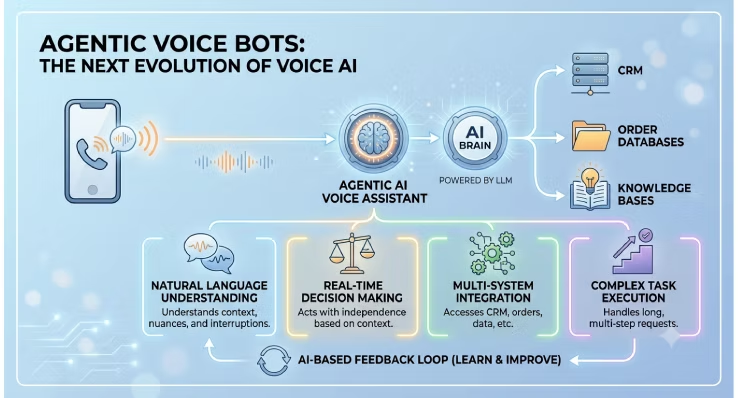
Agentic voice bots are the new major trend in the evolution of voice AI technology. Voice AI agents are advanced and AI-powered systems that can conduct human-like conversations over simple phone conversations or applications. What used to be a robotic greeting while customers called, is now replaced with the help of large language models or LLMs that helps it to understand the nuances and interruptions in a conversation. It can do complex tasks and ensure they reduce the workload of human agents.
The meaning of the word “agentic” itself shows the bot’s ability to act with a sense of independence. Instead of following a complex script flow, an agentic AI voice assistant can:
- Understand natural language instead of requiring to pinpoint exact keywords.
- Make decisions in real time based on the given context.
- Access multiple systems like CRM, order databases, knowledge bases in order to complete tasks.
- Handle long and complex multi-step requests without transferring the caller any further.
- Learn and improve over time through AI-based feedback loops.
In short, by making use of agentic voice bots, modern businesses can conduct their business operations smoothly without increasing their employee strength.
The Major Differences: Agentic Voice Bots vs. IVR
Let us understand the shift from legacy IVR systems to agentic conversational AI in simple terms.
1. Understanding vs. Matching
Standard IVR always matches the keywords or button presses to what the customer does to a predefined menu set. If the customer says some other words or asks a doubt instead of following the command the IVR will remain silent as it does not understand what to do in such a situation.
But agentic voice bots, on the other hand, make use of their natural language understanding (NLU) to understand what the customer actually wants. For example, a customer could possibly say “my package hasn’t yet arrived” or maybe they will ask “where’s my order” or maybe they will put it another way like “I never got my delivery,”. But the AI voice bot will understand all three means the same thing even though said using different terms.
2. Prepared Scripts vs. Human Conversations
IVR menus can only follow a fixed, linear path that is already set in the system. If the customer’s issue doesn’t fit into “Press 1, 2, or 3,” you will need the help of a human agent.
But agentic AI voice bots can conduct human-like conversations smoothly. If needed they can jump between topics, ask clarifying questions, and adapt their responses based on what the caller says by identifying their tone and emotions, similar to a real customer support agent.
3. Task Completion vs. Call Routing
Most traditional IVR systems can only just route the customer’s call to the appropriate department. Other than that they cannot solve the complex queries that a customer might have. They will usually remain stuck at this point.
But agentic voice bots are built for end-to-end task completion. They can seamlessly integrate with backend systems to actually resolve the issues like booking appointments, updating account details, processing payments, or canceling subscriptions without the need of human intervention.
4. One-Size-Fits-All vs. Personalized Experience
IVR systems can only treat every caller the same way as the other, offering the same set of menu regardless of who’s calling the particular business and for what purpose they are calling.
Agentic voice AI can pull customer data in real time to deliver a personalized customer experience by identifying returning callers, referencing past interactions from chat history, and tailoring responses accordingly.
5. High Abandonment vs. Higher Resolution Rates
The customer who is dealing with a complex IVR system will be definitely frustrated. Long menus, repeated prompts, and silences often lead to high call abandonment rates and negative customer satisfaction (CSAT) scores for the business.
But on the other hand, agentic voice bots are designed to reduce such friction, leading to higher first-call resolution rates, shorter average handling time (AHT), and better overall customer experience (CX) provided by the business.
|
Feature
|
Standard IVR System
|
Agentic Voice Bot
|
|---|---|---|
|
User Interface
|
Keypad presses (DTMF) or rigid single-word spoken commands.
|
Natural, open-ended spoken dialogue with human-like pacing.
|
|
Intent Handling
|
Fails on multi-intent requests; strictly follows predefined paths.
|
Maintains context, manages multi-intent, and handles mid-sentence interruptions.
|
|
Integration Depth
|
Limited; primarily handles simple data dips (e.g., fetching account balances).
|
Deep API integration to read/write across CRMs, ERPs, and internal tools.
|
|
Problem Resolution
|
Acts mainly as a routing mechanism to a human queue.
|
Achieves full end-to-end resolution for Tier-1 and Tier-2 inquiries autonomously.
|
|
Reporting Capabilities
|
Basic call routing metrics, drop-off points, and duration tallies.
|
Deep analytics, automatic sentiment analysis, and instant post-call summary generation.
|
Why Businesses Are Shifting to Agentic Voice Bots
The move from basic IVR to agentic AI voice agents isn’t just a passing trend but it’s driven by real business needs and requirements of the time. Let us look at why companies across customer service, healthcare, banking, retail, and telecom industries are adopting conversational AI voice bots:
Better Customer Experience
Customers don’t like to wait in line for service anymore. With the help of the automated IVR system you can easily handle initial queries, instantly routing the call but with an agentic voice bot they can easily eliminate the endless IVR queue and satisfy them with quick answers.
24/7 Availability
Like IVR, AI voice bots are available around the clock and all day along. But unlike IVR where you can only get limited answers to queries, agentic voice bots can actually solve problems even at 2 a.m. without needing a human agent on standby.
Cost Efficiency at Scale
Call center automation through agentic AI can help to reduce deploying a large human workforce for delivering high-quality customer interactions, lowering operational costs significantly and thereby increasing revenue profits.
Reduced Agent Burnout
By automating repetitive and simple queries, agentic voice bots free up human agents to focus on complex, high-value conversations which will help in improving employee satisfaction and reducing call center turnover.
Scalability During Peak Demand
The cloud-based AI agentic voice bot solution is scalable, to grow with your strategy without consuming time and energy to handle the increased call volume.
Insights Backed By Data
Agentic AI systems capture rich conversational data, thereby giving businesses deeper insights into customer intent, common pain points, and service trends which something static like IVR logs simply can’t provide.
Real-World Use Cases for Agentic Voice Bots
There are many uses for voice AI agents and some of them are:
1. Customer Support Automation
Easily handle routine tasks without burdening agents.
2. AI Sales & Lead Qualification
Easily conduct cold calls and collect possible leads for human agents.
3. AI Receptionist & Appointment Booking
The AI can act like a digital receptionist and set a flow for communication.
4. Surveys & Feedback Calls
Trigger feedback surveys after product purchase and services ensure good customer service.
In each case, the bot doesn’t just direct the caller to a department but it resolves the issue directly, which helps in showcasing the true power of agentic automation.
Challenges to Consider
Even though an agentic voice bot offers many advantages, there are also challenges that you need to think about:
- Complexity of implementation: Integrating AI voice agents with existing CRM and backend systems takes more time and effort than deploying a simple IVR script.
- Accuracy and trust: Voice AI must be properly trained and equipped to avoid misunderstandings, especially for sensitive tasks like financial transactions which in later phases can cause disputes.
- Cost of entry: Advanced conversational AI platforms require higher upfront costs compared to traditional legacy IVR software, though long-term ROI is often stronger after the initial costs paid.
- Human fallback: Even the best agentic bots need a smooth escalation path to human agents for complex or emotionally sensitive issues. Because artificial intelligence has its own limitations in comparison.
The Future: Hybrid Models and Beyond
Your business growth strategy should keep up with the changing times. By adopting Bonvoice cloud telephony services you ensure that your business is on the right way to success. By opting for our services you can easily make a cost effective decision and reduce the workload of employees thereby increasing their productivity for the long run. Bonvoice solutions provides:
- Superior Reliability
- Budget friendly Pricing
- Ease of Scalability
- Customer support
Conclusion
The new age workplace environment calls for work life balance. Not everyone is interested in manual labor even for tasks that can be easily automated. Also every business owner who is scaling towards growth takes notes of these features and boosts their upward growth. So depending on old systems is no longer the way to success. So, cloud services are the way to go.
Bonvoice stands as the leading cloud telephony service provider in the market by combining the use of advanced AI and robust telephony. While many tools focus on one or the other, Bonvoice offers a unified AI + Telephony + Automation feature set.
With Bonvoice, you are not just analyzing call data records but decoding the human experience and emotion behind every call.
Frequently asked questions
What is a voice AI agent?
Voice AI agents are advanced AI-powered systems that can conduct human-like conversations over simple phone conversations or applications.
2. How much does an AI voice bot cost?
It depends on the platform and the complexity of the LLM being used.
3. Is voice AI better than IVR?
Yes. While IVR uses rigid menus, voice AI understands better and provides good customer service.
4. Can an AI voice agent replace a call center?
It can help agents by automating routine tasks thereby reducing call volumes placed on employees.
Footnotes:
Sukharevsky, Alexander, et al. Seizing the Agentic AI Advantage. McKinsey & Company, 2025.
Prompts:
1. what is Agentic Voice Bots
2. What is the difference Between Agentic Voice Bots Vs IVR
Reference :