
 ChatGPT
 Claude
 Perplexity
 Grok
Grok
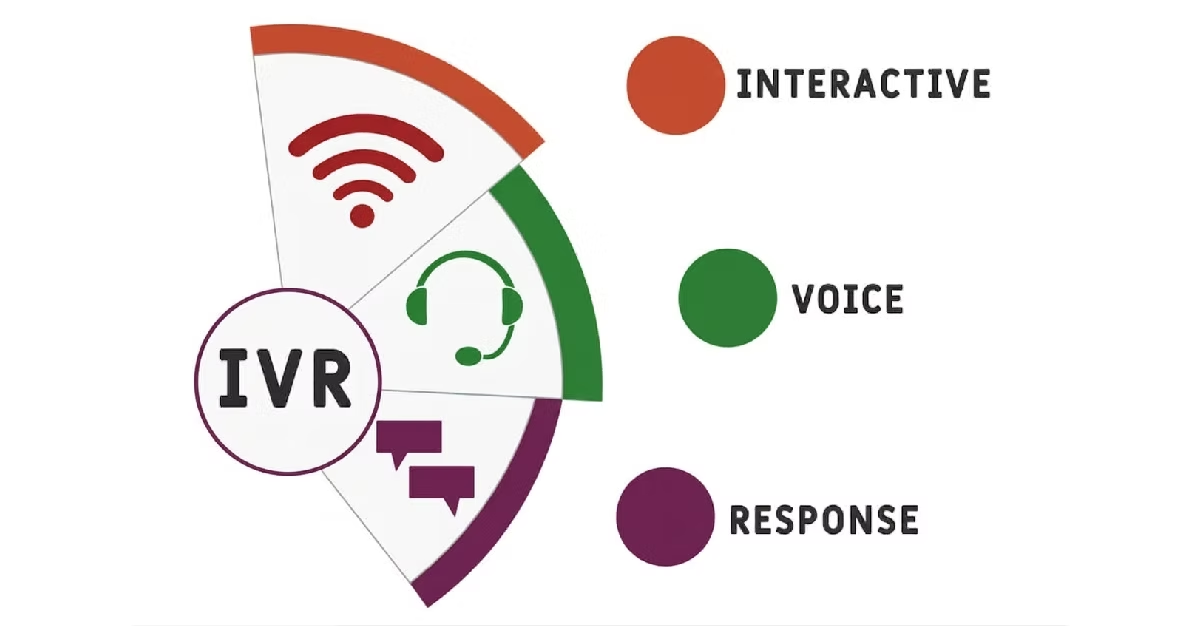
What is IVR? IVR, when expanded as the “Interactive voice response” system is a critical part of cloud telephony solution. It is an automated cloud telephony feature that answers incoming calls and routes them to the appropriate department or agent.
You might have heard the tone press 1 for sales, press 2 for service etc.. while dialing a business phone number. IVR provides you with a pre-set menu of options to choose from so that customers can easily connect the call to the responsible department without waiting in long queues.
Whether you are a growing start-up or a large business enterprise, understanding “What is IVR”? comes as a prerequisite in today’s business world. So let’s look into the same in detail.
Table of Contents
What is IVR?
An Interactive Voice Response system (IVR System) is a cloud-based IVR solution which helps your customer base to communicate with your business over the phone and solve problems before taking it to the live agent. The IVR telephony makes use of pre-recorded IVR greeting prompts and DTMF (Dual-Tone Multi-Frequency) inputs or Voice recognition technology for this purpose. The most important feature of the IVR calling system is the ability to route calls and offer self-service options for easy queries, thereby making 24/7 customer support automation.
What is an IVR Call / IVR Number / IVR Phone System?
While the terms are used interchangeably the terms also represent different layers of a communication stack.
What is an IVR Call?
An IVR call is an inbound or outbound phone call that is handled by an automated system before it reaches a human agent. For example, when you receive an automated “Press 1 to confirm your appointment” call, that is an outbound IVR call.
What is an IVR Number?
An IVR number is a specific business phone number which will either be a Toll-Free or Virtual Number, that has a preset IVR menu attached to it. When a customer dials this number, they get immediately connected to the IVR greeting.
What is an IVR Phone System?
The IVR phone system comprises the entire infrastructure including the software, hardware (or cloud servers), and carrier integrations which helps the businesses to manage its voice interactions. Now-a-days, most businesses have moved away from physical-traditional PBX to hosted IVR systems that run in the cloud.
What is IVR and How does it work?
Understanding how IVR solutions work is the key factor to designing a seamless communication flow. Here is how the 5-step communication flow process:
Step 1: The Initial Connection
A customer dials your IVR number and then the call is received by the cloud telephony server, which automatically triggers the IVR application.
Step 2: The Automated Greeting
The system then activates playing a pre-recorded greeting.
Step 3: Already Set menu
The IVR provides the caller with already set options like press 1 for this press 2 for that.
Step 4: User Input & Information Processing
In the next step the user provides input via the keypad or voice. The system’s DTMF or Speech Recognition engine processes this signal. Then the IVR will analyze the customer query and route to the necessary department or provide the necessary data.
Step 5: The Final Step
The system performs one of three actions:
- Self-Service: The IVR reads the pre-recorded information.
- Call Routing: The IVR directs the call to the agent of the responsible department.
- Information Collection: It asks for an IVR OTP or account number to verify the user before passing them to an agent.

Types of IVR systems
Every IVR system is not created equally. You will choose any particular IVR system, depending on the size of the business and its communication needs:
Touch-tone IVR (DTMF-based) – This classic version requires callers to use their phone keypad. This method is simple and reliable but it can be difficult if there are a lot of preset menus and the caller gets confused.
Menu-based IVR (also called directed dialog) – This system follows a structured hierarchy. This will be a good choice for businesses dealing with different departments (e.g., Sales, HR, Support).
Voice-based IVR (also called recognition dialog) – This system uses basic speech recognition methods. Here, instead of pressing buttons the user can simply say sales or support whoever is his or her requirement. This method feels more natural but can struggle at times when there are heavy accents or background noise disturbances.
AI-powered IVR (Conversational IVR) – This is the modern and trending IVR solution as of 2026 . By making use of Generative AI and NLP, these systems allow for open-ended conversations.
Challenges and Limitations of IVR
While IVR systems offer significant operational efficiency, a poorly designed deployment can introduce critical friction points into the customer experience. Businesses frequently face several challenges and limitations when managing these automated systems:
- Overly Complex Menus: When an IVR features too many options or long sub-menus, callers suffer from “menu fatigue” and get frustrated easily.
- High Call Abandonment Rates: If the system fails to resolve queries quickly or makes reaching a human agent difficult, customers will hang up. This directly impacts customer satisfaction and can result in lost revenue.
- Long Hold Times: Forcing customers through an automated menu only to make them wait on extended hold creates a compounding negative experience.
- Impersonal Tone for Upset Customers: When a customer calls with an urgent issue or a high-stakes complaint, interacting with a robotic script can make them feel undervalued and escalate their frustration.
In order to prevent these pitfalls, businesses must regularly audit their call flows to ensure the automation serves the customer rather than creating a barrier to support.
What is IVR in Call Centers?
A cloud call center is a virtual communications platform hosted and managed entirely by a third-party. You get access to call recordings, routing and other reporting tools over the internet using Contact center as a service or CCaas. This makes the third-party vendor a call center service provider.
A cloud call center is voice based and handles both inbound call center services and outbound call center services. While a cloud contact center is omnichannel. It handles all calls along with other channels like social media messages, email, chats etc.. it handles everything within one unified platform.
VoIP or voice over internet protocol is basically the foundation in cloud telephony services. It converts the voice you send to data packets over the internet, which makes it possible to make communication to and fro without depending on complex hardware systems and wires. But CCaaS is more of a business model. Instead of buying hardware and software yourself, here you can buy the service based on a subscription or pay per use system, so that you do not have to worry about security or maintenance which gets taken care of with the fees you pay.
How does Cloud Call Center services work?
A virtual call center service works by intelligently organizing the call traffic and ensuring every call is directed properly over the internet.
In the old times, every call was handled by a PBX system with complex hardware. But the risk of missed calls was insane. Manual work was tiring and people had to be constantly overworked. But with the cloud service, all these hardware were replaced by remote and secure data centers managed by the service provider. With this the cost effectiveness increased as you no longer needed to buy hardware systems. Also the work efficiency increased, as employees could access everything related to the calls from anywhere or even from their home.
When the customer makes a call, the call automatically enters the service platform which gets received by the provider’s cloud server. The call gets greeted by the IVR system which acts like a virtual receptionist directed by the inbound call center service. The call then gets analyzed by the automatic call distribution feature which analyzes the caller details, urgency and matches it with the employees equipped with the specific skill. The ACD then connects the call to the best possible agent. This is the key to a faster call center service.
Some features of the call center IVR are:
- Interactive voice response (IVR) – by handling simple requests, this feature helps to boost agent productivity. It also collects basic details of the customer before redirecting to the available agent.
- Automatic call distribution (ACD) – this feature organizes the calls and routes it based on skill based routing rules to the best possible agent. This helps to improve customer satisfaction.
- CRM integration – this feature collects all the data from available sources and places it in a central place. The software seamlessly connects with your existing CRM platform. So when a call is received, the agent gets to see a pop up of the customer history and handle the call better.
- Auto dialer/ predictive dialer – for outbound call center services, this feature helps to automatically dial the next number to contact so that it eliminates the manual work for agents.
- Real -time analytics – with the help of a dashboard, the managers get to see metrics and adjust their employees accordingly to handle peak call volumes.
What is IVR Service / IVR Software / Hosted IVR?
What is IVR Service?
An IVR service is a professional service from a cloud telephony provider like Bonvoice, where they will manage the telephony lines and the platform for you over the internet. Your employees simply log into a dashboard and attend the call.
What is IVR Software?
IVR software refers to the logic and interface used to build the preset menus you hear while calling a business phone number. It often includes “Drag-and-Drop” builders, so you don’t need to be a technical coder to create a complex call flow.
What is Hosted IVR?
Hosted IVR means the system is located on the provider’s servers (Cloud) rather than your physical office.
- On-Premise: an on-premise traditional PBX system requires high maintenance and expensive hardware.
- Hosted/Cloud: Here, the system requires zero hardware, follows a pay-per-use model, and is accessible from anywhere in the world.
Key Features of a Modern IVR System
As one of the top IVR service provider in India, Bonvoice delivers a set of IVR software solutions that integrate easily into your digital workflow:
- Dynamic call routing: Bonvoice cloud IVR service routes calls considering the past customer interactions or pre-defined rules. This helps to route the caller quickly to the right team.
- Customizable workflows: Businesses can set up their IVR menu flow considering their business needs.
- Multilingual support: Bonvoice IVR service providers support multiple languages in pre-recorded prompts. This helps communication of business and customer across various customer bases.
- Self-service options: The IVR menu offers self service options that allows callers to get basic information on routine queries. This reduces the agent’s unnecessary workload.
- Call prioritization: The automatic call distribution mechanisms used in the IVR systems can prioritize customer calls based on urgency or customer status.
- Scalability & flexibility: As Bonvoice IVR solutions are hosted on cloud servers, businesses can scale up or down as the demand requires. This makes it ideal for small to large scale operations.
- Multi-level IVR: with Bonvoice IVR system, your business can easily segment your calls thereby reducing confusion among customers.
- High uptime: Bonvoice IVR solutions are designed to enhance reliability with 99.9% uptime, thereby ensuring enhanced customer support.
Some of the benefits by opting for IVR systems precisely tailored to your business requirements are:
Reduce Customer Wait Times – Customers don’t like to wait in line for service anymore. With the help of the automated IVR system you can easily handle initial queries, instantly routing the call. This results in improvement of service quality by using a good IVR service provider.
Improve First-Call Resolution (FCR) – Customers expect to solve their problems quickly. Intelligent IVR routing and self-service ensures the customer connects to the right agent, leading to average handle time and faster resolution of issues with an IVR service provider.
Boost Call Center Efficiency – By automating routine tasks and simple queries, the cloud telephony platform reduces the workload of employees thereby allowing them to focus on more productive tasks that will enhance their efficiency.
Enable 24/7 Self-Service Support – Customers get access to essential information and complete their queries any time of day, which ensures 24/7 customer support automation from the IVR Solution platform and superior convenience to the customers.
Lower Telephony Costs – With shifting customer communication to an automated IVR system your business can significantly reduce the need to employ a large number of employees by efficient use of the system. By choosing a highly cost-effective telephony solution and IVR service provider, you can reduce your business expenditure.
Handle High Call Volumes Smoothly – During peak hours or festive times, your customers would not have to wait for the call to be answered. The scalable hosted IVR system of the IVR service provider can effortlessly manage such high call volume handling, which ensures every customer call is answered professionally without interruption of service.
Build a Professional Business Image – A well-designed IVR for business presents a polished, competent professional business image in front of every caller. The reliable and accurate interaction automation makes your system highly organized. This helps to increase customer confidence in your brand.
Multiple Department Routing – The multi-level IVR menu ensures that the customers are quickly directed to the right department according to the need of service he or she puts forward. This helps to reduce multiple transfers which might cause irritation and frustration to the customer. For example, if the customer is in need of a sales department he or she is directed to them rather than the need to interact with other departments.
Scalable for SMBs & Enterprises – The cloud-based IVR solution is scalable, to grow with your strategy without consuming time and energy to handle the increased call volume. This makes an IVR service the perfect IVR solution for small business phone systems and enterprise grade IVR.
Better Lead Management and Tracking – The IVR system analyses the query and urgency of the situation and then routes the call to the sales representative with the highest chance for conversion. The lead management system thus ensures no lead is missing thereby boosting conversion rates with a good IVR service provider.
Automation for Repetitive Queries – The IVR solution analyses all the queries and sorts the responses for repetitive queries, by using Text-to-speech (TTS) integration to reduce the workload of agents and serve customers a faster resolution.
Real life use cases of IVR
Our enterprise-grade IVR Services cater to diverse industries:
- Banking -With our IVR solution you can enable customer verification and automate simple account queries thereby reducing call loads. By using self-service voice portals your customers can easily check balances that will free your employees’ workload. This automated IVR system ensures 24/7 financial support and improves client trust.
- Healthcare – For the healthcare sector streamlining communication is easy using our hosted IVR system. Using real-time call routing your clients can easily book appointments and get answers for basic queries. This ensures critical calls are prioritized instantly thereby reducing staff workload.
- Insurance- With the smart IVR telephony, the insurance sector can easily automate policy queries, see status checks and verify customers. Using our outbound IVR campaigns can be done for renewals and improving collection rates. This self-service platform thereby improves call center efficiency.
- Retail & E-commerce- With cloud IVR designed for the retail industry you can easily manage order tracking, complaints, queries and requests. Also with Automatic call distribution (ACD) high risk issues can be easily prioritized and self-service reduces call volume. This is an important factor for IVR for business.
- Manufacturing- For the manufacturing sector, our multi-level IVR menu can streamline their supply chain communications. The IVR system easily connects clients using IVR routing that helps to provide a 24/7 service channel for your business.
- Logistics & Shipping- With a dedicated logistics IVR platform your business can easily share order updates and tracking details with customers. This helps to show your service transparency and builds customer trust. This results in customer experience improvement.
- Education- Our education-focused IVR system can automate admission inquiries, exam updates and payment status . Manual tasks can be easily added to our system such as reminders and alerts thereby reducing workload. This helps your institution to provide accessible 24/7 information.
IVR vs. Auto Attendant vs. AI Voice Bots
To understand better in detail, let’s look at this comparison chart.
|
Feature
|
Auto Attendant
|
Traditional IVR
|
AI Voice Bot (Conversational)
|
|---|---|---|---|
|
Input Type
|
Keypad only
|
Keypad + Simple Voice
|
Natural Language / Speech
|
|
Complexity
|
Low (Single layer)
|
Moderate (Multi-level)
|
High (Context-aware)
|
|
Integration
|
Minimal
|
CRM / Database
|
Deep System Integration
|
|
Cost
|
Low
|
Moderate
|
High / Usage-based
|
|
Best For
|
Small Offices
|
Standard Support
|
High-Scale CX
|
Common IVR Mistakes to Avoid
For a seamless IVR integration, avoiding these major mistakes are necessary:
1. Skipping a thorough needs assessment
Every start up business owner or a person who is new to the field makes the mistake of choosing the cheapest per-user price or a list of features that boasts many. They fail to understand how the communication process works in their workplace. They focus on the basic general features and forget to analyse their specific needs.
For example: if a small business uses a traditional phone system they really need to analyse the customer churn and adapt a cloud telephony system to never miss a call. The lack of oversight is also a key mistake. The plan you choose according to your current needs might not be suitable when you have to upscale. So, before you select the best phone system for small business, you must define your communication structure by mapping out every user and call flow. You need to:
- Map the user types: What communication system does your team rely on? What features do they need additionally?
- Future proofing: Choose a system that is easily scalable according to your expansion or growth necessities.
2. Underestimating Network and Hardware Requirements
A VoIP business phone system heavily relies on your internet connection. Thinking that your current internet facility is adequate to fulfill the needs of this service might become the biggest cause for poor call quality.
To ensure clear voice clarity, you must:
- Run a dedicated test to measure the key metrics that destroy voice quality like latency and jitter.
- Ensure the Infrastructure upgrade needs to be conducted. Also configure your router to use QoS (Quality of Service) settings to prioritize voice data over email, file transfers, or web browsing.
3. Ignoring the number porting process
The transfer of your main business phone service for a small business number is a highly regulated process. Mismanaging the porting numbers phase is the number one reason for unexpected downtime. If you shift your office to some other place also you don’t have to worry about telecom providers or a number change. Because a toll free number is actually tied to your business and not to any specific toll free number service provider. This helps to establish trustworthiness and reduces operational difficulties.
In India, a toll free number is yours as long as you pay for it. Also TRAI regulations ensure that the number is portable. Also if you choose to switch the toll free number provider, the new service provider should ensure the seamless portability. So, regardless of the vendor, the number is protected and safely transferred like a valuable asset.
4. Neglecting User Training and Change Management
Even the best office phone systems for small businesses will fail if the team using it is not properly trained. The technical transition is only a part of the process; success lies in how the team adapts to it. Each and every staff in the office need specific training according to their job roles rather than giving general awareness. You need to:
- Appoint at least one person from each team to deeply study the new cloud based business phone system.
- Ensure your staff knows how to manage the auto attendant phone system and call queues, while sales learns to use the mobile softphone effectively, thereby ensuring their role based knowledge.
How to choose the best IVR Solution Provider
- Understand your specific needs – define the needs and goals of the business. Identify what all features you are looking for, instead of just buying what comes first to sight.
- Audit your current environment – you need to tally your existing crm platform and other softwares for easy integration to the service.
- Choose the right pricing model – identify the cost ranges of different service providers and check or hidden fees.
- Complete agent training – give proper training to customers to use the system efficiently and make them understand how much of a help is this for them.
- Monitor KPIs from the first day – take note of the key metrics like service level and first call resolution rates. Analyze the success of migration in every step.
Your business growth strategy should keep up with the changing times. By adopting Bonvoice cloud telephony services you ensure that your business is on the right way to success. By opting for our services you can easily make a cost effective decision and reduce the workload of employees thereby increasing their productivity for the long run.
The Bonvoice platform delivers distinct advantages designed to support business scaling:
- Superior Reliability
- Budget friendly Pricing
- Ease of Scalability
- Customer support
Conclusion
The new age workplace environment calls for work life balance. Not everyone is interested in manual labor even for tasks that can be easily automated. So depending on old systems is no longer the way to success. So, cloud services are the way to go.
Footnotes
Forbes. “6 Tips on Making Interactive Voice Response (IVR) Work for Your SMB.” Forbes, 23 Feb. 2017,
Frequently asked questions:
1. What is IVR in simple words?
IVR provides you with a pre-set menu of options to choose from so that customers can easily connect the call to the responsible department without waiting in long queues.
2. Is IVR the same as an Auto Attendant?
No, there is a difference as an auto-attendant can only route calls while an IVR can act as an automated response person for simple queries.
3. What does it mean by an IVR OTP?
In order to verify transactions the automated IVR reads a one time password to the user to enhance security.
4. What is called a "Hosted IVR"?
The hosted IVR system requires zero hardware, follows a pay-per-use model, and is accessible from anywhere in the world.
5. Why do I need an IVR number?
An IVR number helps to manage high call volumes professionally, ensuring every caller is greeted and assisted instantly without delays.
6. What is the full form of IVR?
The full form of IVR is Interactive Voice Response.