
 ChatGPT
 Claude
 Perplexity
 Grok
Grok
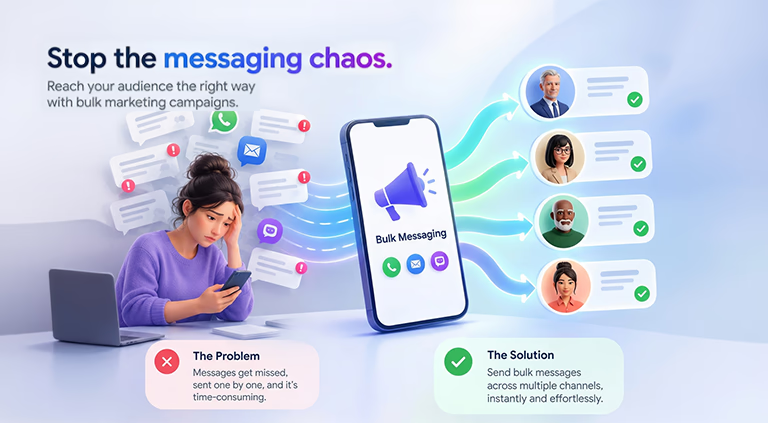
Bulk messaging for marketing campaigns means sending one message, a promo, an event invite, a festival greeting, to a large list of customers at once, across SMS, WhatsApp, or RCS, through an API or a plain dashboard rather than typing to each person one by one. It isn’t personal messaging done at scale. It’s built for the opposite job: reach and speed across a whole list in a single send.
A real marketing campaign rarely lives on one channel alone. A promo often starts as an SMS nudge, moves to WhatsApp for anyone who clicks or replies, and increasingly adds RCS messaging for the growing number of Android users who see richer, branded messages instead of plain text.
How Bulk Messaging Works for Marketing Campaigns
The sending process
Running bulk messaging for marketing campaigns is simpler than it sounds. For most Indian small businesses, it looks like a short checklist:
- Upload your audience list. Export your customer numbers from your POS or CRM as a standard Excel or CSV file and upload it to the platform.
- Pick an approved template. Choose or draft a message template that’s already approved, since pre-approval is what keeps you compliant before the broadcast goes out.
- Set your sender ID. This is the registered name customers see the message coming from, set up either through a no-code dashboard or via API integration.
- Broadcast and track performance. Trigger the campaign, then check real-time delivery reports to see what landed, what bounced, and what got filtered out by DND or consent rules.
The steps stay the same whether you’re sending 500 messages or five lakh. Only the backend infrastructure handling the load changes.
How Bulk Messaging Works for Marketing Campaigns
Every channel is useful in its own way without taking away from other media tools. The benefit of bulk SMS is that it allows reaching larger audiences at minimal costs and not requiring users to have a smartphone.
|
Channel
|
Best for in a campaign
|
Constraint to plan around
|
|---|---|---|
|
SMS
|
Ideal for time-critical sales, OTPs, and reaching audiences without active mobile data or smartphones.
|
Constrained to 160 characters per segment; strictly plain text and links. No rich media.
|
|
WhatsApp
|
Best for interactive catalogs, CTA buttons, and handling two-way conversations with warm leads.
|
Requires strict opt-ins, Meta-approved templates, and tiered per-conversation pricing.
|
|
RCS
|
Delivers rich cards, verified trust badges, and native app-like features directly in the default inbox.
|
Highly reliable across Indian Android devices, but iOS delivery remains limited and carrier dependent.
|
A common pattern among small businesses in India includes bulk messages going out to the full list first, since it’s the cheapest option with the widest reach. WhatsApp follows up with anyone who clicked or replied, and RCS messaging gets layered in as a visually richer version of the same offer for the Android-heavy part of the audience.
Benefits of Bulk Messaging for Marketing Campaigns
The benefits of bulk SMS marketing carry over to WhatsApp and RCS too, since all three run on the same core idea: reaching a lot of people quickly and cheaply.
- Reach without needing an app or data plan. SMS works on any phone with signal, basic or smart, which matters given how many customers outside big cities still run on limited data.
- SMS is also hard to miss. It lands directly on a phone instead of sitting in an inbox, though exact read-rate numbers vary by study and audience, so treat any specific percentage you come across as a rough signal, not a guarantee.
- The cost of math looks great on paper, with a catch. SMS is cheaper per message than most paid ads, but a cheap message doesn’t automatically mean a cheap customer. Segmentation and targeting still decide whether a campaign actually pays for itself.
- Campaigns can launch in minutes rather than days, which is why SMS still wins for flash sales, reminders, and anything else that’s time sensitive.
- Personalization happens without extra effort. A name, a location, a past purchase, a loyalty tier: a single template can carry all of that across an entire list without anyone typing each message by hand.
- It’s also an easy channel to build on. Start with SMS, then layer WhatsApp and RCS later for richer follow-ups.
How Businesses Use Bulk Messaging for Marketing
Promotional Offers & Flash Sales
When it comes to flash sales, the key is having their target audience informed about it in time. SMS marketing sends the first impulse to the target audience and is usually the fastest way of getting this done. WhatsApp comes in for follow-up with product pictures and a link for direct purchase by anyone interested in it.
Event & Webinar Invites
Inviting pre-registered leads can also be done through bulk SMS where WhatsApp takes care of sharing the event’s calendar link and sending the reminder 30 minutes prior to the event. No one has to manually chase RSVPs, and attendance holds up better for it.
Festival & Seasonal Campaigns
Onam, Diwali, Independence Day, End-of-Season Sales (EOSS) are where this channel does its best work. The trick is timing. Segment your customer groups ahead of the rush and get DLT templates submitted early enough that they’re cleared and ready before peak demand hits.
Re-engagement & Cart Abandonment
If a user abandons the cart, an automated SMS or WhatsApp message with a link to complete the purchase can help bring them back to recover the abandoned cart instead of sending emails.
Loyalty & Referral Nudges
Sending a simple reward message or referral code to an existing customer assures you spend way less money than on paid acquisition.
Types of Messages Used in Bulk Marketing Campaigns: Promotional vs. Transactional
Not every bulk SMS serves the same purpose. In India, the distinction between promotional SMS and transactional SMS affects consent, DLT registration, and when a message is allowed to go out.
|
|
Promotional SMS
|
Transactional SMS
|
|---|---|---|
|
Purpose
|
Marketing offers, discounts, advertisements, and promotional campaigns
|
Transaction-related updates such as OTPs, payment confirmations, and essential alerts
|
|
DLT template
|
Requires a registered content template and sender header
|
Requires the appropriate registered content template and sender header
|
|
Consent / opt-out
|
Subject to applicable consent and customer preference requirements, including opt-out provisions
|
Primarily used for transaction-related or essential communication rather than product promotion
|
|
Timing
|
Subject to applicable commercial communication time restrictions and customer preferences
|
Intended to reach customers when required by the relevant transaction or service
|
The practical takeaway: a message that counts as “promotional” on SMS may need an entirely different category tag on WhatsApp, and a different agent registration altogether on RCS messaging. Treating all three channels as interchangeable at the classification level is one of the more common ways campaigns get stuck in approval queues.
TRAI/DLT Compliance for Bulk Messaging Marketing Campaigns in India
Running a bulk SMS campaign in India takes more than uploading a contact list and hitting send. Businesses need to follow the rules under TRAI’s Telecom Commercial Communications Customer Preference Regulations (TCCCPR), covering sender registration, template registration, and consent. TRAI’s own guidance for senders is a useful reference to keep bookmarked.
DLT compliance checklist for TRAI SMS marketing:
- Register as a Principal Entity. Any business sending commercial communications needs to register with an authorized telecom service provider first.
- Register your sender ID. Commercial SMS has to go out under a registered sender header tied to your business.
- Register your SMS template. This DLT template registration step means your message content needs to be registered and approved before it can be sent commercially.
- Collect customer consent. This matters most for promotional messages, where opt-in consent and customer preference rules apply directly.
- Run DND scrubbing. Promotional campaigns need to be filtered against DND preferences before anything goes out.
- Follow the sending-time window. Promotional SMS is restricted to specific hours. Check current DLT and operator rules before scheduling a campaign, since these can shift.
Getting business registration, sender ID, template, and consent right before a message goes out is what keeps rejection rates and compliance issues down when running a TRAI SMS marketing campaign in India.
Challenges & Limitations of Bulk Messaging Marketing Campaigns
Bulk SMS marketing offers speed and reach, but a few limitations are worth planning around:
- Character limits force short, sharp messages. A 160-character SMS segment leaves little room for an offer, a link, and a call to action all at once, so every word has to earn its place.
- DND and consent rules also shrink your real audience. A large contact list on paper can turn into a much smaller receivers list once DND numbers and non-consented contacts drop out, so plan your reach around who’s actually eligible, not your total database.
- Deliverability is all about sender reputation. Sender ID that has had spam complaints record in the past will have trouble in reaching out to clients irrespective of how good their current campaign since reputation is developed over time
- And plain SMS just can’t carry rich media. No images, no video, no interactive buttons. That’s exactly the gap WhatsApp and RCS exist to fill.
Best Practices for Running a Bulk Messaging Marketing Campaign
These bulk SMS marketing best practices apply just as well once WhatsApp or RCS enters the mix:
- Segment before you send. Use purchase history, location, and engagement level to send the right message to the right audience.
- Personalize meaningfully. Go beyond first names. Reference a past purchase, a location, or a relevant offer instead.
- Include a working opt-out path. Give recipients a clear way to stop promotional messages, in line with consent and compliance rules.
- Pick the right sending time. Stay within the permitted window and test different slots to see when your audience actually responds.
- A/B test your templates. Try different copy, CTAs, offers, or urgency levels to see what drives better engagement.
- Submit templates early. Get campaign templates registered well ahead of your send date, especially around major festivals.
- Track performance while the campaign runs. Observe the metrics such as distribution rate, errors, and clicks in real time and make the necessary changes when engagement patterns are low.
- Match the channel to the message. SMS is good for short and urgent messages while WhatsApp and RCS are more advanced and can deal with visuals and video messages better.
How to Choose a Bulk Messaging Provider for Your Marketing Campaigns
A good bulk messaging service can simplify campaign management and make it easy to measure its success. Some important things to look for in a good provider are:
- Templates that comply with DLT regulations and help with registration so that your team is not left to handle all the legal stuff and preparation of the campaign on their own.
- API integration and no-code dashboard so that technical and non-technical specialists can effectively run their campaigns without waiting for each other’s work to be done.
- Delivery analytics that go past “sent.” Actual delivery status, clicks, and opt-outs, the kind of data you can act on mid-campaign.
- Real omnichannel messaging across SMS, WhatsApp, and RCS, from one platform, so the right channel is always available for whatever the campaign needs.
Bonvoice brings all of this together on one cloud telephony and CPaaS platform, running DLT-compliant SMS campaigns alongside WhatsApp and RCS messaging, with reporting in one place.
Talk to Bonvoice about your next campaign or check out the pricing plans to find an option suited to your messaging needs.
Freequently asked questions
What is bulk messaging in marketing campaigns?
Bulk messaging in marketing campaigns refers to the practice employed by marketers to effectively reach a large number of clients using SMS, WhatsApp, or RCS, thereby providing information in the form of advertisements or messages instead of sending the information to each customer separately.
Is bulk SMS marketing legal in India?
It is legal as long as one conforms to certain regulations that are required by TRAI and DLT, which include registering the entity, sender headers, and template, sending messages with the customer’s consent and within the pre-approved period of time.
How much does a bulk messaging marketing campaign cost?
Different aspects of the message such as channel, carrier, volume, and campaign type determine the costs. In SMS marketing, costs are counted based on the number of messages sent whereas in WhatsApp different approaches are applied in counting fees.
What's the difference between bulk SMS and WhatsApp broadcast?
Bulk SMS messages are sent in text format through carrier networks, while WhatsApp may send information in a more sophisticated manner, such as images and may also connect users for conversations about the received information.
How many messages can I send in one campaign?
There’s no universal limit. Campaign capacity depends on your provider, your approved templates, sending throughput, and the size of your consented list.