
 ChatGPT
 Claude
 Perplexity
 Grok
Grok
The automated call routing of an incoming call to the correct agent, team, department or queue depending on the rules defined by you, like caller selection, time, day, skill, or customer’s history. It helps in saving wait time and transfers and thus enables the customer to connect to the right person on the first attempt.
Without Call Routing, all the calls go to one destination, and whoever is free answers it. The billing issue comes to a sales representative, a high-potential lead remains on hold behind an ordinary query, and the after-hours calls get lost. However, with call routing, each call gets its judgment even before a human handles it.
Call routing vs call forwarding vs IVR vs ACD
|
Term
|
What it does
|
|---|---|
|
Call forwarding
|
Sends every call to one fixed number, with no per-call decisions.
|
|
Call routing
|
Decides where each call goes based on rules you set.
|
|
IVR
|
The automated menu callers hear ("Press 1 for Sales"). It collects information.
|
|
ACD (automatic call distribution)
|
Queues the call and assigns it to the best available agent.
|
Simple example: IVR asks the question; ACD allocates, and routing is the process that connects them. It is stated by Wikipedia that the technology of ACD is credited with enabling the idea of the call centre and that IVR is used along with the ACD software, which makes use of data from the IVR, traffic, and availability of agents to select the best candidate. For more, read the Wikipedia entry on automatic call distributors.
How does call routing work?
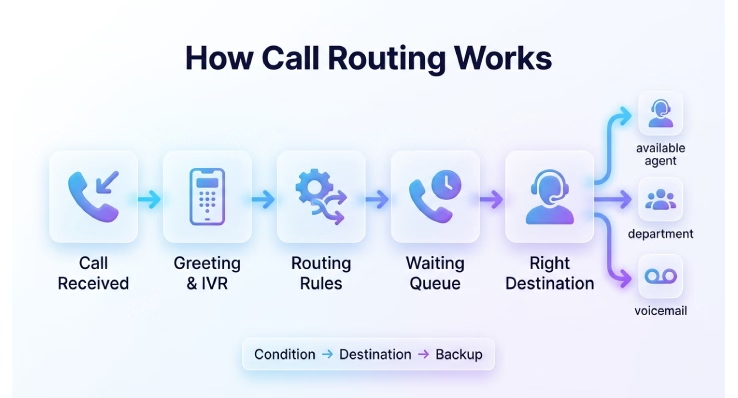
- Call received – At this stage, the system receives and fetches data such as the dialled number and the ID of the calling party.
- Greeting/IVR asks the user for his/her service requirement – The user tells his/her needs either through digit dialling or voice commands.
- Rules are applied by the system – It correlates the entered data against time and availability of agents according to the rules configured.
- The call waits in a queue if nobody is free – The caller hears hold music, a position update or a callback offer. See our guide to call queue management for more.
- Ensuring that the call reaches the proper recipient – If no individual picks it up, it will surely go to an alternative party, like a different department, an answering machine, or someone who promises to return the call.
Every routing rule follows one formula: condition + destination + backup.
Types of call routing
|
Type
|
How it works
|
Best for
|
|---|---|---|
|
Skills-based
|
Matches the call to the agent with the right skill or language
|
Support teams with specialists
|
|
Round-robin
|
Rotates calls evenly across agents in a fixed order
|
Sales teams sharing leads fairly
|
|
Longest-idle
|
Sends the call to the agent who has waited longest
|
Busy teams balancing workload
|
|
Ring group
|
Rings several phones at once or in sequence
|
Small teams and front desks
|
|
Time-based
|
Changes the destination by hour, day or holiday
|
Businesses with set working hours
|
|
Priority/VIP
|
Moves important callers to the front of the queue
|
Premium customers, urgent requests
|
|
AI-based
|
Uses the caller's spoken words and context to decide
|
High call volumes, varied requests
|
- Skills-based routing – sends calls to the person who is most capable of resolving issues arising through the call. For instance, if the caller speaks in Hindi while facing a billing issue, he is routed to the billing agent who speaks in Hindi.
- Round-robin routing – allows each operator to handle the call so that one does not get too many calls at the same time. For instance, in a group of four salespeople, all the callers are passed to each salesperson one after another.
- Longest idle routing – places priority on agents that have been waiting the longest.
- Ring group (hunt group) routing – connects one phone with several devices at once, and anyone among them can answer the call.
- Time-based routing – defines where calls will be directed based on the time of day.
- Priority/VIP routing – identifies important callers and gives preferential treatment to them.
- AI-based routing – knows what the caller has to say and makes decisions accordingly.
When choosing between the above, the important thing is to determine which routing option is best suited for addressing your primary issue. Ring groups or time-based rules should suffice for calls that are simple; skills-based routing should be used by expert teams, while AI routing should be employed when menu systems cannot handle the high volume of call variations.
IVR call routing
IVR call routing utilises a computerised process that determines why the caller is calling and sends him or her to the proper department.
You may think of the IVR system like a receptionist who greets all incoming callers and asks them only one question. IVR will obtain this answer and act according to the routing procedure. If you didn’t have the routing procedure, the IVR would just be an empty menu.
An example of a menu: “Thank you for calling. Press 1 for Sales, 2 for Support, 3 for Billing, or 0 for an agent.”
Types of IVR:
- One level: one menu, after which the call is transferred.
- Hierarchical structure: the menu operates on a tiered model, with the selection of the first option leading to another menu (for example, selecting Support leads to Technical or Account options)
- Speech-activated: a user can express his or her requests verbally instead of using the keypad.
- Artificial Intelligence assist: the device is capable of recognising the intent and context of the requests and can process them independently.
The auto attendant is an easier version of IVR, while IVR is capable of handling more complicated interactions such as payments and account access. Forbes Advisor’s IVR guide covers the differences in more detail, and Wikipedia explains the technology behind IVR.
Design tips (from the caller's side):
- Keep to 4-5 options. Callers forget long lists.
- Use two levels at most.
- Put the most common reason first.
- It’s important to include a way to connect with a person, like “Press 0”.
- Audiences favour direct communication.
Most frequent mistakes: excessive menus; usage of internal terminology in option names; lack of human contact; and options ending with an unanswered call. Learn more about our IVR service.
How to set up call routing
- Identify the reasons for calls: Consult call logs to discover the main reasons for calls.
- Determine who is responsible: Assign each reason to a person or a group.
- Decide on the routing system: Select between skills-based, round-robin, or ring group systems.
- Create an IVR: Record a greeting and a short menu for the system.
- Set rules for after-hours calls: Enable voicemail, callback, or extra staffing.
- Call your own number: Evaluate the IVR’s efficiency.
- Check the reports weekly: Look into the waiting times and the number of calls abandoned.
AI call routing
Conventional routing relies on customers to select the appropriate option from the menu. AI Routing allows customers to state their requirements, and the system takes care of everything else. AI can process spoken sentences, which allows it to identify urgent callers based on received speech and choose the most suitable team. An AI voice agent performs an even more complex activity. It can respond to the caller, ask some questions, and fulfil primary requirements. See our guide to voice AI agents.
When using AI in a call centre context, keep in mind that it could be unnecessary for small teams with limited call types and a simple IVR. While AI becomes highly beneficial in environments with many languages and heavy call volumes, it also brings promising results when clients’ requests are not aligned with available options. Explore our AI receptionist and virtual receptionist service to see how.
Advantages of call routing
- Reduced hold time: Callers reach an available and qualified staff member much faster.
- Reduced hang-ups: By getting to the right person quickly, callers are less likely to hang up.
- Reduced missed calls: Backup and after-hours settings help to catch calls that might have otherwise fallen through the cracks.
Efficient routing can also increase the rate of first call resolution, as fewer calls are passed from one group to another.
Conclusion
Call routing ensures that calls are sent to the right people and that they are routed on the basis of certain guidelines established by the company. Always start with a well-designed IVR and clear policies regarding calls that need not be answered after hours. To see how this works with your own numbers, explore our call management solution, and our guide to call queue management.
Frequently asked questions
What distinguishes call routing from call forwarding?
Call forwarding sends all calls to one designated number, but call routing determines the destination of each call. Routing relies on such factors as the preferences of callers, the time of day, and the expertise of agents to ensure that calls go to the appropriate person or team.
What is call routing with IVR?
With IVR call routing, a pre-recorded menu is used to determine the reason for the call, and the call is forwarded to the right department or unit. The caller either enters a number or speaks, and the routing rules take over.
What is the difference between IVR and ACD?
IVR serves as an automated interface that gathers callers’ requirements, whereas ACD serves as a queueing system. They typically work together, with IVR choosing what information to gather and ACD performing the work of handling it.
How many options should an IVR menu have?
IVR menus should include no more than four or five options, as longer lists are harder to recall and result in callers hanging up or hitting the wrong button. It is advisable to limit IVRs to two levels and include a person in the system at all times.
What is skills-based routing?
Skills-based routing routes calls to the representative that is most qualified to handle the call. The aspect that makes skills-based routing effective is that the caller directly reaches an agent who is capable of resolving the issue without further transfers.
Which call routing system would work best for a small business?
In most cases, a combination of IVR, ringing groups, and time-based routing will suffice for most small businesses. This system is simple and practical for all after-hours calls and can subsequently be adapted into a skills-based system.
Reference Links
External: