
 ChatGPT
 Claude
 Perplexity
 Grok
Grok
When a business receives more number of customer calls than the number of the staff they have to handle the call, an efficient call queue management system holds the calls in an organised line. The customer won’t receive any busy signals.
As each missed call is a lost revenue to the business, the system acts as a net that catches every potential customer. In this article, we’ll see what a call queue management system is, how it works, and how the system can be an asset to a growing business.
What is call queue management?
Call queue management is the way in which a business handles and organizes the incoming calls when there are more calls than the available staff. We can also consider it as a virtual waiting line to hold customers in a particular sequence until an agent attends the call.
Without a call queue management system, the phone lines will be busy and the calls will ring forever. With this system, every call will be acknowledged fairly.
Why call queue management is critical for businesses?
Businesses go for call queue management as a part of their strategic move. After implementing the call queue management system, the reactive firefighting will change to proactive service.
As missed calls directly result in lost revenue, having a robust call handling system is the difference between a thriving business and one that loses leads to competition.
Let us see why call management system is necessary for a business ecosystem:
Customer experience:
Call queuing software’s main aim is to protect customer experience. Customers may abandon calls with long, silent wait times.
- Reduced wait times: Virtual call queue feature allows customers to wait in line without being tethered to their phones. So, the call abandonment rate will decrease.
- Better service quality: By combining features of IVR system and intelligent routing, calls will reach the right team instantly. So, when the call is finally connected, the customer will feel the agent has the correct skills to help him and the wait time is worth it.
Revenue & conversions:
Speed is the most important thing in sales & support. Cloud call queue management will not allow useless expenses for businesses.
- Faster response: Higher conversions: Using automatic call distribution, a potential contact is connected to the sales rep in seconds. This will increase the chances of closing the deal successfully.
- Protecting every lead: Without a call queue management software, a busy signal is a closed sign. A cloud telephony call queue management captures every lead in the queue. The team can follow up on answers as soon as possible.
Agent productivity:
With a chaotic distribution of calls, an employee may get burnout easily. With call queue management best practices, agents will be more relaxed and can focus on their work more efficiently.
- Balances workload: A call queue system will distribute the calls evenly among the team members. This will prevent continuous distribution of work to a particular agent while others remain idle.
- Reduces burnout: When the real-time analytics is available and the call queue is managed by customer support automation, agents will feel everything in control. So, agents will be in more focus and can meet the SLA targets without stress.
How does the system work?
The call queue management system will build a smart highway for the incoming call traffic. Call queue management software ensures every call will move smoothly toward the right team. Let us see how the system works to maintain a high customer experience.
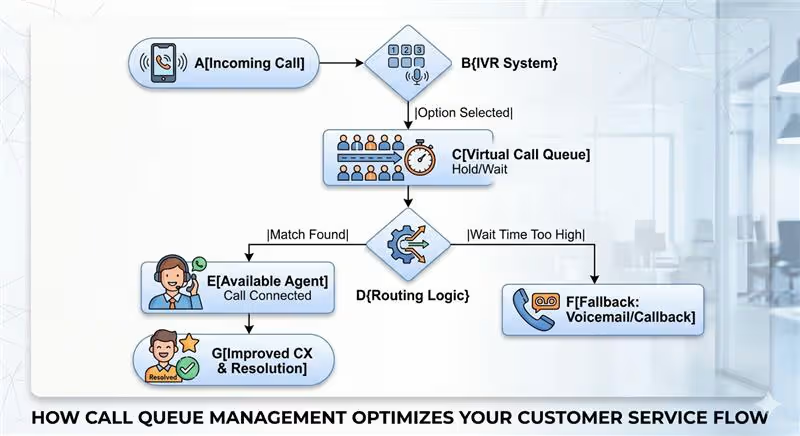
Step-by-step call queue flow
- Incoming call received: When a customer dials a business number, the process starts. The VoIP system or cloud telephony call queue management picks the signal instantly. At the customer’s end, there will be no busy tone.
- IVR interaction: Interactive voice response systems act as a receptionist. It offers the customer many options. This is very important in customer support automation. It helps to find the purpose of the call even before the customer enters the queue.
- Call enters the queue: After the customer selects the number, the call will enter into a virtual call queue. The call queuing software plays the hold music and offers real time analytics like average wait time to keep the caller engaged. This will also reduce the call abandonment rate.
- Routing logic applied: An intelligent routing will take place. The system looks at the pre-set call queue management best practices, such as “Round Robin” or “Skills-Based Routing” to find the best path for the call.
- Agent assignment: Now, the ACD engine will find an available agent. The system usually rings the agent who has been idle the longest time or one with needed expertise for that call. This will also increase agent productivity.
- Fallback (voicemail/overflow): If the queue is full or the SLA time exceeds, the call handling system triggers a fallback. So, a voicemail is sent to the caller or a call beach option is sent.
Key features of call queue management system
Some of the key features of an efficient call management system for increased productivity and CX is as follows:
Intelligent call routing: Every call should reach the right place. For a call distribution system, this is the main part.
- Skills-based: Callers get connected to the agent with the specific expertise needed to solve their problem.
- Round-robin: This routing algorithm distributes calls evenly across the team in a fixed order. This will keep the workload fair.
- Longest-idle: Routes the next call to the agent who has been waiting for a task the longest.
IVR integration: An IVR call queue system acts as a receptionist.
- Call filtering: IVR screens callers by asking questions. And sent to the correct department.
- Self-service: Self service options allows customers to get simple routine queries without the help of an agent.Allows customers to get simple answers (like checking an account balance) without ever needing an agent.
Real-time queue monitoring: With queue monitoring, managers get the real-time analytics that help in decision making.
- Dashboards: This gives details on average wait time, active calls, and current queue depth.
- Agent tracking: Agent tracking tracks the individual performance and status. This helps the team meet its SLA targets.
Callback & virtual hold: The feature is very important in call queue management.
- Reduce abandonment: Callback feature lets callers hang up and receive a return call when it’s their turn. This lowers the call abandonment rate.
Music & announcements: Instead of keeping the waiting time as a silent void, plays helpful tips, current promotions, or other updates. This keeps customers engaged. This feature improves the user experience.
Overflow & failover handling: With rapid call volume spikes, the feature acts as a safety net.
- Voicemail: Callers will automatically get the option to leave a message if the wait exceeds a specific limit.
- Call forwarding: Calls are redirected to a secondary department or an external service to reduce call wait time in call center environments.
Types of call queue management strategies
- Skill based routing: The customers are routed to the right team, not just the available agent. Some customer concerns need special expertise, like language preference, technical knowledge and more. So, automatic call distribution system routes call to the right team with the required expertise.
- Priority based routing: Urgent issues or high value customers can be moved in front of the queue or can be routed to the specialised agents depending upon the priority level of the issue.
The automatic call distribution system uses various algorithms like round robin (sequential call distribution for balanced work load among agents), longest idle (call routes to the agents with least call handled count), or fixed order (follows a set order of agents for call routing).
Best practices of call queue management
The checklist for the call center queue management strategy is the following:
- Optimize IVR system: The menus must be short and simple. This will result in an efficient call routing from the beginning.
- Implement skill based routing: With intelligent routing, the callers will be matched with the qualified agent.
- Offer callback options: Callers can keep their place in the queue without staying on the line.
- Maintain realistic SLA: There should be clear goals for average wait time to keep consistent service.
- Use informative hold messages: Companies can use FAQs or useful promotions to keep the callers engaged and improve customer experience.
- Monitor real-time analytics: Queue monitoring dashboards help to adjust staffs according to live traffic spikes.
- Specify an overflow path: There should be a cloud telephony call queue management to forward calls to backup teams or voicemail when the support is not available.
- Regular review of call recordings: Audit the call interactions within the software.
- Prioritize high value calls: Set up the ACD features to move VIP customers or urgent queries to front of the queue.
- Empower agents: The VoIP system and CRM should be in sync. So, the agents will have a clear picture of the call. This will reduce call wait time in call center interactions.
Use-cases
- E-commerce- Order queries
- Healthcare- Appointment booking
- Real estate- Lead management
- Banking- IVR-based services
Conclusion
Each missed call is a lost revenue to the business, the call queue management system acts as a net that catches every potential customer. In this article, we have seen what a call queue management system is, how it works, and how the system can be an asset to a growing business.
After implementing the call queue management system like Bonvoice, a business’s reactive firefighting will change to proactive service. This results in increased agent productivity and customer experience.
Frequently asked questions
1.What is call queue management?
Call queue management is the process in which a business handles and organizes the incoming calls when there are more calls than the available staff.
2.How does a call queue system work?
An IVR call queue system acts as a receptionist.
- Call filtering: IVR screens callers by asking questions. And sent to the correct department.
- Self-service: Self service options allows customers to get simple routine queries without the help of an agent.Allows customers to get simple answers (like checking an account balance) without ever needing an agent.
3.What is the best call queue management software?
Some of the main call management softwares available in India includes Bonvoice, RingCentral, CloudTalk, Nextiva etc.
4.What is the difference between call routing and call queue?
While both the terms are often used together in cloud telephony call queue management, they serve distinct purposes in a call handling system. Call routing ensures the caller reaches the right department. Call queue will reduce the wait times and prevent high call abandonment rates.
References:
- Wikipedia Entry: “Call Management.” Wikipedia, Wikimedia Foundation, 31 Jan. 2024, en.wikipedia.org/wiki/Call_management.
- Bonvoice Article: “Call Management.” Bonvoice, bonvoice.com/cloud-telephony-providers/call-management/.
Prompts used:
- Call queue management system
- Working of call queue management
- Key features of call queue management
- Use cases of call queue management
- How does the system benefit business?