ChatGPT
 Claude
 Perplexity
 Grok
A predictive dialer solution is calling software that dials several numbers at once and hands only the answered calls to agents who are free. If your team still dials by hand, you already know the problem. An agent types a number, waits through the rings, and gets a busy tone or voicemail. Then they do it all again. Research found that sales reps spend just 28% of their week actually selling, and dialing by hand eats into what’s left. Predictive dialing wins some of that time back. It watches how many agents are free and how often people pick up, then speeds up or slows down the dialing to match. Below, we’ll cover how it works, what to look for, how to choose one, and how to tell if it’s paying off.
What Is a Predictive Dialer Solution?
Here’s the simple version. Your team loads a list of contacts. The software calls them, waits to see who picks up, and sends each answered call to an agent who’s free. The agents talk. The software does the dialing. It’s one kind of business dialer software, built for teams that make a lot of outbound calls every day.
How predictive dialing differs from manual calling
When using manual dialing, an agent has to dial the number and wait until somebody picks it up on the other end. There may be many calls that come to nothing, resulting in all this waiting throughout the course of a long shift. On the other hand, predictive dialing calls the contacts on behalf of all of the agents and passes the answered calls to agents, ensuring that the agents are able to allocate as much of their time as possible to being in contact with people.
Who needs a predictive dialer solution?
You’ll see it most often in:
- Outbound sales and lead-generation teams
- BPO and telemarketing companies
- Customer retention and renewal teams
- Collections and payment-reminder teams, who also have to follow the calling rules that apply to them
How Does a Predictive Dialer Solution Work?
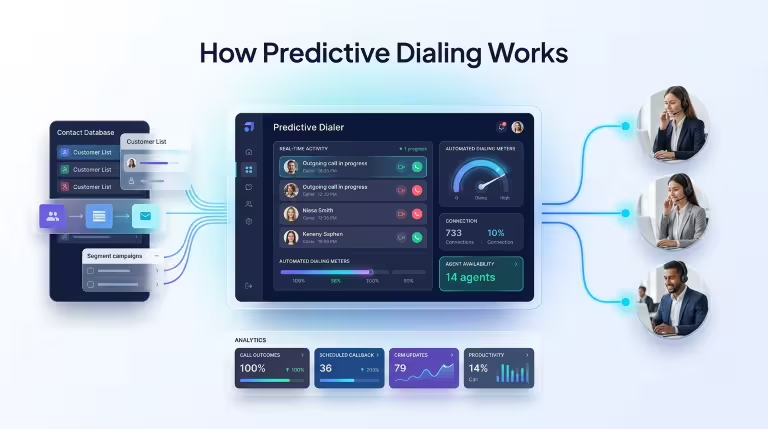
There are five steps behind the scenes.
- Prepare your contact list and categorize it by campaign and priority. After bringing your contacts into the call center’s system, the software will check for information about your active agents.
- Calculate how many agents are available for the calls. The system will take into account information on recent calls and the agents’ time needed to prepare for the next call.
- While making calls, the system will automatically dial several contact numbers in a row. It does so to ensure that it always has someone to connect with agents as soon as they finish their current calls and are ready for the next customer interaction.
- Spot the answered calls and send them to agents. The software tells real answers apart from endless rings, busy tones and, where supported, voicemail. Answered calls go to a free agent. The rest are logged and set aside.
- Log the outcome and learn from it. Every call gets a result: interested, call back later, not reachable. Callbacks get scheduled, the CRM is updated, and reports show managers what’s working and what isn’t.
One honest caveat. No dialer spots live people perfectly, and none removes every unanswered call. How well it works depends on the setup and the technology behind it.
Key Features to Look for in Predictive Dialer Software
Don’t judge a dialer by the length of its feature list. Judge it by the problems it solves. These are the ones worth checking.
Intelligent dialing and pacing algorithms
Dial too slowly and agents sit around. Dial too fast and people answer to silence because nobody is free. Good pacing adjusts to agent availability as the day goes on, and abandoned-call controls keep the second problem under control.
CRM integration and automatic call logging
Nobody enjoys retyping notes after a call. With CRM integration, the customer’s history is on screen when the call connects, and the outcome and lead status are saved without extra work.
Answering machine and call-progress detection
This spares agents from listening to rings and voicemail greetings. It’s never perfect, so ask any provider what happens when it gets one wrong.
Real-time dashboards and call analytics
You want talk time, connect rate, call outcomes, campaign results and abandoned calls in one view, not scattered across three reports.
Callback scheduling and lead management
Not every prospect will be available during the first attempt. Callback scheduling, retry rules, and lead prioritization help teams maintain organized follow-up processes instead of relying on manual reminders.
Call recording, monitoring, and compliance controls
Recording helps with quality checks. Access controls, consent records and do-not-call lists help your team stay within the calling rules.
How Does a Predictive Dialer Solution Increase Agent Talk Time?
Talk time goes up when the gaps between conversations get smaller. Here’s where those gaps come from, and how the dialer closes them.
Reduce time spent on manual dialing
Typing numbers and redialing is dull, repetitive work. The dialer takes it over.
Minimize idle time between conversations
Calls are paced around who’s free, so the next one is often ringing just as the last one ends. For more on this, see how intelligent dialing deals with waiting time.
Connect agents with more answered calls
The system filters out rings and busy tones first, so agents mostly speak to people who actually picked up. More of their logged-in time turns into real conversation.
Improve follow-up and campaign efficiency
Scheduled callbacks, lead priority and CRM notes mean agents aren’t relying on memory or sticky notes.
Picture two agents on the same shift. The first finishes a call, finds the next number, dials, and waits. Often nobody answers, so the cycle starts over. The second finishes a call and the next answered one is already waiting. Same person, same hours, but the second one spends more of the shift talking.
Don’t mistake more dials for more sales, though. Call volume is how many calls went out. Connect rate is how many reached a person. Talk time is how long agents actually spoke. Conversion rate refers to how many of the people you aimed for did what you wished them to do. The dialer is here, first of all, to let the talking time be high since the talking time will depend on the script, offer, and list. The most interesting metric is talking time per hour when logged in.
Predictive Dialer vs Power Dialer vs Progressive Dialer vs Preview Dialer
|
Dialer Type
|
How It Works
|
Best Suited For
|
|---|---|---|
|
Predictive Dialer
|
Dials multiple numbers using predicted agent availability and call-answer patterns
|
Large, high-volume outbound campaigns
|
|
Power dialer
|
Automatically dials the next number when an agent is ready
|
Structured outbound sales and follow-ups
|
|
Progressive dialer
|
Places the next call when an agent is available, usually one call per agent
|
Controlled campaigns that need an agent ready before dialing
|
|
Preview dialer
|
Shows lead information before the agent starts the call
|
Personalized sales, complex leads, and account management
|
Which dialing mode should your business choose?
If it is important to manage the speed of calling, then predictive dialing will be apt for carrying out a lot of calls. But if you have a limited amount of employees, long discussions, and a need to manage calls more easily, progressive dialing, power dialing, or preview dialing can be of more benefit.
Benefits of Using a Predictive Dialer for Outbound Calling
These advantages are characteristic of predictive dialing only. However, they apply to any type of outbound dialing solution based on predictive dialing.
- Higher agent productivity: Less dialing and less waiting means more of the day goes to conversations.
- More efficient lead outreach: Teams can work through their eligible contact lists step by step, without skipping people or calling the same person twice by accident.
- Better campaign visibility: Dashboards and agent-level reports show who is doing what, and which campaigns are slowing down.
- Improved sales and follow-up workflows: CRM context, call outcomes, and scheduled callbacks keep lead management tidy.
- Scalable outbound operations: A cloud-based setup can handle campaigns that grow and shrink, and teams that work from different places, depending on what the provider offers.
How to Choose the Right Predictive Dialer Solution for Your Business
Evaluate your call volume and team size
Start with figuring out how many phone calls you make every single day, how many agents will work simultaneously, and also what percentage of growth you expect to achieve. Predictive dialing works only if the volume of calls is large and steady.
Check CRM and cloud telephony integration
Make sure the type of dialing equipment you choose (dialer) works with the customer records and telephone system installed at present.
Review reporting and performance tracking
Check that it tracks talk time, connect rate, abandoned calls, campaign outcomes and conversions.
Assess compliance and data security
Inquire about consent opt-outs, access provisions, calling limitations, and how the data operations look as far as the Indian telecom regulations are concerned. Merely obtaining software won’t suffice to ensure compliance. The way your crew conducts call is equally important.
Understand pricing, onboarding, and support
Ask how agents are licensed, whether there are usage charges, what setup and training involve, and what support is included.
How to Measure Predictive Dialer Performance
|
Metric
|
What it measures
|
|---|---|
|
Agent talk time
|
Time spent in active customer conversations.
|
|
Agent occupancy
|
Share of available or logged-in time spent handling calls, based on the definition your organization chooses.
|
|
Connect rate
|
Percentage of dialing attempts that lead to a defined successful connection.
|
|
Call abandonment rate
|
Percentage of answered calls disconnected before an agent handles them, using your stated definition.
|
|
Conversion rate
|
Percentage of leads or contacts that reach the outcome you want.
|
|
Average handling time
|
Average length of handled calls, including after-call work if your reporting counts it.
|
Record your metrics before you begin utilizing a predictive dialer. After that, conduct a comparison with similar variables, such as campaigns of the same nature, periods, and list of clients. Different groups tend to have varied outcomes from one another owing to the different quality of lists, answer rates, campaign types, and the strategies being utilized.
Focus on abandonment rates. The Telemarketing Sales Rule of the Federal Trade Commission in the USA defines an abandoned call as one where there is a human connection and no sales agent is on the other end, and its safe harbor allows a maximum of three percent of such calls. In India, different regulations and laws apply, though.
Why Consider Bonvoice for Predictive Dialing?
Bonvoice’s predictive dialer dials multiple numbers at once and connects agents to live calls only. It also covers campaign management, reminders and scheduling, and CRM integration that updates customer data after calls. Analytics show call performance and agent productivity, and because it’s cloud-based, there’s no on-site hardware to look after. If agent productivity, campaign control, reporting and room to grow are on your list, it’s worth a closer look.
Frequently Asked Questions
What is a predictive dialer?
Predictive dialer is a program that calls multiple phone numbers and connects calls that are answered only to the ready agents. While dialing, predictive dialers process statistical data and select the right speed of dialing.
How does a predictive dialer increase agents' talk time?
Predictive dialers independently make calls without waiting for agents to be free, as they transfer those phone calls only to agents that are open to answer. This is a perfect method to shorten the time between phone calls.
What is an auto dialer and how is it different from a predictive dialer?
Auto dialers represent a wider group of automatic phone callers but predictive dialers are used for making calls based on the results of calculations that take into account agents’ workload.
Is it worth using a predictive dialer for small businesses?
The decision of whether to implement a predictive dialer in one’s business depends on particular specifications of the business.
Does predictive dialer software integrate with CRM systems?
Many do this; however, the level of available support varies between different service providers. Look into the information concerning CRM systems compatibility and data transfer before purchasing.
Is predictive dialing legal in India?
It depends on the purpose of your calls, consent and preference rules, and your telecom setup. Under TRAI’s TCCCPR framework, promotional calls use the registered 140 number series, and customers can block them through the DND registry. The regulation also covers registration of senders and consent. Check the current requirements before you launch.
References
- Federal Trade Commission, call abandonment and the Telemarketing Sales Rule: https://www.ftc.gov/node/42071
- Tribune India (ANI), TRAI on 140 and 1600 number series: https://www.tribuneindia.com/news/business/telecom-regulatory-authority-of-india-clarifies-framework-for-1600-and-140-number-series/