

 ChatGPT
 Claude
 Perplexity
 Grok
Grok
Twilio pricing has always been tricky from the very start. At the first glance any prospectable buyer would easily think that they offer really good services at a very cheap pricing. But the surprise twists hits you when you receive the bill at the month’s very end. It is because unlike other cloud telephony service providers twilio does not offer flat monthly fees. It is almost 2x or 5x the initial cost that you have estimated.
Twilio, although is a wonderful service provider built on good infrastructure, is based on a pay-as-you-go model pricing and hides a lot of its pricing components visibly. Now, let us look into detail how twilio pricing works, its billing structures and how an unified communication platform like Bonvoice can be a much better alternative to it.
Before looking at twilio pricing, first of all you need to get a clarity about your business communication requirements. Here are five basic questions you need to look out for:
Q1: How many messages do you send monthly?
The entire call volume will be helpful to adjust your requirements whether you need to choose retail rates or is it eligible for enterprise discounts etc..
Q2: Do you need WhatsApp?
Adding a third party to your system will add meta fee structures too.
Q3: Do you make or receive calls?
You need to verify your incoming and outgoing call volumes.
Q4: Do you need OTP verification?
Sending a basic text alert is priced differently than using specialized, high-delivery authentication tools like the Twilio Verify API.
Q5: Do you need phone numbers?
Every virtual number for business carries a monthly fee and you need to verify if you need a local presence across multiple regions.
Twilio Pricing Breakdown
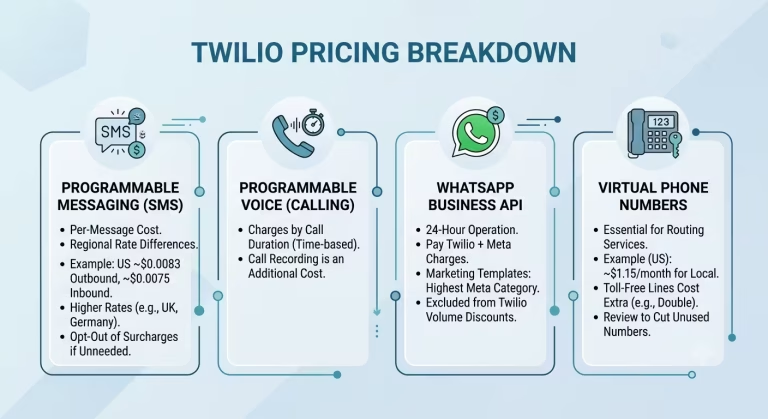
Twilio does not sell their software as a service. Instead they sell their products like telecom utility components. Here is how the communication blocks are designed to sell:
- Programmable messaging (SMS) – twilio’s SMS pricing depends on per message sent. It is better to understand that while pricing is noted you need to look for the regional differences too. Like, in the US the outbound messaging is approximately around $0.0083 while the incoming cost is lesser around $0.0075 each. International rates may vary depending on the destination country too. Because the pricing is much higher in the UK and Germany. Forgetting about such surcharges and amount levied based on regions need to be taken care of or opted out if they are not required for your business.
- Programmable voice (calling) – voice pricing is measured exactly equal to the amount of time spent on the call. But the secret lies in call recording. If your business needs to keep data of call records then you will have to pay a sum for the recordings additional to the voice call charges.
- WhatsApp Business API – unlike standard SMS service, WhatsApp is provided by meta and works 24 hours a day. So your business has to pay a twilio fee along with meta charges which might not be explicitly specified by them. Marketing templates sent to users to drive sales always charge the highest Meta category, and they do not count toward your standard Twilio volume discounts.
- Virtual phone numbers – in order to route any of the services, you must acquire a virtual phone number from the twilio inventory. A standard US local number might cost around 1.15 dollar per month while toll free lines may double the charge. So, if you have opted for a virtual number for business purposes in many places you might need to cut short some of them or otherwise you will be paying fees for something that is not useful to you anymore.
Why Twilio bills seems higher compared to competitors
There are few reasons by which the billing seems to be higher for your business. They are:
- Extreme billing breakdowns: here, you do not purchase the service as a whole instead you pay for each call which comprises a number of factors like call charges, number lease, recording tool, and its data storage facility. Here, you will be billed for each service separately, not as a whole.
- Linear scaling: you choose a pay-as-you-go model. So if the business has to tend to a huge call volume suddenly or cut their staff to a few, your billing will also be likewise. Because with sudden expansion you might get the services fast but the billing level might not be what you prepared for previously.
- Developer tax: Twilio actually provides you with raw API codes and not a built-in read to use platform. So you might need to spend your business working hours on developing, designing and fixing bugs of the platform all by yourself and do the testing.
Twilio v/s Bundled Platforms: the reality of operations
While companies who are planning for growth and expansion cannot waste their time and money on developing from raw API codes, it is easier for them to choose options which are Twilio alternatives and their competitors like Bonvoice. Let us look at the differences:
|
Feature
|
Building With Twilio
|
Deploying With Bonvoice
|
|---|---|---|
|
Development & Setup
|
Heavy Engineering Lift: You have to write custom code, connect separate webhooks, and configure databases to make channels talk to each other.
|
Plug-and-Play Dashboard: A unified business phone system, auto-dialer, and contact center interface are ready to roll out on day one.
|
|
Cost & Budgeting
|
Volatile Monthly Expenses: Financial forecasting is difficult because your bills swing unpredictably based on daily usage numbers.
|
Predictable Bundled Plans: Clear, feature-focused subscription structures let you know your exact software costs in advance.
|
|
Management & Control
|
Fragmented Component Assembly: Managing your stack means monitoring distinct codebases for SMS, Voice, and WhatsApp.
|
Zero-Code Operational Control: Non-technical marketing and support managers can easily build IVR phone menus and update WhatsApp automations.
|
Long-term Pricing benefits: Twilio v/s Bonvoice
Let us look at an example comparison of a mid-sized team needing 25,000 monthly SMS units, structured automated WhatsApp alerts, cloud telephony, and dedicated customer support:
|
Cost Element
|
Twilio Model
|
Bonvoice Model
|
|---|---|---|
|
Messaging Fees
|
Variable: Paid completely per message fragment; highly sensitive to carrier surcharge shifts.
|
Flexible/Included: Predictable messaging pools with transparent volume management.
|
|
Voice Charges
|
Variable: Unbundled, metered usage tracking across separate inbound, outbound, and recording pipelines.
|
Bundled: Built-in calling allocations designed for routine business operations.
|
|
IVR & Call Routing
|
Extra Setup: Requires engineering hours to code workflows or paying per-node execution fees via Twilio Studio.
|
Included: Native, visual drag-and-drop interactive voice menus built into the system core.
|
|
Customer Support
|
Developer Docs: Free access is limited to community forums. Rapid, hands-on enterprise support requires a paid tier.
|
Managed Support: Hands-on assistance, guided account onboarding, and direct access to engineers.
|
|
Budget Predictability
|
Low: Financial updates bounce around monthly depending on slight changes in team or customer activity.
|
High: Subscription-style pathways make accounting completely transparent.
|
How to choose the best for your business
The right decision can be only taken after a thorough analysis of your specific business requirements:
You need to choose Twilio if:
- You have a dedicated in-house software team to look into the operations.
- You want raw API codes for custom mobile applications that need strict privacy.
- You have the bandwidth to build and maintain your own visual user interfaces from scratch.
You need to choose Bonvoice if:
- You want a built-in ready to use platform that will not cause technical delays.
- You need a WhatsApp Business API, Cloud Telephony, and a multi-level IVR system working perfectly out of the box.
- You prefer predictable, fixed monthly software expenses and bills that do not shock you.
- You want technical support to transition the team smoothly to the service.
Frequently asked questions:
How much does Twilio cost per month?
It is based on a pay-as-you-go model and cannot be priced exactly.
Is Twilio cheaper than WhatsApp Business API providers?
While Twilio’s raw per-message developer API rates look lower on paper, it often becomes more expensive than packaged WhatsApp Business API providers due to hidden charges.
Why is Twilio pricing difficult to estimate?
Twilio pricing is complex because bills are completely unbundled and variable.
Does Twilio charge for incoming SMS?
Yes, Twilio charges for both outbound and inbound SMS.
Does Twilio charge for phone numbers?
Yes, Twilio charges a standard recurring monthly subscription fee per virtual phone number.
Does Twilio charge for WhatsApp conversations?
Twilio passes through Meta’s official per-message template fees and tacks on its own processing markup fee.
How much would Twilio cost for 10,000 SMS per month?
Sending 10,000 baseline US local SMS would cost roughly $83 per month in message fees, but the final bill will be higher once you include surcharges.
Is Twilio good for small businesses?
Twilio is generally a tough option for small businesses.
What is the best Twilio alternative if I need WhatsApp, Voice and IVR together?
The best alternative for teams seeking an all-in-one platform is a managed provider like Bonvoice. Check out the official website for further details.
Footnotes:
“Twilio Customer Engagement Platform Reviews & Ratings.” Gartner Peer Insights, 2026.
Prompts used:
- Twilio pricing plans
- Bonvoice as a Twilio alternative