
 ChatGPT
 Claude
 Perplexity
 Grok
Grok
Call whispering comes into play at a time when customer relationship management is taken as a serious business by enterprises. Onboarding new customer representatives is kind of a balancing act for them. But at the same time with this learning period, you cannot let them affect your customer satisfaction score or your average handle time.
The traditional ways of training a new employee has its own ways like a classroom teaching or shadowing their work process. But it will take more time and that cannot be beneficial to the business. Real-time execution is what matters for any customer who wants to solve their query easily. Here, the call whispering feature will act as a safety net for your staff training dilemmas. It allows contact center managers to involve between calls and easily handle situations without further escalation and also completely hidden from the customer.
In this blog, we will discuss in detail why call whispering is a must feature for any business dealing with customers, how to improve their KPIs and enhance employee onboarding process.
What is Call whispering?
Call whispering or whisper coaching feature is an advanced telecommunication feature that will allow the manager or any department lead to hear the live call and give their suggestions or opinions on how to handle the call seamlessly. This will not work like an interruption. Rather it will help the manager to stay completely hidden from the customer and his or her process. But this feature is not the same as live call monitoring. Let us look at some major differences by understanding what each means:
|
Feature
|
How It Works
|
Best Used For
|
|---|---|---|
|
Silent Monitoring (Listen)
|
The supervisor listens to the live call completely muted. Neither the agent nor the customer knows they are there.
|
Quality assurance, compliance auditing, and baseline evaluation.
|
|
Call Whispering (Whisper)
|
The supervisor can speak directly to the agent. The customer is entirely unaware of the supervisor's presence.
|
Real-time coaching, technical troubleshooting, and script compliance.
|
|
Call Barging (Barge-In)
|
The supervisor fully enters the call, turning it into a three-way conference where everyone can hear each other.
|
Crisis control, escalating angry customers, or rescuing a failing interaction.
|
Why use call whispering for training new staff?
Implementing call whispering feature in your business training program can be beneficial to:
- Reduce onboarding lifecycles: classroom learning cannot reduce the pressure an employee goes through in their minds while handling the real call. By making use of live whisper coaching you can move your trainees easily into real life situations with assistance. Rather than passive shadowing it will help the employees gain knowledge about the company and its procedures quickly and easily.
- Protect customer experience: when a new hire faces difficulties in their call it is bound to affect the customer experience. Call whispering ensures that even though your employee is new to the job he or she will receive proper assistance from their supervisor without affecting the live call.
- Reduce agent anxiety and burnout: the first few days at a workplace will be more about learning new processes and working seamlessly. It tends to enhance a new hire’s anxiety and if they feel like they are assisted properly in this transition it can prevent a future burnout.
Step-by-step process to train new staff with call whispering
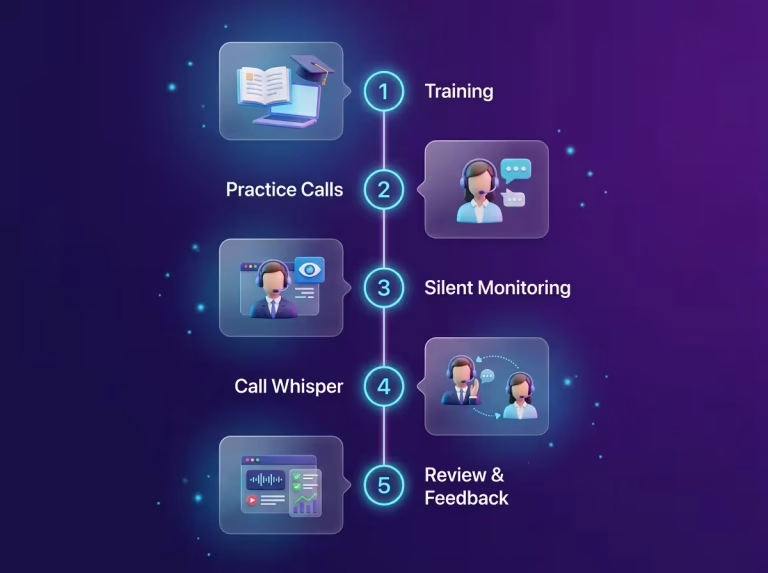
- The first step is to establish technical and behavioral training. Before diving directly into calls ensure that your employees get proper product knowledge and an idea to navigate through your internal CRM. This will be helpful to make them aware of core concepts so that when the manager is giving him cues he will easily catch up with it.
- The second step is to conduct mandatory whisper familiarization sessions. You can run mock calls and make the new employees perfect their skills easily. Also they need to learn to maintain the communication flow if the supervisor needs to whisper suggestions.
- The third step is to initiate silent monitoring interventions. This will be helpful when the supervisor will be able to hear all the calls silently monitoring the process. Also instead of a quick loud suggestion supervisors can also learn how to blend in their advice without interrupting the call.
- The fourth step is to give direct verbal cues via whisper. If the agent hits a roadblock, experiences trouble, or misses a critical workflow step, click the “Whisper” icon in your communications hub. This way the supervisor can easily give a precise instruction and provide assistance.
- The fifth and final step is to conduct post-call analysis. With an option for pairing your whisper sessions with an immediate 2-minute debrief or an end-of-day call review using the saved call recording you can easily get a critical analysis of your performance.
Call whispering use cases
|
Industry
|
Primary Use Cases
|
Why It Matters
|
|---|---|---|
|
B2B SaaS & Tech Support
|
1. Teaching complex troubleshooting methods to tier-1 agents.
2. To teach agents how to handle software feature objections.
3. In order to remind trainees to upsell a higher service tier.
|
This will help to prevent customer wait times and at the same time keep the conversations fluid in between troubleshooting.
|
|
Banking & Financial Services
|
1. In order to ensure strict adherence to financial regulatory compliance.
2. Give updates on real-time interest and loan terms in the middle of consultation.
3. Preventing disclosure of sensitive data.
|
Helps to keep agents aware of financial laws in real time in order to avoid legal penalties and troubles.
|
|
Healthcare & Insurance
|
1. Teaching new coordinators through delicate patient intake laws.
2. Notifying agents on specific policy exclusion and coverage limits.
3. In order to ensure patient privacy compliance.
|
Maintains extreme accuracy during critical medical or insurance conversations along with empathy.
|
|
E-commerce & Retail Support
|
1. Coaching agents on how to process and handle complex returns, refunds, or replacement claims.
2. Giving updates and nudges to specific promotional or discount codes to close a hesitant buyer.
3. In order to handle high-stress calls from frustrated shoppers tracking lost shipments.
|
This helps to protect brand loyalty, improves First Call Resolution (FCR), and maximizes customer experience.
|
|
Real Estate & Property Management
|
1. Teaching property specific details to new leasing agents.
2. Guiding agents on how to tackle high-value negotiations with talking points.
3. Prompting agents to lock in an on-site viewing date.
|
This will help junior agents speak authoritatively about expensive assets, directly impacting conversion and booking rates.
|
|
Telemarketing & Inside Sales
|
1. Teaching real-time rebuttals to junior agents facing tough objections.
2. Reminding agents to ask critical qualifying questions.
3. Prompting agents to use specific closing techniques.
|
Accelerates the sales pipeline by giving new agents the confidence and style of a top-performing closer.
|
Best practices for call whisper coaching
Everything we do needs to be in accordance with the situation. Likewise, if a supervisor is constantly involving and giving the staff unnecessary cues he or she will feel frustrated and helpless. This will badly affect the agent’s performance too. So, in order to simply avoid bad practices your business needs to follow these reminders:
- Keep the advice concise and strictly follow a three word policy.
- Make the words like encouragement instead of micromanagement.
- Try to maintain positive reinforcement when the agent performs well.
Conclusion
Bonvoice stands as the leading cloud telephony service provider in the market by combining the use of advanced AI and robust telephony. While many tools focus on one or the other, Bonvoice offers a unified AI + telephony + automation feature set. Call whispering comes as a standard feature every business requires while trying to improve their customer experience. With Bonvoice, your business can easily adopt a powerful cloud telephony service with an amazing features set curated to support the needs of today’s business scenario.
Frequently asked questions
What is the difference between a cloud telephony service and a traditional PBX system?
A traditional PBX is an on-premise hardware-based system that routes calls through landlines whereas cloud telephony works entirely over the cloud or internet.
Why are businesses switching from traditional landlines to cloud telephony?
Businesses shift because cloud telephony offers better benefits for their business at a low cost than traditional PBX.
Are cloud telephony services cheaper than PBX systems?
Yes. Cloud telephony services are typically cheaper than PBX systems as they use a subscription model of payment.
Footnotes:
Kraus, Drew, et al. “Magic Quadrant for Contact Center as a Service.” Gartner, 8 Sept. 2025,