
 ChatGPT
 Claude
 Perplexity
 Grok
Grok
An epidemic has taught us how we can manage our work even from home without going to the office daily. People found it a bit confusing at first but then slowly got settled into it. Now, even when reality calls people back to the office, some people look for work from home options. Day -by-day the number seems to increase rather than decreasing. It has become the need of the hour for business owners to rethink the workplace scenario and offer comfort and flexibility to their employees in order to maintain their business growth.
But the problem arises when we think about how a business can maintain a unified communication procedure across all departments working hybridly. The answer lies in services like cloud telephony in hybrid workplace.
Table of Contents
Cloud Telephony in Hybrid Workplace
Cloud telephony is often referred to as VoIP or voice over internet protocol, which is a cloud-based service that facilitates calling and receiving calls over the internet in a business communication scenario. The use of cloud telephony in hybrid workplace is the solution that businesses can rely on in order to ensure smooth workflow and communication.
Making a cloud telephony hybrid work model is not easy. We are familiar with the use of traditional phone systems and it was an easy mode of communication until recent times but not anymore. The legacy phone systems rely on complex hardware and fixed location. But now with the changing times workplaces are meant to be more flexible. They cannot adhere to the restrictions anymore while cloud telephony services provide them a much more effective solution in lesser cost.
The primary shift after using cloud telephony in hybrid workplace will definitely make your communication system feel like a strategic asset.
Core features of Cloud Telephony essential for Hybrid Workplaces
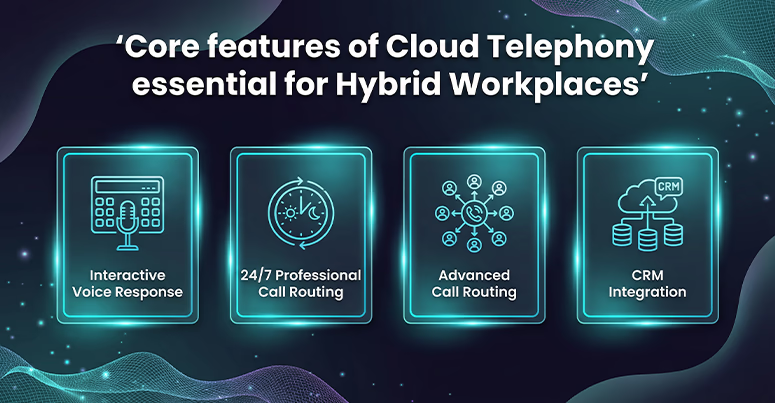
Interactive Voice Response
After acquiring a professional number the another step is to manage the calls that rush through every hour, even when you are busy. This is where IVR or Interactive voice response changes the game in your business strategy. So what is an IVR?
IVR is often termed as auto attendant, which is the automated menu that greets the callers with options like, Press 1 for sales, Press 2 for queries, Press 3 for billing etc…
This is an essential feature in a cloud telephony for remote staff.
What happens in a scenario that lacks an IVR?
For small to mid range enterprises, the major challenge they face is to handle the call volume. Often they lose customers because they couldn’t reply or take the call due to their busy phone systems which leads to customer frustration and thereby churns. Also even if the staff picks up the call they will be drained too soon of their productivity which can instead be used on their tasks effectively.
IVR handles this call volume without requiring you to hire a full-time receptionist as staff. It acts as an infinitely scalable filter.
24/7 Professional Call Routing
The most essential need of a call routing system is to handle calls effectively and the greatest benefit is that they work 24/7 regardless of the hour. This helps to give your business a feeling of standard and customer – centric. For operational efficiency cloud telephony for hybrid workplace heavily relies on this feature.
With implementing a call routing system you can:
- Direct sales to sales : if a customer is asking a query regarding a product and its specification the system can directly route it to the sales team member.
- Support to support: if the customer has some concerns over a product or service they can be directed to the support team to solve the issue.
- After hours information : if a customer is seeking information which is after the working hours of the company or institution, the system can provide essential information like hours of operation or a link to an online FAQ before offering to take a message, solving simple queries without staff intervention.
So therefore, an effective IVR doesn’t just route calls, it screens and prioritizes them, giving your cloud telephony hybrid workplace team a critical head start.
Advanced Call Routing
Through a basic call routing system we can handle all the calls without getting anything missed. But advanced call routing systems add an intelligent layer to this process by passing the call to the appropriate agent who deals with the specific section of the query. This system definitely impacts the efficiency of your business by increasing your first call resolution rate.
Intelligent call routing ensures that it uses its predefined logic to transfer the call to match the customer’s need with the agent’s capability. Imagine an IT firm, where a call related to a software issue is directed to x and a call related to network setup is directed to y. This ensures a skill based routing thereby reducing customers frustration and ensuring their ease of use. This is an essential feature for employees using cloud telephony for remote work. Also this feature allows the queries after your working hours to be routed to an on call manager or a voicemail box thereby ensuring every call is answered and customers expectations are met.
CRM integration
For every business platform, smooth workflow needs to be ensured. In order to achieve it, the seamless flow of information removes confusion and chaos, especially in a workplace with a number of employees working on different sections. In the case of a call center or a sales team, whenever a customer calls, with the use of CRM integration provided by cloud telephony in hybrid workplace solutions, a screen pops up with the customer’s past history of purchase, tickets and behavior. This helps the employee to handle the calls smoothly and improve their first call resolution rates. Also this allows them to use the average handle time and improve the time efficiency.
Benefits to look out for
The integration of cloud telephony in hybrid workplace has its own valuable benefits.
Reduce Customer Wait Times
Customers don’t like to wait in line for service anymore. With the help of the automated IVR system you can easily handle initial queries, instantly routing the call. This results in improvement of service quality by using a good IVR service provider.
Improve First-Call Resolution (FCR)
Customers expect to solve their problems quickly. Intelligent IVR routing and self-service ensures the customer connects to the right agent, leading to average handle time and faster resolution of issues with our IVR service provider. This capability is important for a cloud telephony hybrid work strategy.
Enable 24/7 Self-Service Support
Customers get access to essential information and complete their queries any time of day, which ensures 24/7 customer support automation from the IVR Solution platform and superior convenience to the customers. With this you can fully use the cloud telephony for remote teams across different time zones.
Enhance Customer Experience (CX)
With the help of smart IVR technology, a professional, personalized interaction can result in customer experience (CX) improvement. This proves that your business values their time by making every interaction seamless and efficient. This is an important feature while deploying cloud telephony in hybrid workplaces.
Build a Professional Business Image
A well-designed IVR for business presents a polished, competent professional business image in front of every caller. A reliable and accurate interaction automation makes your system highly organized. This helps to increase customer confidence in your brand.
Conclusion
The shift to a hybrid workplace has been a new normal rather than just a trend. It has withstand the test of time. With the help of a good cloud telephony service provider your business can easily adapt to this new normal. This will allow your employees to work comfortably thereby ensuring their welfare. This will help to reduce burnout among them and they will be able to continue to do their best in the job for longer.
Frequently asked questions:
1.What are the basic features to look out for in a cms?
A good call management system will provide you with toll free number facility, IVR, advanced call routing , call analytics and reporting.
What is the outcome of poor integration?
If the integration was not successful, you will get to see data duplication, inconsistency, and poor user adoption.
Footnotes:
“Flexible Work’s Enduring Appeal Affects Workers, Employers, and Real Estate.” McKinsey & Company, 6 May 2025, https://www.mckinsey.com/industries/real-estate/our-insights/flexible-works-enduring-appeal-affects-workers-employers-and-real-estate.
Prompts:
Cloud telephony for remote work
Cloud telephony and workplace flexibility