

 ChatGPT
 Claude
 Perplexity
 Grok
Grok
Agility, speed, and intelligence is very important in communication for modern-day businesses. Earlier, companies depended on old PBX business phone systems to keep communication alive. With the discovery of internet-based calling, VoIP service providers reduced the international calling costs and conventional copper line bills.
As modern businesses progress through 2026, the VoIP phone service is no longer enough. Many advanced companies are moving from basic internet calling to more intelligent cloud-based calling systems. They need a system that grows along with their business. In this article, we will see some of the top VoIP service providers in 2026, and why businesses are hitting the limits of traditional setups, and explain why platforms like Bonvoice represent the next evolution of phone systems for business.
What is a VoIP Service Provider?
Without using the copper lines or on-premise hardware infrastructure, VoIP service providers use the internet to deliver digital communication services. A voice over IP phone service converts audio signals to digital packets. It allows companies to send and receive HD calls through desk IP phones, mobile apps, or computers.
Companies are not limited by the challenges of traditional telephone systems with VoIP telephone service. It is similar to a digital substitute for physical phones. Even though the system routes the calls efficiently, it doesn’t have deep data logic, native apps, or automated intelligence.
Top 8 VoIP Service Providers in the market
When brands enhance their communication systems, they carefully evaluate the top VoIP service provider platforms both at international and domestic level. The following are some of the top players in the domain:
1. Nextiva
Nextiva is a stable option for mid market companies who need a unified communication system. The service combines voice, video and messaging into a single interface. But, they rely on traditional desktop apps or specialised hardware. So, hybrid teams can’t make quick or decentralised updates.
RingCentral is a global enterprise giant. They offer compliance controls, vast global routing, and reliable uptimes. The limitation is the complex setup process and high cost of ownership. This is very difficult for growing startups and mid-size companies.
3. Zoom Phone
With its advanced video ecosystem, Zoom Phone offers light weight, voice centric add on for organisations that have Zoom Meetings. The deployment is intuitive. But, it doesn’t have inbound routing logic, deep call center workflows, and intelligence features.
4. Aircall
The service is mainly for sales & support teams. It integrates with CRMs and allows instant data logging. However, the performance and stability of calls depends on third party app APIs. The costs scale up quickly as teams expand.
5. Ooma Office
The service is a solid entry point for small storefronts who need simple and reliable desk phone calling. The setup process is simple and doesn’t need any technical expertise. But for enterprises, it lacks the analytics layer, AI features and unified communication features.
6. Vonage
It is an API-forward platform tailored well for developers. The service allows users to embed customizable communication components into their own software. For standard business consumers, however, the day-to-day user experience can feel fragmented across legacy software setups.
7. CallHippo
CallHippo’s offerings suit better for customer support and sales teams who have a highly flexible software dialer. The base plan is budget friendly. But essential features like automated call transcript or dashboard supervisor seats are billed separately. This will increase the monthly cost.
The service is a long standing VoIP operator. They are enterprise focussed and have a strong presence across India and Southeast Asia. Their credit based pricing bundles can make the billing unpredictable. The setup and configuration process requires technical expertise.
Comparison of VoIP Service Providers
The following comparison tables help brands to evaluate the top VoIP service providers in the market and compare their focus areas, rates, and operational capabilities.
|
Provider
|
Best for
|
Key features
|
Pricing
|
India support
|
|---|---|---|---|---|
|
Nextiva
|
Mid-market corporate offices
|
Team messaging, video, basic call logic
|
From $20/user/month
|
Limited / Global routing
|
|
RingCentral
|
Global enterprise teams
|
Enterprise security, vast carrier network
|
From $25/user/month
|
Enterprise localized setups
|
|
Zoom Phone
|
Video-first workspaces
|
Native Zoom UI integration, softphone apps
|
From $10/user/month
|
Global outbound focus
|
|
Aircall
|
CRM-centric sales reps
|
One-click CRM plugins, shared contact lists
|
From $30/user/month
|
Global routing only
|
|
Ooma Office
|
Local small businesses
|
Virtual faxing, overhead paging support
|
From $19.95/user/month
|
None / US & Canada focus
|
|
Vonage
|
Customizable API development
|
Flexible communication APIs, app store
|
From $19.99/user/month
|
Limited developer routing
|
|
CallHippo
|
Fast-growing support teams
|
Power dialers, call multi-tagging layouts
|
From $18/user/month
|
High / Specialized routing
|
|
Exotel
|
South Asian enterprises
|
Parallel outbound dialers, developer APIs
|
From ₹9,999 bundle
|
Native / Strong Indian telecom
|
Key Features to look for in VoIP Providers
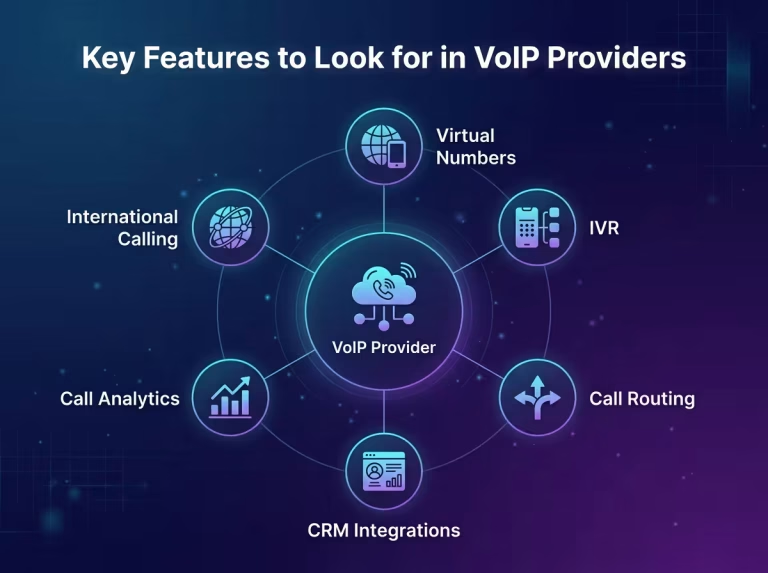
Some of the main features to look for while evaluating business phone platforms includes:
- Virtual numbers: Virtual numbers help businesses to establish immediate local, national, or toll free identities anywhere. There is no need for physical telephone lines.
- IVR: Interactive voice response systems automatically greet customers and guide them through multi-level menu options. Callers can avail services through self-service options or are routed to an agent for more complex queries. Bonvoice, being one of the top IVR service providers, offers multi-lingual IVR with efficient call routing.
- Call routing: Smart call routing directs the incoming calls considering several factors like availability of agent, time of the day, or language needs.
- CRM integrations: Platforms should be able to sync the calling workflows with databases like Salesforce, Bitrix24, etc.
- Call analytics: There should be real time reporting dashboards to track parameters like average hold times, call abandonment rates, and performance of agents.
- International calling: Outbound routing options allows teams to reach global clients without facing unpredictable traditional long distance fees.
Advantages of VoIP System
With VoIP systems, businesses gain a clear operational benefit over the traditional phone systems:
- Low cost: There will be no cost for maintaining expensive on-premise PBX, physical lines. This cuts the upfront CapEx.
- Remote communication: Hybrid teams can make and receive business calls from anywhere, anytime through their mobile phone or laptop.
- Scalability: VoIP systems can easily add new extensions, numbers, and lines quickly. No need to wait for physical technician installations.
- Global communication: VoIp can connect international offices into a single, unified dial plan. So, team work feels like a local interaction.
Limitations of VoIP System
Despite the advantages over traditional desk phones, traditional internet phones also have some disadvantages:
- Internet dependency: As VoIP services depend on the internet, local network issues can cause audio issues or dropped calls.
- Limited automation: The system is primarily for connecting calls. So, teams need to manually do post call logging and follow-ups.
- Basic workflows: Workflows struggle to efficiently route the calls such as connecting a high value customer to the right team.
- Limited omnichannel support: Traditional systems isolate the voice conversations into a separate silo, disconnected from customer interactions on WhatsApp, SMS, or live chat.
Cloud telephony is a cloud based telephone system that uses VoIP to manage calls. It is possible through a web-based platform.
How does it work?
Cloud telephony remove the physical hardware dependency in the communication channel. It works through:
- Hosted on cloud servers: Cloud telephony services are hosted in secure, off-site data centers. It is often handled by the provider.
- No hardware infrastructure: There will be no servers, wiring, or IP PBX. Teams use desktops or mobile devices to connect to the cloud communication system.
- Virtual connectivity: When a customer calls to the virtual phone number, the call request is processed in the cloud. Then, it is routed through an intelligent call routing system to the correct employee.
What is a VoIP system?
VoIP is a technology that allows voice calls over the internet without the need of a traditional telephone line. VoIP considers voice as a piece of data such as an email or a web page.
How does it work?
In VoIP, the voice data turns to digital signals in 3 steps:
- Voice-data conversion: When a customer calls and speaks to a business phone system, the voice converts to digital signals.
- Packetization: Then, these signals are broken down into small packets of data.
- Transmission: Over the internet, the data packets are transmitted to the receiver. After reaching the destination, the packets will change back to the original voice sound.
A comparison table:
|
Feature
|
VoIP systems
|
Cloud telephony
|
|---|---|---|
|
Core Architecture
|
Internet data protocol replacing analog lines
|
Off-site browser-driven service ecosystem
|
|
IT Maintenance
|
Requires technical setup, SIP trunks, or routers
|
Zero-touch; handled entirely by provider
|
|
AI Integration
|
Dependent on third-party software plugins
|
Native ai receptionist & automated summaries
|
|
Data Synchronization
|
Periodic or manual updates via CRM APIs
|
Real-time automated data and action triggers
|
|
Channels Supported
|
Primarily voice calls and simple SMS text
|
True omnichannel (Voice, WhatsApp, Web Chat)
|
Why do businesses shift to cloud telephony?
Many companies are shifting to cloud telephony systems for their communication purpose for the below main reasons:
- Advanced IVR: Multi-lingual, responsive options resolve routine queries easily.
- Smart call routing: Efficient routing algorithms route callers to the exact agent within no time.
- CRM & WhatsApp integration: Voice calls- WhatsApp messaging integration into a single platform.
- Automation: Follow-up texts and ticket status update automation makes post call workflow smooth.
- Scalable: Instant virtual channels to handle huge call volumes during peak traffic.
- AI Sentiment analysis: With Bonvoice AI sentiment analysis, a standard phone call from a simple audio stream turns into a rich source of actionable data. We transform live audio into text and tone data to detect customer emotions in real-time. This allows businesses to automatically flag frustrated callers, coach agents mid-conversation, and score 100% of calls for quality assurance.
- Hardware independent setup: Bonvoice requires zero on-site infrastructure. The setup will be fast, smooth, and managed digitally.
- Smart call management: With the features like intelligent IVR, advanced call routing, real-time analytics, integrations, omnichannel support, Bonvoice transforms the customer-business communication strategy.
- Indian business focussed: Bonvoice understands local market needs, telecom compliance requirements, and regional operational challenges. For Indian businesses searching for reliable alternatives to VoIP, Bonvoice offers localized support and optimized pricing.
- Enterprise features: Enterprise features usually come with premium costs. But, Bonvoice offers advanced automation, analytics dashboards, scalable call handling, and flexible integrations without locking businesses into rigid, expensive contracts.
- Bonvoice pricing & flexible plans: The unpredictable billing is one of the main reasons many companies are opting out of VoIP services. Bonvoice offers transparent pricing with flexible monthly plans.
How to decide between the two?
A business’s ideal communication setup depends heavily on its team’s operational complexity and overall traffic volume.
|
Business type
|
Recommended solution
|
Primary operational need
|
|---|---|---|
|
Freelancers
|
VoIP
|
Simple, low-cost outbound business number
|
|
Small Teams
|
VoIP
|
Basic shared calling logic without heavy automation
|
|
Startups
|
Cloud telephony
|
Rapid scalability, app syncs, and flexible pricing
|
|
Support Teams
|
Cloud telephony
|
Live analytics, call queues, and automated workflows
|
|
Enterprises
|
Cloud telephony
|
Advanced AI routing, sentiment tools, and compliance
|
Conclusion
In 2026, we can definitely say business communication is moving toward smarter, cloud-based, and unified systems. As the trends we mentioned above grows, businesses should carefully select their business VoIP service providers as it affects the efficiency and customer relationships.
When selecting business VoIP service providers, companies should look beyond basic calling and must focus on:
- AI and automation features
- Easy integration with business tools
- Strong security and regulatory compliance
- Support for multiple communication channels
- Local expertise, especially when choosing VoIP providers in India
By partnering with Bonvoice cloud telephony, businesses can stay competitive, flexible, and well-connected in a digital-first world.
Frequently asked questions
1.What are the best VoIP service providers?
Some of the best VoIP service providers are Nextiva, RingCentral, and Exotel.
2. Which VoIP provider is best in India?
There are many top names in the VoIP service market. Selecting the best one depends on a business’s goal and objectives. Companies must evaluate various VoIP service providers and check their focus areas, rates, and operational capabilities.
3. Is VoIP better than cloud telephony?
VoIP is a technology that transmits voice over the internet. Meanwhile, cloud telephony is the full service hosted by a provider.
4. What are the disadvantages of VoIP?
Some of the challenges of VoIP include internet dependency, basic workflows, and limited automation.
5. Why are businesses switching to cloud telephony?
Many companies are shifting to cloud telephony systems for their communication purpose for the main reasons including smart call management, CRM & WhatsApp integration, automation, scalability, and lower upfront CapEx.
6. Can VoIP work without cloud telephony?
Yes, businesses can use voice over internet protocol on a private, on-site IP PBX server without using a cloud provider.
7. Which system is best for small businesses?
For small businesses and growing teams, cloud telephony is the best solution. It requires no upfront cost, no dedicated tech support, and includes advanced features with the subscription pricing model.
References:
- Violino, Bob. “How Small and Midsize Businesses Benefit from VoIP Services.” Forbes, 20 Sept. 2016,
- LaPlante, Alice. “6 Criteria for Choosing a Hosted VoIP System.” Forbes, 31 Mar. 2017,
- “Cloud Telephony Providers.” Bonvoice
Prompts:
- Which are the best VoIP service providers for businesses in 2026?
- VoIP vs Cloud Telephony: Which communication solution is best for your business?
- How do you choose the right VoIP service provider for your business?