
 ChatGPT
 Claude
 Perplexity
 Grok
Grok
When establishing a new venture, securing a reliable business phone system is a critical milestone, yet many organizations struggle with the cloud telephony vs VoIP vs PBX debate.
“VoIP is the technology, PBX is the system, and cloud telephony is the modern delivery model.”
Navigating the difference between cloud telephony and VoIP and how they both stack up against a traditional PBX phone system remains a frequent point of confusion across various industries.
In this article, we will discuss what each of the terminology stands for and how businesses should analyse each and select the business phone system that aligns with their goals.
Clearing the confusion- Cloud telephony vs VoIP vs PBX
Businesses may feel overwhelmed while selecting the best communication system for business. Some terms like voice over internet protocol and private branch exchange are used often and interchangeable. This may cause a confusion between cloud telephony vs VoIP vs PBX. Many decision makers find difficulty in making a decision because of these jargon heavy vendor pitches regarding setups and a lack of clarity in cloud telephony vs VoIP cost comparison models. There will also be a fear of committing to a call management software that is not scalable. Businesses will feel unsure about which is better cloud telephony or PBX for their long-term growth.
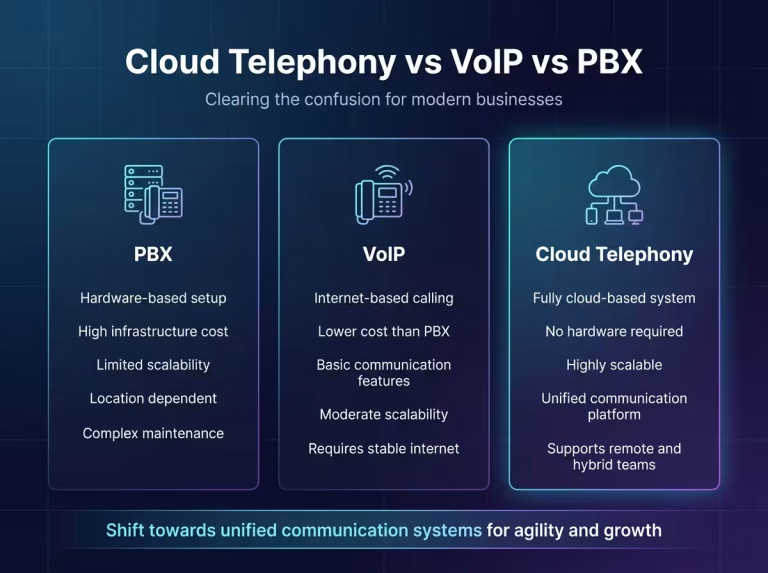
However, you are not alone. This confusion is common. But, businesses should understand there is a growing trend of shift toward a unified communication system. This is the first step to clarity. While a standard VoIP phone system provides basic communication, cloud telephony solutions offer scalable cloud communication systems. Businesses can replace their complex hardware with an efficient cloud communication system. So, they can remain agile in an evolving market.
PBX- What is it, How does it work, Key benefits, Where is it used, Limitations, Cost analysis
What is a PBX system?
PBX (Private branch exchange) system as the name suggests is a private telephone network. It is used within a company. This system will manage the internal anc=d external calls of an organisation. So, the users should share a limited number of external phone lines. There will be no dedicated line for each and every employee. Even if the system is a traditional PBX or an IP PBX, it routes the calls efficiently across a business phone system.
Some of the common types of PBX system includes:
- On-site PBX: Traditional PBX systems are hardware based. It should be set up in an office. It includes a server room and standard copper telephone lines.
- IP PBX: This type of PBX is VoIP based. However, it still requires hardware to be set up on-site.
- Cloud PBX: Hosted PBX is the preferred option in cloud telephony vs traditional PBX debate. A provider will be there to manage this type. There will be no bulky hardware setup. The entire cloud communication system will be at the provider’s data center.
How does it work?
The PBX system works as follows:
- Internal routing: When an employee calls another, the system routes the call through an internal network. There is no need for an external phone line.
- External routing: When an employee calls a customer like in an outbound calling system, the PBX connects the internal extension to the public switched telephone network (PSTN) or a voice over internet protocol (VoIP) trunk.
- Data conversion: In an IP PBX, the voice signals are converted to digital signals so it can travel over the internet. This acts as a bridge in a VoIP phone system.
Key benefits
PBX systems offer some specific advantages even with the rise of cloud communication solutions. It includes:
- Internal call management: There will be seamless call transfers and extensions. The calling between employees within the same office will be free.
- Control over communication: Businesses will have direct control of their call routing system and internal data.
- Reliability: On-site PBX phone system can function independently of the external internet if set up for local landlines.
Where is it used?
PBX systems are still common in:
- Large corporate offices: There will be a pre-existing call routing system and dedicated IT team to handle the system.
- Hospitals & hotels: Many physical extensions need a stable inbound calling system and internal intercoms.
- Manufacturing plants: The communication must remain functional always. With external internet, there are chances of service interruption.
Limitations
Some of the common pain points of using PBX system includes:
- High upfront cost: The initial setup cost for expensive servers and installation will be high.
- Maintenance difficulty: As the system is physical, manual support is needed for repairs or updates.
- Limited scalability: To add new users, companies should buy extra hardware cards or wiring.
- Dedicated IT team: There should be a dedicated technical team to handle the software and hardware patches.
Cost analysis
When considering PBX systems, the main incurrence of cost will be from:
- Upfront setup cost for servers, license, and wiring will be high when compared to cloud communication solutions.
- The monthly fee will be low as users only need to pay for SIP trunks/lines and power.
- The maintenance cost will be high as it requires on-site IT or paid contractors for repairs.
- While adding new features, extra hardware cards are needed and it may be expensive.
VoIP- What is it, How does it works, Key benefits, Where is it used, Limitations, Cost analysis
What is a VoIP system?
VoIP is a technology that allows voice calls over the internet without the need of a traditional telephone line. VoIP considers voice as a piece of data such as an email or a web page.
How does it work?
In VoIP, the voice data turns to digital signals in 3 steps:
- Voice-data conversion: When a customer calls and speaks to a business phone system, the voice converts to digital signals.
- Packetization: Then, these signals are broken down into small packets of data.
- Transmission: Over the internet, the data packets are transmitted to the receiver. After reaching the destination, the packets will change back to the original voice sound.
Key benefits
For growing companies, selecting VoIP is a strategic decision. Some of the main benefits include:
- Low cost with high ROI: When checking cloud telephony vs VoIP cost comparison, reduced expense is the immediate benefit offered by VoIP. As the system operates over the internet, there is no infrastructure charge. Also, the call charges will be low, often allowing businesses to save between 50% to 75% on monthly bills.
- Global accessibility: VoIP avoids the geographical barriers. With virtual numbers, there will be a local number in a country giving the business a global footprint even though there is a single office. With a local inbound calling system, the customer trust will increase and there is a better chance of them answering the calls. Employees can also access the cloud communication system via laptops or mobile apps. This allows remote mode of work.
- Flexible usage: Businesses can easily add a new user or update the call management software dashboard easily. It integrates video, SMS, and chat into a single platform.
Where is it used?
In 2026, VoIP is used in:
- Remote & hybrid startups: Global teams can remain connected via laptops or mobile phones without a physical office.
- Customer support & call centers: Customer support teams can use inbound calling systems with AI powered IVR to handle high volumes of calls.
- Healthcare: Clinics can use it for secure patient calls. By integrating it with analytics, the response time can be tracked.
- E-commerce: A virtual phone number helps to create a local presence in multiple regions. This reduces international costs.
Limitations
Some of the limitations of VoIP system includes:
- Dependency on internet: VoIP relies on internet protocol. So, a poor connection or power outage can drop the calls.
- Emergency service tracking: Mapping a virtual phone number to a physical location in emergency cases may be a failure.
- Security challenges: There should be robust encryption to prevent frauds or hacking.
Cost analysis
The cost associated with VoIP will be:
- Upfront setup cost for installation and hardware will be minimum. So, it is more affordable than PBX.
- The monthly fee will be based on a subscription model.
- There will be no maintenance cost as the provider manages server updates and other infrastructure.
- New feature addon are typically activated instantly through software for small fee increments as a part of a tiered plan.
Cloud telephony- What is it, How does it work, Key benefits, Where is it used, Limitations, Cost analysis
Cloud telephony is a cloud based telephone system that uses VoIP to manage calls. It is possible through a web-based platform.
How does it work?
Cloud telephony remove the physical hardware dependency in the communication channel. It works through:
- Hosted on cloud servers: Cloud telephony services are hosted in secure, off-site data centers. It is often handled by the provider.
- No hardware infrastructure: There will be no servers, wiring, or IP PBX. Teams use desktops or mobile devices to connect to the cloud communication system.
- Virtual connectivity: When a customer calls to the virtual phone number, the call request is processed in the cloud. Then, it is routed through an intelligent call routing system to the correct employee.
Key benefits
- Cost savings: There will be no huge upfront cost like that of a PBX phone system.
- Scalability: Businesses can easily add users or new virtual phone numbers in seconds.
- Remote mobility: Teams can use the solutions from anywhere through mobiles, laptops, etc. So, it is very suitable for hybrid work models.
- Zero maintenance: Provider will manage all updates and security patches. So, there is no need for dedicated IT support.
- AI integration: AI powered IVR and smart call routing help to automate customer communication.
- Useful insights: The call analytics software helps to track performance metrics. This is not possible with PBX systems.
- Omnichannel support: Cloud telephony service combines voice with CRM tools and other communication tools.
- Advanced features: Without expensive hardware setup, there will be instant access to IVR and other advanced services.
Where is it used?
- Customer support: Customer queries can be handled efficiently with smart IVRs.
- Remote teams: Agents can use their outbound calling software via laptops and keep the virtual number professional.
- Real estate: With intelligent call routing, the customer queries can be routed to an agent’s phone.
- Healthcare: Hospitals can easily manage appointment bookings with the cloud phone system.
- E-commerce startups: Companies can offer 24/7 support to its customers via smart IVRs.
- Financial institutions: Call analytics software helps to monitor calls for security and regulatory compliance.
- Education providers: Cloud telephony systems easily scale up without crashing during enrollment times.
Limitations
Some of the challenges linked with cloud telephony system includes:
- Complete dependency on the internet: Cloud based phone systems require stable internet connection to operate.
- Recurring subscription cost: The long term subscription of a unified communication platform sometimes exceeds the one-time cost on traditional IP PBX.
- Limited customisation: Sometimes, there is a limitation in customising the features and other software provided by the host’s platform.
- Security: As the data is stored on cloud, companies should depend on the security rules of the provider to protect their confidential data.
- Reliability on provider: When there is an outage in the data center of the provider, it means your business is offline.
Cost analysis
When analysing the cloud telephony solution, the cost structure agility. Let’s break down the cost details:
- Upfront cost is the lowest among all the three for cloud telephony solutions.
- The monthly fee is a predictable subscription cost that includes many advanced features.
- There is no maintenance cost for the user and every cost associated with maintenance will be completely controlled by the provider.
- New features can be added through the call management software dashboard without any installation or downtime.
Key differences of cloud telephony vs VoIP vs PBX explained
The main differences between cloud telephony vs VoIP vs PBX is summarised in the following table:
|
Comparison factor
|
Cloud telephony
|
VoIP
|
PBX
|
|---|---|---|---|
|
Definition
|
A full-service cloud-based phone system.
|
The tech used for voice over internet protocol.
|
A physical on-site switching system.
|
|
Type
|
Service-based (Hosted).
|
Technology-based.
|
Hardware-based (On-premise).
|
|
Setup
|
Virtual; zero hardware needed.
|
Plug-and-play IP phones.
|
High; requires servers and wiring.
|
|
Cost
|
Predictable monthly OpEx.
|
Low upfront; subscription fees.
|
High CapEx (upfront investment).
|
|
Scalability
|
Instant via software dashboard.
|
High (add lines easily).
|
Rigid; requires hardware cards.
|
|
Maintenance
|
Managed by the provider.
|
Minimal local upkeep.
|
High; needs a dedicated IT team.
|
|
Flexibility
|
Extreme; works on any device.
|
High; mobile & desktop apps.
|
Low; tied to the office building.
|
|
Best use-case
|
Startups and remote teams.
|
Modern business phone system.
|
Large firms with high security needs.
|
Cloud telephony vs VoIP vs PBX- How to choose?
When companies need a suitable business phone system, they can consider the following details.
Choose PBX if:
- On-premise control is a top priority. This allows brands to keep everything within the office premise itself.
- There is a need for strict compliance or security needs like government or highly regulated finance sectors.
- The business had a dedicated IT team to hardware maintenance, updates, or complex setups.
Choose VoIP if:
- Business only requires basic internet calling just in case the goal is to move away from analog lines and save on long distance charges.
- A custom system is needed like a proprietary customer communication platform.
Choose cloud telephony if:
- Businesses need to scale instantly. Brands can add a new virtual phone number or scale your entire outbound calling system in minutes without buying more hardware.
- Brands must have a professional IVR system, AI-powered IVR, or intelligent call routing. Then, we can say it is an omnichannel communication platform.
- Businesses promote hybrid work models. So, employees can stay connected via mobile or desktop apps from anywhere.
- Low cost & zero maintenance is a priority, cloud telephony offers the most predictable OpEx model.
Bonvoice- The best cloud telephony solution for modern businesses
Bonvoice is the most suitable option for businesses who need a reliable, scalable, & cost-effective cloud telephony solution.
Why does Bonvoice have an edge?
- Hardware independent setup: Bonvoice requires zero on-site infrastructure. The setup will be fast, smooth, and managed digitally.
- Smart call management: With the features like intelligent IVR, advanced call routing, real-time analytics, integrations, omnichannel support, Bonvoice transforms the customer-business communication strategy.
- Indian business focused: Bonvoice understands local market needs, telecom compliance requirements, and regional operational challenges. For Indian businesses searching for reliable alternatives to VoIP, Bonvoice offers localized support and optimized pricing.
- Enterprise features with flexible pricing: Enterprise features usually come with premium costs. But, Bonvoice offers advanced automation, analytics dashboards, scalable call handling, and flexible integrations without locking businesses into rigid, expensive contracts.
Bonvoice pricing & flexible plans
The unpredictable billing is one of the main reasons many companies are opting out of VoIP services. Bonvoice offers
- Transparent pricing
- No hidden charges
- Flexible monthly plans
- Custom enterprise packages
- Pay-as-you-scale options
For a startup with 5 agents or a growing company with 200+ users, Bonvoice adapts to the budget and scale. This flexibility makes Bonvoice one of the most practical cloud telephony solutions available today.
Conclusion
Selecting the best business communication phone system is a strategic move for many businesses as it helps them shape the customer experience and trust in the long run. Businesses will feel unsure about which is better cloud telephony vs VoIP vs PBX for their long-term growth. This confusion is common. But, businesses should understand there is a growing trend of shift toward a unified communication system.
According to Market Growth Reports, in India, adoption of cloud telephony service market has grown by 37% year-on-year, with over 21,000 new installations recorded in 2023. For most modern businesses, cloud telephony offers the best balance of cost, scalability, and features.
FAQs
1. What is the main difference between VoIP and cloud telephony?
VoIP is a technology that transmits voice over the internet. Meanwhile, cloud telephony is the full service hosted by a provider.
2. Is PBX outdated in 2026?
Hardware-based PBX phone system setups are legacy technology in 2026. But, the concept has changed into the IP PBX and hosted PBX. Both remain highly relevant.
3. Which is cheaper: PBX or cloud telephony?
Cloud telephony is usually cheaper because it has zero upfront hardware costs. A private branch exchange requires buying expensive servers and paying for maintenance.
4. Can VoIP work without cloud telephony?
Yes, businesses can use voice over internet protocol on a private, on-site IP PBX server without using a cloud provider.
5. Which system is best for small businesses?
For small businesses and growing teams, cloud telephony is the best solution. It requires no upfront cost, no dedicated tech support, and includes advanced features with the subscription pricing model.
References:
- Cloud Telephony Market Report
Market Growth Reports. Cloud Telephony Service Market Size & Share [2033], MarketGrowthReports.com, 30 June 2025, https://www.marketgrowthreports.com/market-reports/cloud-telephony-service-market-103394. - “Business telephone system.” Wikipedia: The Free Encyclopedia, Wikimedia Foundation, 24 Apr. 2026, en.wikipedia.org/wiki/Business_telephone_system.
- “India’s Leading Cloud Telephony Providers.” Bonvoice, 2026,
Prompts used:
- Cloud telephony vs VoIP vs PBX
- Cloud telephony vs VoIP
- Cloud telephony vs PBX
- Which is better: cloud telephony or PBX or VoIP?