

 ChatGPT
 Claude
 Perplexity
 Grok
Grok
The full form of OTP is One-Time Password. It is a unique verification code that is valid for a single login or a transaction. As OTP expires within seconds, it will remain useless if it is stolen. One time passwords help businesses to verify their customers identity, prevent fraud transactions by authorizing the user. OTP synchronises conversation between a business server and the customer’s personal device. There are different types of OTP models businesses can use considering their requirements and security needs.
In this article, we will see what OTP is, how it works, why it is used, its types and a lot more
What is OTP?
OTP stands for one time password. It is a temporary authentication code that ensures a secure login. It serves a critical verification purpose by adding an additional layer of OTP authentication that expires within minutes. This verification code is delivered through communication channels like SMS, email, or automated IVR OTP call to complete the OTP verification process.
Why is OTP used?
The main reason why OTP is used lies in 3 important security pillars like identity verification, fraud prevention, and transaction authorization. As this verification code is dynamic in nature, it will offer a secure login. By linking the user’s digital profile to a physical device, it offers robust two factor authentication.
- Identity verification: When a person accesses their account, OTP verification will help them to prove who truly they are. A unique authentication code is sent to the registered device. The system will then confirm that the person trying to login has the physical custody of the authorized device.
- Fraud prevention: As OTP is time sensitive and expires within minutes, it will be useless to hackers even if it is stolen. This real-time limitation will reduce the risk of unauthorized account access.
- Transaction authorization: When it comes to what is OTP in banking, we can say it is a final checkpoint before the money moves. OTP authentication makes it necessary for an approval from the actual account holder before important actions like transferring money.
Relevance of OTP in modern business growth
Beyond the security benefits, businesses can use the OTP verification process as an important strategy for their business growth. One-time passwords can optimize their marketing funnel with clean data and customer trust.
Here is why otp is used by modern businesses:
- Lead verification: High quality data is very essential for every business. With the OTP, companies can make sure the contact information they collect from the potential customers is correct. When a customer enters the verification code sent to them, it proves the lead is genuine. This will save the sales teams from wasting time contacting wrong numbers.
- Reduce fake signups: When a registration requires an OTP authentication, it will block automated spam. This ensures that user growth metrics show real data with engaged customers rather than bot traffic.
- Improved conversion rates: A seamless secure login will improve the confidence of the customer. Even if it is an IVR OTP or SMS, a smooth authentication experience reduces checkout abandonment. Customers will feel safer doing transactions on platforms that give importance to security. This will increase sales and customer retention.
How does OTP work?
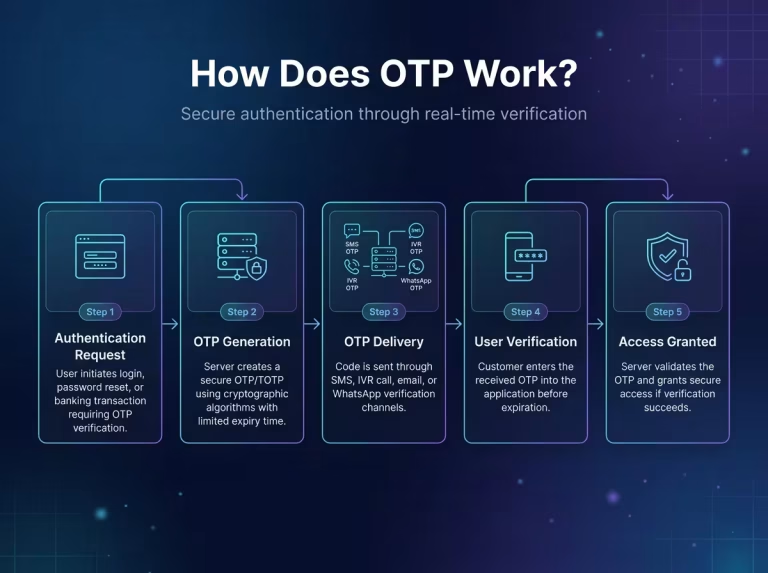
OTP is similar to a synchronised conversation between a business server and the customer’s personal device. The following steps help us to understand how OTP works.
Step 1: The process begins when the user attempts an action that needs the OTP authentication. It may be logging into an account from a new browser, resetting a password, or initiating a banking transaction.
Step 2: The server at the platform’s end will create a OTP or TOTP with the help of cryptographic algorithms. This will be the authentication code. This code will be a numerical code with a strict expiration countdown like 30 to 60 seconds.
Step 3: The server now sends the code to the registered contact. The OTP verification uses channels like SMS or email (Text based verification code sent instantly over cellular data), IVR OTP ( An automated IVR OTP sent to users without internet in which the system calls the user and reads the numbers aloud) or WhatsApp OTP (Time-sensitive verification code sent directly to a user’s verified WhatsApp account instead of their standard SMS inbox).
Step 4: After the customer receives the code on their device, they should type the digits into the application prompt before the code expires.
Step 5: Lastly, the server compares the digits the user entered with the code it generated. If it matches and the time hasn’t expired, the OTP authentication will be successful. The user can now easily get the access.
How OTP Codes Are Generated: HOTP vs. TOTP
Every dynamic passcode has a cryptographic engine behind it. The two factors that define one-time password generation are HMAC-Based One-Time Password (HOTP) and Time-Based One-Time Password (TOTP).
HOTP (HMAC-Based One-Time Password)
Defined in RFC 4226, HOTP generates codes using an HMAC algorithm combined with an incrementing counter that consists of two factors:
- Shared Secret ($K$): A unique key known only to the authentication server and the client token/device.
- Counter ($C$): An incrementing integer tracking the number of generated passcodes.
Each time a user requests an OTP, the counter increases by one on both client and server. The primary disadvantage of HOTP is counter desynchronization: if a user generates several codes without submitting them to the server, the client and server counters will fall out of sync.
TOTP (Time-Based One-Time Password)
Defined in RFC 6238, TOTP builds on HOTP by replacing the event counter with a time-based value derived from a shared clock:
Where:
- $T_0$ is the epoch start time (usually 0).
- $X$ is the time step window (typically 30 or 60 seconds).
The TOTP codes auto-expire after $X$ seconds, so they inherently restrict the window and replay attacks without requiring manual counter management.
What are the various types of OTPs?
There are several types of OTP verification methods. Let us see how a one time password can be delivered to ensure a secure login.
SMS OTP
This is the most common form of OTP verification. When the user logs in, the system will send an SMS with 4 to 6 digit verification code to their mobile number. It is very convenient because it doesn’t need any internet. But it is vulnerable to SIM swapping attacks as hackers trick the mobile carriers into routing the code to their devices.
Email OTP
An Email OTP is sent to the customer’s email inbox. This OTP is usually used for resetting passwords or secondary account verification. However, if the email account is compromised, a hacker can easily bypass this security.
App-based OTP (TOTP)
In TOTP, customers use authenticator apps like Google authenticator setup on their phone. These apps use a time based one time password algorithm to generate a new code every 30 seconds. As the code is generated in the phone and doesn’t travel through a cellular network, this verification method is very secure.
Voice OTP (IVR OTP)
In IVR OTP, an automated system calls the customer’s phone line and reads the code aloud. This is very effective as it is useful for visually impaired users or those with landlines. It also avoids regional SMS delivery failures. And it offers reliable OTP authentication globally.
Hardware token OTP
Hardware token OTPs are physical, keychain-sized electronic devices. At the press of a button, the internet chip displays a unique code. This token doesn’t need any network, and is impossible to hack remotely.
|
OTP type
|
Delivery channel
|
Security level
|
Best for
|
|---|---|---|---|
|
SMS
|
Cellular Network
|
Medium
|
General user signups
|
|
Email
|
Internet / Inbox
|
Medium
|
Password resets
|
|
App-based
|
Local Device App
|
High
|
Secure account logins
|
|
Voice (IVR)
|
Automated Call
|
Medium-High
|
Accessibility & Global backup
|
|
Hardware
|
Physical Device
|
Extremely High
|
Enterprise & High-value banking
|
A real life OTP authentication example
Imagine we are logging into a corporate bank account. If we use SMS, we wait for a text message. If we use an app, we open the Google Authenticator to copy the code. IF we use an IVR OTP, the phone rings and the automated voice says the number aloud like “ The security code is 1-2-3-4.” Even if the channel used in different scenarios varies, the main purpose of the OTP authentication is to keep the customer data safe.
A comparison of OTP vs password vs pin
OTP, Password, and PIN (personal identification number) all are for identity verification. But, they differ as follows:
- OTP: The system sends time sensitive 4 or 6 digit codes to the registered device. OTP authorizes high value transactions.
- Password: The customer opens the app and types in the unique password to initiate secure login.
- PIN: The user needs to type a quick 4-digit pin to unlock the saved profile on that phone.
|
OTP type
|
OTP
|
Password
|
PIN
|
|---|---|---|---|
|
Definition
|
A temporary, single-use dynamic code.
|
A static, user-created alphanumeric string.
|
A static, user-created numeric code.
|
|
Lifespan
|
Time-sensitive: Expires within 30 seconds to 10 minutes.
|
Long-term: Remains the same until manually changed.
|
Long-term: Remains the same until manually changed.
|
|
Primary use case
|
Two factor authentication & transaction authorization.
|
Primary layer for account creation and secure login.
|
Device access (phones), ATM withdrawals, and SIM locks.
|
|
How it’s delivered
|
Sent via SMS, email, or an automated ivr otp call.
|
Created and memorized by the user.
|
Created and memorized by the user.
|
|
Security risk level
|
Low: Useless to hackers once expired or used.
|
High: Vulnerable to data breaches, phishing, and reuse.
|
Medium: Safe unless the physical device/card is stolen.
|
Is OTP Secure?
OTP is more secure than static passwords. However, they are not entirely secure. To completely understand OTP meaning, we must understand its challenges and why the industry is moving toward even a tighter OTP authentication protocol.
Major security vulnerabilities of OTP
- SIM swap fraud: In SIM swap fraud, the hacker can use social engineering to trick the mobile carrier into porting the user’s phone number over to a sim card they have. After this, the incoming text messages including the OTP code will reach the hacker’s phone.
- Phishing attack: Attacker may create a fake clone of a website. When the user tries to log in, the prompt asks for the user details. The fake site then sends a real OTP to the user’s phone. The user will then type the authentication code into the fake site. This allows hackers exactly what they need to hijack from the user’s active session.
- Man in the middle (MitM) attack: In this attack, the attacker will place them between the user device and the business server. When the code is transmitted between business and user, the hacker can sniff the data packets out of the air. So, they can use the code in real time before it expires.
- Malware interception: If the user unknowingly installs malicious software, that malware can gain access to SMS messages. When the OTP arrives, the malware copies the code and transmits it to a remote command server managed by the hacker.
OTP vs. Passkeys: What Is Replacing SMS OTP?
As telecom-based single-use passwords has seen a rising number of security threats, the industry is transitioning toward Passkeys which are passwordless standards built on FIDO2 / WebAuthn specifications.
How Passkeys Differ
Passkeys use asymmetric public-key cryptography tied directly to physical hardware (e.g., Apple Touch ID/Face ID, Windows Hello). This will provide:
- Phishing Resistance: The browser validates the domain origin during authentication. A passkey cannot be submitted to a spoofed phishing URL.
- No Code Copying: The authorization happens via cryptographic challenge-response protocol and the user never manually reads, copies, or types a string of digits.
Where OTP Still Fits
While Passkeys are rapidly replacing SMS for primary web/app logins, OTP mechanisms remain essential for:
- Out-of-band transaction confirmations (e.g., step-up authentication for unusual money transfers).
- Fallback pathways for users without biometrics or modern hardware endpoints.
- Low-cost consumer onboarding in developing regions with diverse device ecosystems.
Relevance of OTP in Modern Business Growth
Far from being purely an IT compliance measure, effective OTP implementations give measurable business outcomes:
- Lead Quality Optimization: Requiring phone or email verification during registration purges invalid or mistyped contact details from CRM databases, ensuring sales teams act on verified lead channels.
- Mitigation of Automated Bot Signups: Integrating real-time authorization blocks script-driven account generation, preserving database integrity and analytics reporting.
- Lower Cart Abandonment: Implementing native auto-fill APIs and reliable OTP delivery channels minimizes checkout friction, preventing drop-offs during payment steps.
How to make the OTPs more secure?
Many brands are moving from traditional SMS and upgrading the OTP verification methods.
- Authenticator apps: With app-based TOTP, companies can avoid the challenges of SIM swapping as the codes are locally generated in the chip of the hardware device and don’t travel over a cellular network.
- IVR OTP: IVR OTP voice calls reduce the risk of text-sniffling malware.
- FIDO2/Passkeys: For utmost security, financial institutions are exploring cryptographic passkeys that bind a login session directly to the physical device biometrics. There is no need to type the code.
Best practices in OTP security
User-level best practices
- Users must never share the OTP. No legitimate institutions will ask the user to share their OTP. If some asks, it is often a scam.
- Before entering the code, users must confirm the course and context of the code.
- When an application allows, choose app-based two factor authentication and stay away from SMS. This will reduce the sim swap fraud.
- The smartphone should be set up in such a way that, even if it is locked, it should hide the notifications. So, the hacker won’t be able to read the code from the notification bar.
Business-level best practices
- An OTP should have only a small lifespan. So, companies should set the expiry window to 30 seconds to 3 minutes. So, hackers will have no time to intercept the code.
- Businesses can also limit the number of times a user can request or incorrectly enter a code. This will reduce brute force attacks.
- Businesses should offer multiple OTP delivery channels. So, when an SMS fails, there should be an automated IVR OTP voice call or an email backup.
- The automated messages clearly state the intent of the message, instead of just sending a string of numbers.
Common OTP Problems and Technical fixes
Let us discuss some of the common issues associated with one time passwords and how to fix them.
- Delivery delays: During peak hours, a text based verification code can take several minutes to arrive at the user end. By that time, the code may often expire.
How to fix it?
Businesses can use multi-channel routing. If an SMS is not delivered within 15 to 30 seconds, the system would trigger an alternative channel like WhatsApp or IVR OTP voice call.
- SMS dependency: By only depending on cellular networks for 2FA, users may be subject to serious security threats like sim swapping. Also, international SMS delivery rates can be highly unreliable and expensive for growing companies.
How to fix it?
Businesses can shift to app-based OTP authentication using time based one time password protocols. These codes are generated locally on the device chip. They completely bypass telecom networks.
- User friction: When a user is required to exit the application, open their messaging inbox, copy the OTP code, go back to the app, and paste the code again may lead to significant friction. This increases the drop off rates during checkout processes.
How to fix it?
With native API tools like Google’s SMS User Consent API for Android and Auto-Fill code attributes for iOS, applications can automatically detect, read, and autofill the authentication code with a single tap from the user.
- Network failures: If the user is in a travel or is in a physical dead zone, they cannot receive cellular signals. This will lead to a total lockout from their accounts.
How to fix it?
Companies should provide offline capable authentication methods, They can use app-based authenticators or physical hardware tokens as it doesn’t require cellular network.
How to select the best OTP service provider?
When selecting the OTP service provider, businesses should look into:
- Delivery speed: This is the main reason why OTP is used in real time safely. The verification code needs to arrive within 2 to 5 seconds. Otherwise, the customers may get frustrated.
- Global reach: The provider must have strong connections to networks world wide so the OTP verification messages never get lost or blocked across borders.
- Failover options: If the SMS network goes down, the provider should automatically send the authentication code via WhatsApp or IVR OTP voice call.
- Legal compliance: If businesses have users in India, the provider must follow strict local TRAI rules.
- Fraud protection: A good OTP service provider will block weird traffic spikes automatically.
Conclusion
OTP or One Time Password is a unique verification code that is valid for a single login or a transaction. A seamless secure OTP login will improve the confidence of the customer. Even if it is an IVR OTP or SMS, a smooth authentication experience leads to a smooth customer experience. This helps businesses to establish brand identity & customer trust.
As cybersecurity threats evolve, the methods behind how otp works are transforming as well. Relying solely on standard telecom channels leaves systems vulnerable to interception and human error. Today, modern platforms are mitigating these risks by incorporating omni-channel setups (like WhatsApp authentication) and shifting toward phishing-resistant frameworks.
FAQs
What is the full form of OTP?
The full form of OTP is One-Time Password
What is OTP in banking?
In digital banking, an OTP is a time-sensitive security code sent to an account holder’s registered phone number or email. It serves as a final step-up authorization check before approving high-risk actions.
How long does an OTP remain valid?
App-based TOTP codes typically rotate every 30 seconds, while SMS or email codes generally allow a 2 to 5-minute window.
Can an OTP code be reused?
No, an OTP is invalid immediately after its first successful validation or once its time window expires.
Why am I not receiving my OTP code?
Common reasons include cellular network congestion, aggressive spam filtering by mobile carriers, incorrect contact details on file, or device-level SMS blocking settings.
Is an app-based OTP safer than an SMS OTP?
Yes, App-based OTPs (TOTP) are generated locally on your device using a cryptographically shared secret key.
Prompts used:
- What is OTP?
- OTP Verification
- OTP Authentication
- One time password
- How does OTP work?
- OTP real life example
References:
- “One-time Password.” Wikipedia: The Free Encyclopedia, Wikimedia Foundation, 2 May 2026