

 ChatGPT
 Claude
 Perplexity
 Grok
Grok
Call center businesses can optimize the journey of their customers with an advanced IVR for call centers. With DTMF input or speech recognition, IVR makes sure every caller experiences smart call handling efficiency from the very first ring itself.In this article, we will see the role of IVR in call center optimisation and the best practices companies should follow while designing their IVR workflow.
Introduction- Role of IVR in modern call centers
Interactive Voice Response or IVR for call centers is an automated telephony system. It acts between a business and its customers through DTMF input or speech recognition IVR. A call center IVR system is similar to a receptionist. It will collect the information of the caller and use a call routing system to direct inquiries to the most suitable agent or team. With customer self-service system options, customers can handle simple queries themselves. This will boost call handling efficiency. As a result, there will be a seamless customer journey optimization.
IVR in contact center has become an important milestone in contact center automation. It is a part of the omnichannel communication model. IVR offers:
- AI powered interaction between caller and business
- Data integration through CRMs
- Gatekeeper efficiency in managing high traffic volumes
How does IVR work in call centers?
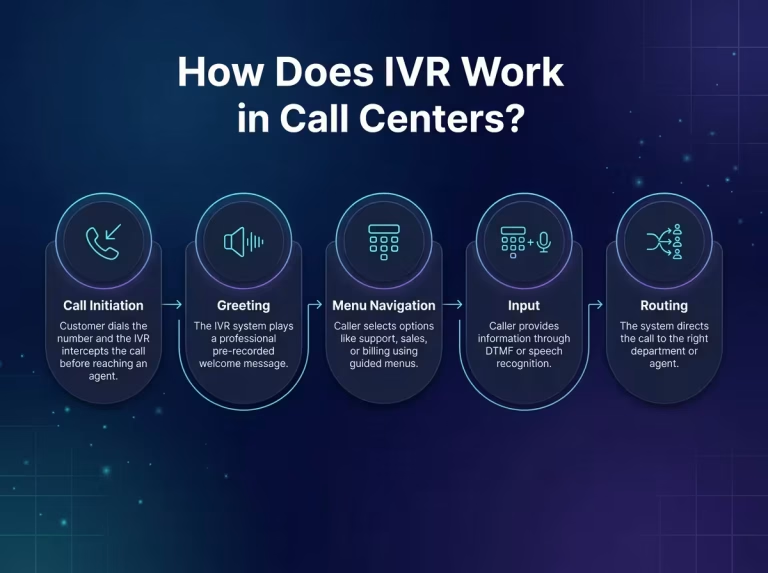
To master the call center technology stack management, businesses should know how IVR works in call center environments. The steps by step flow of IVR working includes:
- Call initiation: The process starts when a customer dials the number. The cloud IVR for call centers intercepts the call before it reaches an agent. This is like a handshake between the caller’s phone and the voice response system.
- Greeting: The IVR system plays a pre-recorded greeting. This sets the tone for the interaction. A professional interactive voice response call center greeting reinforces brand identity.
- Menu navigation: The call flow design will provide the caller with options like “Press 1 for support, 2 for sales, etc.” A well structured menu will avoid frustration of the customer and important for customer experience automation.
- Input: The caller provides information either through DTMF input or speech recognition IVR.
- Routing: After knowing the intent of the call, the call routing system will direct the call to the right team.
Types of call center IVR systems
Businesses who need to improve their call handling efficiency must understand different types of IVR for call centers. As the technology evolved into voice AI in customer support, the right system depends on a business’s call center technology stack and the needs of the customer.
- Touch-tone IVR (DTMF): This is the oldest call center IVR system. Touch tone uses DTMF. i.e., when a caller presses a number on the keypad, the system recognizes it as a specific tone to navigate the call flow design.
- Speech-based IVR: With speech recognition IVR, customers can speak their requests. Instead of pressing 1, they can just say support.
- AI-powered conversational IVR: This IVR represents the cutting edge of IVR in contact centers. With AI voice assistant technology and NLU, a conversational IVR can understand the caller intent and context.
- Cloud IVR vs. On-premise IVR: When companies choose the best IVR system for call center operations, the way in which the system is deployed is also an important architectural concern.
|
Feature
|
Cloud IVR for Call Centers
|
On-Premise IVR
|
|---|---|---|
|
Setup
|
Fast; part of a cloud IVR suite.
|
Slower; requires physical hardware.
|
|
Scalability
|
Instant scaling based on call volume.
|
Limited by physical server capacity.
|
|
Maintenance
|
Handled by the ivr solutions for call centers provider.
|
Handled by internal IT staff.
|
|
Customization
|
High (via APIs and integrations).
|
Total (but requires deep technical expertise).
|
Key features of IVR systems
- Intelligent call routing: With the help of ANI or customer ID, IVR for call centers routes the customer to the skilled available agent in the right team with the right context. It will fasten the resolution rates.
- CRM integration: Bonvoice IVR for call centers integrates core software with CRMs. This helps call centers to understand peak call times, common customer queries, agent performance, and customer satisfaction. This helps them to improve the service further.
- Speech recognition: Speech recognition is the technological bridge that transforms a traditional automated phone system into a more fluid, human-like interaction.
- Self-service options: Routine but time consuming tasks like tracking an ecommerce order can now be easily done at the customer end with the help of smart IVR for call centers.
- Multi-level IVR: Specifically designed IVR route calls from customers intelligently with the help of multi-level menus. The customers are properly sorted and routed to the right team instantly.
- Call analytics: To maintain the best IVR system for call center standards in 2026, companies must track more than just call volume. Key performance indicators (KPIs) include containment rate, drop-off points, average handling time, transfer rate, etc.
Benefits of IVR for call centers
- Reduced call volume: A robust IVR for call centers manages high traffic and reduces the number of inquiries that require a live agent. By utilizing contact center automation, businesses can filter out routine requests. So, agents can use their time for complex issue resolution.
- 24/7 availability: With traditional systems, customers need to wait for business hours to get even the basic services. However, with IVR for call centers, customers get the services even out of the working hours. Even if it is a holiday or midnight, customers can still access the essential services.
- Faster resolution: With smart routing, customers get the assistance from the needed expertise in no time. This results in faster resolution rates.
- Cost efficiency: With reduction in operational cost and staff cost, the IVR for call centers is a great option for growing teams.
- Improved CX: With proper integration of CRM, the IVR for call centers can welcome the customer with their name and easily identify their call context using the previous saved data. This ensures a customized experience to the caller.
Real use cases
- Banking and finance: High-security, repetitive tasks
- Healthcare: Patient care and administrative tasks
- Retail & e-commerce: Order tracking & post purchase support
- Telecommunications: Account recharges, technical troubleshooting, or plan upgrades
- Travel & hospitality: Booking confirmation, loyalty programs, & emergency updates
Best practices for IVR workflow
While businesses opt for IVR for call centers, they should consider the following practices:
- The menus should be kept short. If there are only 3 to 4 choices, it will prevent the choice paralysis and improve call handling efficiency.
- There should be a simple way to reach human help. This avoids frustration of customers that may occur within the automated phone system.
- USe CRM data to greet callers and personalise interactions.
- Callers must be assigned to the best-qualified agent instantly based on their profile via an intelligent call routing system.
- Even if the customers hang up, keep their place in line to enhance the benefits of IVR in call center experiences.
Conclusion
IVR in contact center has become an important milestone in contact center automation. It is a part of the omnichannel communication model. To master the call center technology stack management, businesses should know how IVR works in call center environments.
With Bonvoice IVR for call centers, businesses can know how to set up IVR for call center success, ensuring the IVR solutions for call centers actually reduce stress for both the agents and the customers.
Frequently Asked Questions
1.What is meant by IVR for call centers?
Interactive Voice Response or IVR for call centers is an automated telephony system which acts as a digital receptionist. It acts between a business and its customers through DTMF input or speech recognition IVR.
2. What are the benefits of IVR in contact centers?
IVR for contact centers reduces resolution time, average handling time, and improves CX with optimised cost.
3. How does IVR work in call centers?
IVR in call centers work through a series of steps including call initiating the call, greeting the customer, menu navigation, input through DTMF or voice recognition, and smart routing to the right team.
References:
- Wikipedia Article: “Interactive Voice Response.” Wikipedia: The Free Encyclopedia, Wikimedia Foundation, 7 May 2026
- Bonvoice Website: “IVR Service Provider.” Bonvoice, 2026,
Prompts used:
- IVR for call centers
- IVR call center
- Call center IVR system
- IVR in contact center