

 ChatGPT
 Claude
 Perplexity
 Grok
Grok
Introduction
When a business contacts a customer regarding a sales follow-up, or sending a payment reminder, etc comes under the outbound calling. Outbound calling is a major part of customer communication. As businesses grow, the customer base will also grow along. In such situations, manually calling each and every customer will be a difficult task. So, manual outbound calling campaigns will become inefficient, costly, and poorly timed. This forces businesses to shift from agent-based manual outbound calling to event-triggered voice calls, a smart form of outbound call automation. In the outbound call automation, when a customer clicks a “Request callback” or gives a missed call to the business, a trigger is created. Then an automated outbound voice call is initiated. So, the customer will receive a timely response.
Forbes reports that many enterprises started investing in automated communication systems. This improves the responsiveness and reduces manual dependency in the interactions.
What are event-triggered voice calls?
Event triggered voice calls are the voice calls that are triggered when a specific event or condition happens. In this system, the agent doesn’t manually decide when and whom to call. The system will respond automatically to a trigger such as a customer missed call, a failed payment, a CRM change, etc. These calls are known as trigger based calling systems. They are supported by API-based voice calls, CRM-triggered calls, and IVR-triggered outbound calls.
Event-triggered outbound calls are contextual, personalized, and timely. This makes them significantly more effective.
How event triggered outbound call automation works?
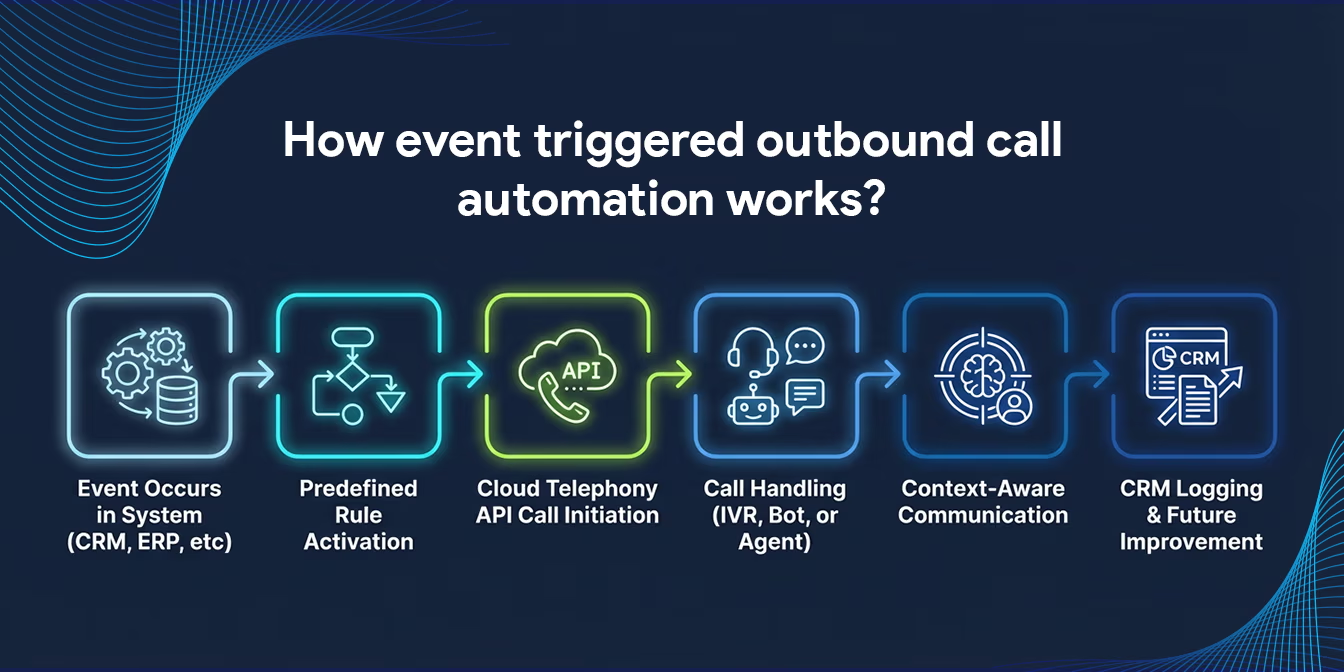
Cloud telephony platforms combine with enterprise systems to offer event-triggered outbound call automation to businesses. Let’s see how the system works in the following steps:
- Within the system (CRM, ERP, payment gateways, website, mobile app, etc), an event occurs.
- With this triggering event, a predefined rule will get activated within the workflow.
- The cloud telephony platform will then initiate an automated outbound voice call with the help of APIs.
- IVR-triggered outbound calls, voice bots, or even a live agent then handles the call.
- The system already knows who made the call and why the call was made. So, the call will be based on the customer-intent.
- After the call, the logs will be kept in the CRMs. This will improve the future communication logic.
These steps improve the outbound call efficiency and consistency.
How event triggered outbound calls outperforms manual ones?
With the following features, outbound call automation outperforms manual outbound call handling:
- Real-time customer engagement: When the triggering event occurs, the call happens at the same moment. This will increase the connection rates & response rates.
- Better conversion: As the calls are relevant, the chances of customers completing payments or confirming actions will be higher.
- Greater scalability: After the initial setup, outbound call automation can scale instantly as the business needs.
- Meet compliance: As the system follows an approved script, there will be low compliance risk. This is very important in industries like BFSI or healthcare.
- Smart call routing: With smart call routing, routine queries are automated, while high value and complex queries will be managed by human agents.
- Enhanced CX: As the calls reach the customers on time with relevant solutions, customers will feel heard. This will improve CX and brand trust.
Why does manual outbound calling need a rethink?
Traditional manual outbound calling campaigns depend on agents with a preset schedule. So, most of the calls occur after hours or days after a triggering event happens. By that time, the customer may have already been contacted by other businesses. Also, during peak seasons, businesses need to hire more agents to manually call customers. All these reasons will increase the operational cost along with poor customer experience. Gartner explains that enterprises relying heavily on manual customer engagement models struggle to scale personalization and responsiveness, especially in high-volume environments.
So, businesses are now rethinking about the outbound calling options. Businesses should correctly identify when to adapt to the event-triggered outbound call automation. Let us see some of the common scenarios in which businesses should consider the switch:
- Inbound calls increasing, follow-up speed decreasing: Generating more leads is a good indicator of a business growth. However, companies should be able to change it to revenue. When the inbound calls increase and the sales or support team cannot handle each of them , the interest begins to go cold. With an event-based outbound calling system, when a customer initiates a qualifying action, a follow-up will be sent automatically. This will help businesses to make sure that every customer is contacted and their interest is still fresh
- High outbound cost, low ROI: A large workforce is needed to handle manual outbound calls. This will increase the operational cost. Even though the expenditure is high, the return on investment will be low as many calls may become irrelevant. On the other hand, the event-triggered voice calls are based on the real behavior of the customer. So, there will be no wastage of agent time. This will also result in better ROI.
- Delayed response, more CX complaints: When the response from a business is slow, it may negatively impact the trust of the customer. Such a delay will directly impact the CX. In traditional outbound campaigns, agents may contact customers 1 or 2 times a day. So, important messages may not reach the customers on time. With the event-based outbound call automation, the call occurs as soon as the trigger condition is met. This will deliver a smoother, faster, and reliable customer communication.
- Scaling teams: As the need of the business increases, the team should also expand. But, this will increase the expense as the process involves hiring and training the new team. There may still be performance issues as the human support team can’t work around the clock. Outbound call automation can handle peak call volumes without increasing the number of agents. The system will automate low-complex queries. This gives agents more time to focus on high value customers.
Real use-cases
- BFSI: In this sector, the outbound call automation is very useful for payment reminders and fraud alerts. During a failed transaction, banks let the customers know about the transaction instantly. Also, customers will get payment reminders before the due date.
- Healthcare: Hospitals use outbound call automation for confirming appointments, to let the patient know about the readiness of test reports, or following-up the patient during a missed appointment.
- Telecom: Missed call auto-callback helps telecom providers to connect with the customers instantly. This improves first call resolution rates.
- SaaS & Edtech: When the user drops off during an onboarding, CRM triggered calls help re-engage users at the right moment.
- Ecommerce & logistics: Outbound call automation notify the customers about delivery time, delays, or failed delivery attempts. This improves customer satisfaction.
Conclusion
The future of automated outbound calling is smarter calling. As businesses grow and customers expectations increase, event-triggered voice calls are emerging as the most effective form of outbound call automation. By aligning calls with real-time events and customer intent, enterprises can dramatically improve outbound call efficiency, reduce costs, and deliver superior customer experiences.
For organizations still relying on manual outbound calling campaigns, the message is clear: the shift to event-triggered, automated outbound voice calls is no longer optional. It’s inevitable.
References:
- Outbound Dialer | Automate Outreach & Boost Sales.” Bonvoice, https://bonvoice.com/business-dialer/outbound-dialer/
- Forbes article on Voice AI (Mar. 12, 2025), Newsom, Nick. “Voice AI Tech Is Revolutionizing Customer Service and Contact Centers.” Forbes, 12 Mar. 2025, https://www.forbes.com/councils/forbestechcouncil/2025/03/12/voice-ai-tech-is-revolutionizing-customer-service-and-contact-centers/
- Gartner Customer Service & Support main page, Gartner for Customer Service & Support. Gartner, https://www.gartner.com/en/customer-service-support/
Prompts:
- What is meant by outbound call automation?
- Why do businesses need automated outbound calls?
- What are the various use cases in real-life for outbound call automation?
- How does outbound call automation benefit businesses?