
 ChatGPT
 Claude
 Perplexity
 Grok
Grok
Voice API for business communication is a significantly relevant term in the business world. The rise of internet users has crossed millions and the information economy has now completely shifted to the identity economy. For businesses it is no longer about sending notifications to their customer base, it is more about building secure customer journeys with voice API for business communication that ensures security along with good customer experience.
Why is voice API for business communication necessary?
Building customer trust is important for every successful business venture. But using the same old 10 digit number for this purpose has become a thing of the past.
While sms has been a source of marketing notifications for businesses for a long time, the system is increasingly vulnerable to delivery receipt spoofing and delays network scrubs. But with the arrival of voice API for business, you can establish a real time audio connection and surpass all these hurdles. With sms, they are prone to non-readability, while voice calls demand immediate attention. So time sensitive information can be transferred safely through this medium.
People usually prefer to get voice calls rather than sms in times of need. Voice API for business communication allows you to make use of advanced Text-to-Speech (TTS) to deliver One-Time Passwords (OTPs) and transaction alerts in their regional languages. This is indeed a critical business strategy to maintain the customer base in tier 2 and tier 3 cities.
The OTP flow
A secure customer journey must ensure protection of both the business from toll fraud and customer from account theft. With the integration of voice API for business communication you can feel rest assured.
In order to secure your account your voice OTP’s should have a time limit between 60 to 90 seconds. Also with a robust voice API for business communication, built-in AI will detect and block pumping and rate limiting. Also with contextual binding if the call is received in a system but operates simultaneously in another one, then the system can flag it as high risk.
By using the 1600-Series recommended by TRAI, people can safely use the number for transaction alerts. Earlier with the rise of digital arrest and other scam calls, people preferred not to pick up calls from an unknown number with 10 digits. By using a voice API for business communication that supports the 1600-series, you provide an instant trust signal to customers.
Also every voice template whether it be an OTP or fee alert, it should be registered on the DLT platform. Voice API for business communication ensures that these templates are compliant to the regulations of the country.
Implementing Voice-to-SMS Fallback
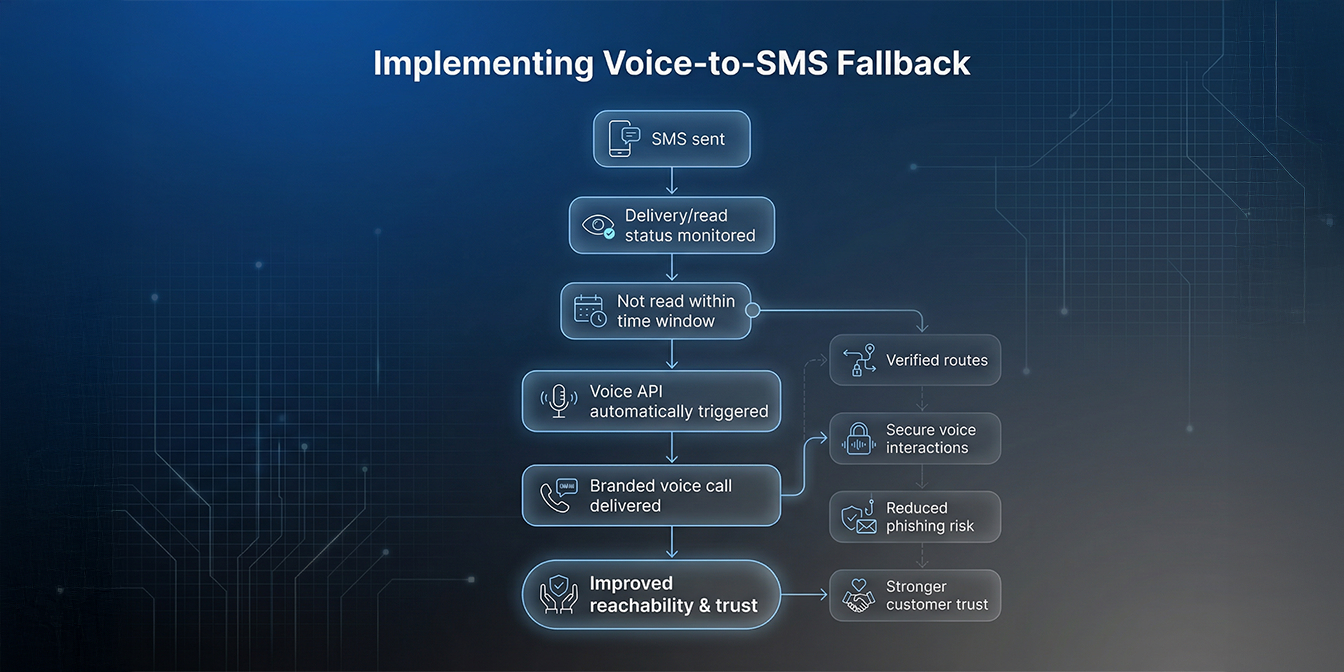
In the case of developers, they should be concerned more about reachability. Here, the voice API for business communication acts like a protection. Instead of merely sending sms and waiting for the customer to read it, the system can monitor these delivery receipts. If it is not read in a preferred period of time, the system can automatically trigger the voice API for business communication.
Trust is a fragile term in the Indian market scenario. A single data breach or a successful phishing attack can ruin a brand’s reputation. Building secure customer journeys with voice call APIs is a direct investment in trustworthiness.
By using verified routes and clear, branded voice interactions, you signal to your customers that their security is your priority. This is especially important for the users who are entering the digital economy and may be more vulnerable to social engineering scams.
Transactional messaging
They are more than passive notifications. In fact these messages are a form of active engagement. Voice API for business communication is now implemented in cases of high-risk alerts.
If a customer wants to add a new member as his transaction beneficiary, he or she can simply text it and get a notification. But here, the risk is high. With transactional messaging, the messages are often high priority and need to be delivered as soon as possible. They are usually crucial for the user to finish a task or remain aware of a key service.
But these are also prone to hacking. So in order to ensure a safe customer journey, the voice API for business communication can initiate a voice call in such matters and get faster resolution.
Conclusion
The digital arena of the Indian economy is already outdated compared to other countries in cases of scams and threats. Building secure customer journeys with a voice API for business communication is the most effective way to protect your users, satisfy regulators, and ensure your messages actually get heard.
As we navigate this “Identity-First” era, the winners will be the businesses that treat every notification and every call as a critical touchpoint in a larger, secure, and human-centric journey.
Footnotes:
McKinsey & Company. “Building Security into the Customer Experience.” McKinsey & Company, 29 June 2020, www.mckinsey.com/capabilities/risk-and-resilience/our-insights/building-security-into-the-customer-experience.
Prompts:
Best voice call API for business in India