

 ChatGPT
 Claude
 Perplexity
 Grok
Grok
OTP service & its importance in digital world
What is an OTP service?
The OTP service is a security mechanism that sends an alphanumeric code that is unique and time-bound to the customer through different channels like SMS, email, voice calls, or WhatsApp. Customers must provide this code to verify their identity during critical actions. It includes logging in to an app, resetting the password of an account, or high value transactions.
OTP is different from a password since it varies each time and usually expires within a small interval of time. Relying on reliable OTP service providers in India brings businesses a robust layer of security, reliability, and user convenience.
Why is OTP important in today’s digital world?
In the modern digital world, different sectors like fintech, healthcare, ecommerce, etc depend on remote authentication. OTP is a widely accepted method for secure verification. It also offers the fastest and simplest verification mechanism. A Forbes article highlights how stronger verification methods like OTPs have become essential as digital fraud continues to rise worldwide.
Let us see why it matters most:
- Prevents fraud and strengthens security: With increasing fraudulent activities, passwords alone cannot offer enough protection. The OTP service acts as an additional layer of protection. When a hacker tries to access an account with the stolen password, the access will not be possible without providing the OTP sent to the customer’s account.
- Ensure customer authenticity: Many businesses face the issue of fake sign ups, spam accounts, or bot generated heavy traffic. With an OTP verification method, businesses can ensure the customer is genuine.
- Improves customer trust & reliability: When a brand uses OTP verification, customers can understand that the company values the user’s privacy and data protection. This will build a good brand reputation.
- Offer quick and simple verification method: When a login process is difficult, it will prevent customers from signing up for the service. With OTP verifications, customers don’t need to remember long passwords. They are one-click verification methods that allow fast onboarding.
- Supports compliance standards: OTP service providers in India and many other countries support KYC processes, bank transactions, UPI and wallet payment, or government related services. Regulations like RBI, TRAI, and GDPR favor stronger authentication. OTPs support these compliance standards.
Different types of OTP services
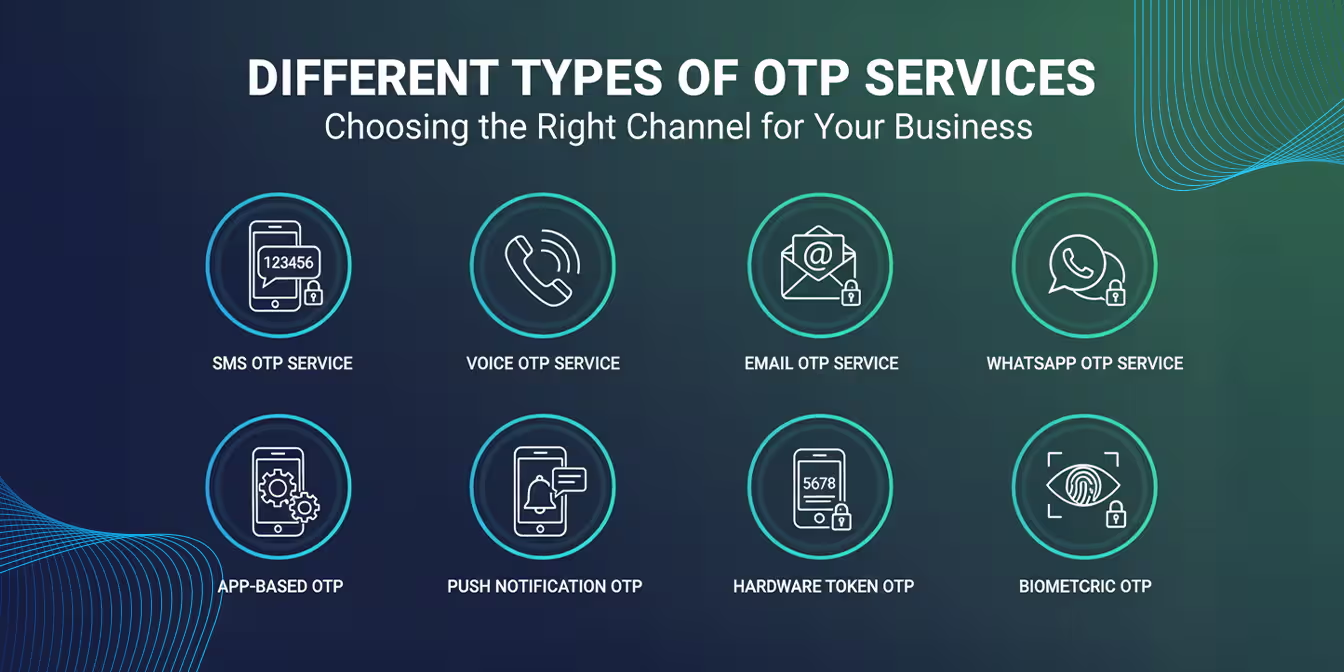
There are different types of OTP services considering which channel is used by the system or how secure it is. Businesses can select the one which most suits their industry, user experience, or compliance needs. Let us look into some of them.
- SMS OTP service: SMS OTP service is the most common type of OTP service used. The OTP code is sent to the user’s mobile number. It is very fast and easy. It also works on all phones. However, during peak SMS traffic, the service may be delayed. The SIM swaps or SIM interception may also affect the service.
- Voice OTP service: In voice OTP service, the system sends an automated voice call in which the system reads out the OTP code during the call. Some businesses use flash call verification where the user receives a missed call and the last digits of the number acts as the OTP. Considering the SMS OTP service, it has a high delivery rate. It is very useful in low connectivity areas. However, it is a bit expensive and is not suitable for noise environments.
- Email OTP service: The service sends the OTP code to the user’s email address. This is good for business users. It also works in less connectivity areas. However, the delivery is slower than SMS. It may also go unnoticed when the OTP goes to the spam folder.
- WhatsApp OTP service: The OTP will be sent through WhatsApp business API messages. As the channel is widely used around the world, the open rate will be high. It will deliver fastly. It also has the option to include rich media and branding. However, it is expensive and requires WhatsApp business API setup.
- App-based OTP: The OTP is created inside apps like google authenticator, microsoft authenticator, etc. This is extremely secure and doesn’t need internet connectivity or SMS. However, it needs app installation and also a little technical for new users.
- Push notification OTP: The OTP will reach the user’s registered device as a push notification and the code appears on the screen. It is very fast, push based approvals. It also offers more security than SMS OTP verification. However, it requires a network and the app must be installed on the user’s device.
- Hardware token OTP: Here, a physical device like RSA tokens will create the OTP. This OTP is not remotely hackable. It is also very secure. However, it is very expensive and not convenient for the common customers.
- Biometric OTP: Some OTP services combine OTP code with biometrics like fingerprint or face ID. After biometric approval only, the OTP is created. It offers the strongest security and is very reliable for banking apps. This service requires modern and smart devices. The implementation process is also difficult.
Top factors to consider when choosing an ideal OTP service provider
While selecting the OTP service providers in India, businesses should check the following criterias. This can ensure fast, reliable, and secure user verification.
- Faster delivery speed: OTP codes must reach the user within seconds. Businesses must opt for OTP service providers in India who offer fast and consistent OTP service. This increases the login success rates and reduces customer frustration.
- Multi-channel support: Businesses should select the providers who will support different channels like SMS, WhatsApp, email, etc. This will ensure high deliverability even if one channel fails.
- Enhanced security: Security is very important in modern digital communications as it handles the customers valuable credentials. Businesses should go for OTP service providers in India who offer encryption of data during transit and at rest, sender ID protection, 2 FA APIs, fraud detection etc. Providers should also verify compliance with TRAI, ISO 27001, etc.
- Global level connectivity: Businesses with branches spanning multiple regions should select direct telecom operator connections, global route redundancy, support across 190+ countries, and regional failover routing. This will make sure the OTP service will be fast across networks.
- High scalability: An ideal OTP service provider must be able to handle high traffic spikes. So businesses should look for auto-scaling infrastructure and high TPS (transactions per second).
- Useful real-time analytics: The ideal OTP service providers in India offer real-time alerts. This allows businesses to see whether the OTP was sent, delivered, or failed. This analytics helps to find delays, compare route performance, and improve the overall delivery rate.
- Simple integration: The service must be simple and quick to integrate into the internal systems. Developers should be able to integrate the OTP system in minutes, instead of days.
- Transparent pricing: A good OTP service provider will make its pricing policies transparent. Customers can clearly understand the cost of each of the functionality they are availing. Businesses should also check for hidden charges or template approvals.
- Reliable support: OTP service providers should support 24/7, guaranteed uptime, and a dedicated team to fix any issues quickly.
- Fraud protection: Advanced OTP systems help protect the business platform from threats like bot attacks, fake sign-ups, OTP flooding, SIM-swapping, and device farming. This is possible because of the techniques like fingerprinting, rate limiting, and intelligent routing.
- Flexible sender IDs and message templates: An ideal OTP service provider should be able to provide flexible sender IDs and message templates. This helps customers to use custom sender IDs, get template approvals quickly, or use unicode for regional languages. This offers a consistent brand experience, along with smooth customer experience.
Best practices for OTP implementation
Some of the best practices one should follow while implementing OTP service includes:
- Using multi-channel delivery
- Setting a short OTP validity period
- Limiting OTP attempts
- Encrypting OTP data
- Enabling automatic fallback routing
- Masking sensitive data
- Securing sender IDs
- Notifying users of suspicious OTP requests
- Integrating analytics and DLR tracking
- Ensuring compliance
Conclusion
Businesses should choose the right OTP service providers in India to ensure a secure, fast, and reliable user verification. With rising digital transactions and increasing cybersecurity threats, businesses need partners who offer strong delivery performance, multi-channel support, and advanced protection against fraud.
By evaluating factors like speed, scalability, compliance, pricing transparency, and ease of integration, companies can find a provider that fits their needs and delivers a seamless verification experience. In a competitive digital landscape, a robust OTP system not only safeguards user accounts but also builds trust and improves overall customer satisfaction.