
 ChatGPT
 Claude
 Perplexity
 Grok
Grok
Introduction
In 2025, the communication between customer and business is no longer solely based on plain text messages. It now shifts to rich media and conversational messages. With increasing customer and smartphone penetration, businesses can now reach customers through different business messaging channels. It includes SMS (Short message service), WhatsApp business, and RCS (Rich communication services). Brands should decide which is the correct channel for their business. Companies should choose between RCS vs WhatsApp vs SMS for business, considering their requirements.
In this article, we’ll see a brief description on each of these communication services and how a smart brand can mix them to optimize the impact.
What is SMS messaging?
SMS messaging is one of the oldest ways of sending text messages to mobile phones. It serves as the backbone of communication for many decades. Many brands still evaluate RCS vs WhatsApp vs SMS for business as SMS is the most reliable option.
SMS pros and cons
Let us see some of the advantages of this traditional communication service:
- Global reach: SMS service works in both feature phones as well as smart phones.
- No internet needed: As SMS service delivers messages over carrier networks, receivers without data or wifi can get their messages.
- Reliability: Many transactional SMS service providers go for this service because of its simple message delivery mechanism.
- Cost-effective: It is a most affordable and scalable option for many bulk SMS service providers.
Along with the advantages, there are also some shortcomings for SMS. It includes:
- No rich media: SMS service only allows plain text. It is not suitable for sending HD videos, images, or carousels.
- Limited interaction: As SMS only allows plain text, customers can’t interact beyond simple replies.
- Poor tracking: The message analytics usually only includes whether the message is delivered successfully. It doesn’t offer any insights into customer engagement or conversions.
- No branding: As SMS comes from generic phone numbers, there is no scope for brand identity or logos. So, SMS marketing will deliver low engagement.
However, SMS is best for transactional notifications or confirmations. It reaches customers even with a basic feature phone or no internet connectivity.
What is WhatsApp business messaging?
WhatsApp business brings rich media, chat-style communication. It also offers catalogs, automation and powerful tools for customer engagement. For many brands that compare RCS vs WhatsApp vs SMS for business, WhatsApp serves best for engagement and conversational depth.
WhatsApp pros and cons
Some of the advantages of WhatsApp message service includes:
- Rich media: Through WhatsApp notifications, companies can send their customers images, videos, documents, buttons, catalogs, etc. This offers an app-like interaction.
- Personalized engagement: Customers can respond to the messages directly. Chat bots or agents can handle the chats.
- More secure: In WhatsApp business message service, the messages are end-to-end encrypted. This is more suitable for chats involving sensitive data.
- User familiarity: As the service is used across the globe, most of the customers are familiar with it. Selecting this service leads to higher open rates & engagement.
- Automation: WhatsApp business API can integrate with CRMs and other support systems.
Some of the limitations of WhatsApp business service includes:
- Internet connectivity: The service needs WhatsApp installed and an active network. Else, the customer won’t receive the messages.
- Cost: There will be varying cost considering the conversation or message volume the businesses handle. It may also get expensive considering scale and geography.
- Platform dependency: As the business is depending on a third party app, any changes to the WhatsApp policy may also affect the business’s reach.
- Verification limitations: A verification (green tick) is needed to maximize the trust of the customer. Without it, there may be limitations for the business accounts.
WhatsApp business service offers personalized customer support and interaction. It allows businesses to send marketing campaigns with media rich content. Also, helps in lead nurturing and customer engagement.
What is RCS messaging?
RCS messaging is the evolution of SMS/MMS which brings modern messaging features directly into the phone’s default messaging apps. The service is usually described as SMS 2.0. Without any specific app, RCS for business allows businesses to send rich media messaging to customers. They can also deliver messages from verified brand profiles. Companies analysing RCS vs WhatsApp vs SMS for business, chooses RCS for its rich media support.
According to Forbes, a major RCS messaging platform announced that it delivered over 10 billion RCS messages in 2024, which is five times more than in 2023. This makes it one among the effective business messaging channels.
RCS pros and cons
Some of the strengths of RCS includes:
- Rich media: Messages including HD images, video, carousels, etc can be delivered with the help of phone’s native messaging system.
- No extra installations: Customers don’t need to set up any third party application. However, their phone and carrier should support RCS.
- Better branding: Businesses can send messages with their name, logo, and brand colors. This increases trust and reduces spam.
- Enhanced analytics: With RCS business messaging (RBM), companies can track delivery status, read recipients, button clicks, etc. This helps in tracking engagement of the customer.
- Integration potential: RCS can integrate with CRM systems or other internal workflows; This helps to provide tailored experience to the customers.
RCS is most suitable for marketing campaigns with interactive content, promotions, or product launches.
Some of the limitations of RCS includes:
- Limited carrier/device: Some carriers offer only partial RCS services. RCS is best for androids while iphones still don’t fully support RCS.
- No end-to-end encryption: RCS doesn’t offer end to end encryption.
- Multiple stakeholders: There are several stakeholders including carriers, google, messaging platform providers for RCS.
- Pricing unfamiliarity: RCS pricing depends on carrier, message type or volume. This is difficult compared to the conversation-based pricing of WhatsApp.
RCS vs WhatsApp vs SMS: Messaging channel comparison
The below business messaging feature comparison table will give a clear picture on RCS vs WhatsApp vs SMS for businesses.
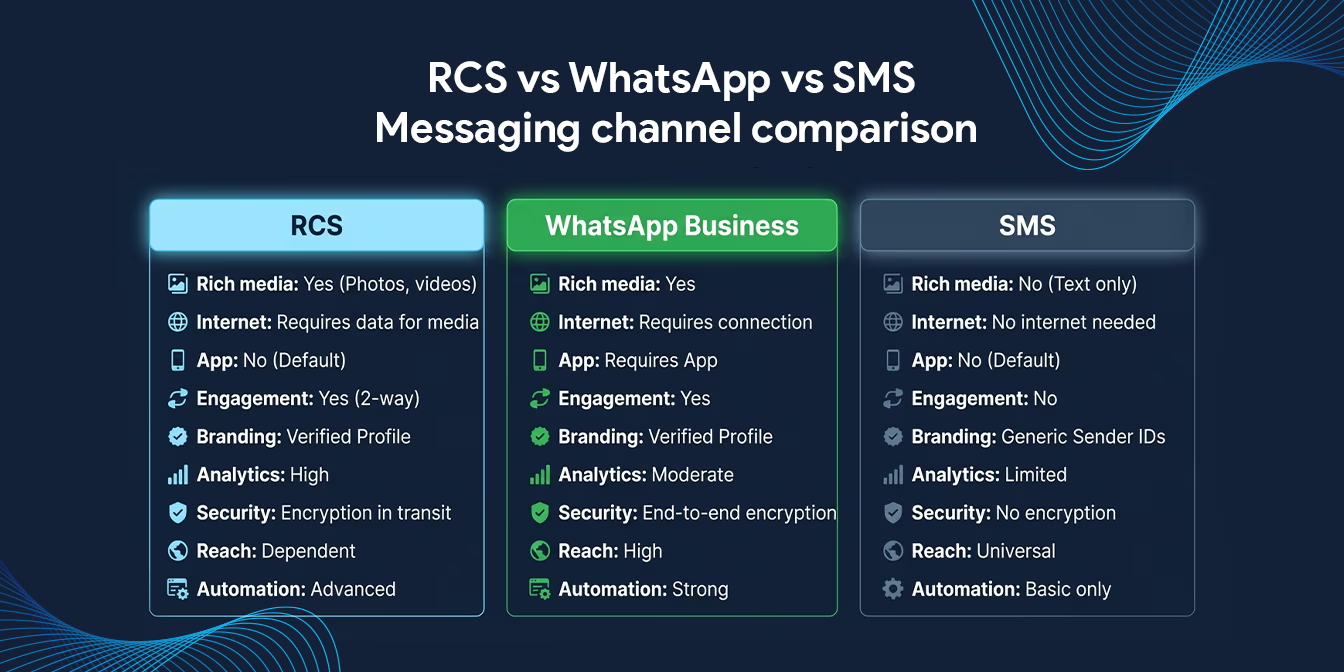
In summary, we can conclude RCS & WhatsApp are best for engagement and branding. SMS, on the other hand, is the most dependable fallback option for mass reach and important alerts. Many businesses select a mix of all the services. This helps them to make sure no message is undelivered.
Which messaging channel is best for different use cases?
Companies should select between RCS vs WhatsApp vs SMS use cases by analyzing their goals, customers, or other limitations. Let’s see which service is suitable as best messaging channel for business of different kinds:
Businesses can select SMS when:
- They need maximum reach. This covers customers with feature phones and smart phones.
- Sending bulk images at low cost.
- Sending transactional or time sensitive messages like OTPs & critical alerts.
Businesses can select WhatsApp business messaging when:
- They need to offer personalized and conversational customer engagement.
- Plan to use chat based workflows.
- Handling sensitive or personal data of the customer.
- The audience is more likely to be active on WhatsApp.
- Providing customer support and conversations as it offers real-time two-way conversations.
Businesses can select RCS service when:
- Messages is for marketing and promotional purposes as it supports rich media, carousels, images, videos, and CTA buttons.
- Sending rich media content without forcing customers to set up a third party app.
- Businesses need better analytics and engagement reports.
- The audience is mainly android (supporting RCS) users.
- They want a middle path between plain SMS and “app-heavy” messaging.
Cost & engagement comparison
When considering cost, we can say SMS is the cheapest option for basic messages and alerts. Thus, making it a good option when comparing SMS vs WhatsApp cost for simple use cases. WhatsApp business will have predictable conversation-based pricing. This helps brands to calculate WhatsApp ROI correctly. If the volumes are higher and several templates are used, the cost will be high. RCS pricing is generally higher as it has higher cost for setup and per message because of rich media and carrier charges. However, many brands consider RCS worthwhile due to its higher messaging ROI in engagement-driven
In terms of engagement, RCS will offer more engagement when compared with SMS or WhatsApp business messaging. This is because customers will get the interactive and visually compelling content directly in their native messaging app on the phone. WhatsApp business also supports media and chat offering more solid engagement. This is useful for brands that have an established audience. On the other hand, the engagement rate that SMS can provide will remain lower when we compare it with other communication channels.
Which messaging channel should businesses choose in 2026?
In 2026, the best method for businesses is to use a mix of SMS, WhatsApp business, and RCS. When comparing RCS vs WhatsApp vs SMS for business, companies must know that by relying on just one channel, they cannot meet the growing need of the customer.
- Businesses can use SMS for essential OTPs.
- Businesses can use WhatsApp business for customer support and personalized chats.
- Businesses can use RCS for rich, interactive marketing messages.
If RCS isn’t supported at the customer end, businesses can fall back to SMS or WhatApp. TO get best results, brands should combine SMS’s reach, WhatsApp’s engagement, and RCS’s rich media experience.
Conclusion
In 2026, the landscape of business-customer messaging will change from that of 2025. It may become more diverse and richer. For brands evaluating RCS vs WhatsApp vs SMS for business, the smartest strategy isn’t depending on one channel. It’s embracing a hybrid design. That is by using SMS for core reach; WhatsApp Business for conversational support and personal engagement; and RCS for rich media campaigns, interactive messages, promos, and customer touch-points.
References:
- Doffman, Zak. “Google Reveals New RCS Update for Android — iMessage Users Need This Now.” Forbes, 30 Nov. 2024.
- Buddy Infotech. “RCS vs WhatsApp Business vs SMS: Which One Is Right for Your Brand in 2026?” Buddy Infotech, 10 Nov. 2025.
Prompts:
RCS vs WhatsApp vs SMS: which messaging channel is best for business in 2026?
What is the difference between RCS, WhatsApp Business, and SMS for customer communication?
Is RCS better than WhatsApp Business for marketing and promotions?
Which messaging channel offers the best reach, cost, and engagement for businesses?
When should businesses use SMS vs WhatsApp vs RCS for customer messaging?
FAQs
What is the main difference between SMS, WhatsApp, and RCS messaging?
The main difference is the engagement each channel offers. RCS and WhatsApp offer rich media support and 2-way conversations. SMS only allows texts, but without internet need.
Which one is better for business in 2026?
RCS is suitable for businesses that want an app-less, interactive messaging.WhatsApp offer secure and conversational messaging. SMS is good for time sensitive messages like OTPs
Which messaging channel offers the highest reach?
SMS offers highest reach as it works on all mobiles with all carriers, that too without internet dependency.
Is RCS secure for businesses?
RCS offers encryption in transit and verified sender identities. However, it doesn’t support end-to-end encryption. So, it is best for non-sensitive communications.
Which channel is most cost-effective?
SMS is most cost effective. WhatsApp will have predictable conversation-based pricing. RCS will be more expensive as it supports rich media.