
 ChatGPT
 Claude
 Perplexity
 Grok
Grok
CPaaS (communication platform as a service) or cloud-based is a mode of communication where your video, WhatsApp, SMS, and voice are directly integrated to your existing applications using programmable APIs.
It helps you order your building blocks of communication like voice, video and others in your software without the requirement of a backend telecom infrastructure. It is actually the most important digital factor that supports everything from UPI transactions to providing you with delivery updates online. It is a customizable, scalable and omnichannel way of communication.
Table of Contents
What is CPaaS?
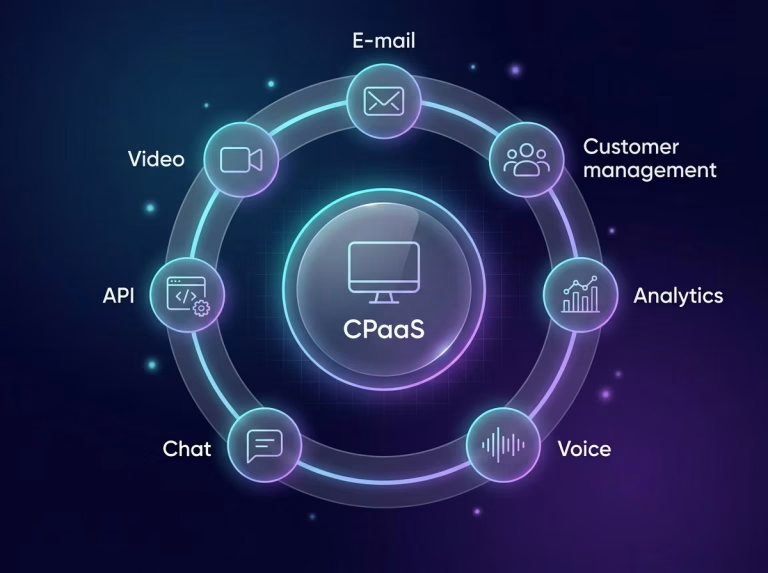
The term CPaaS stands for communication platform as a service. It acts as a bridge between traditional telecom structure and internet-based cloud system. It belongs to the cloud family of SaaS, UCaaS etc… where the focus is on the cloud infrastructure as a service. In simple terms, CPaaS is like a Lego set. Instead of buying the whole pre-built telecom infrastructure here you get pieces like building blocks of voice, video and the others which you can choose from that benefits your business and plug them into your mobile app or website.
In technical terms for developers, Communication service as a platform is a set of programmable APIs and SDKs that helps to abstract the complexity of PSTN. It enables the programmatic execution of real-time communication with restful APIs, handling everything from SIP trunking to webhook integrations for event-driven workflows.
How CPaaS Works
In order to understand Communication Platform as a Service, you must learn the four-layer stack that connects your app to a user’s handset.
- API Layer – this acts as an interface. Developers use standard languages like python, node.js, java for calling APIs, SMS or MMS which helps to send promotional messages, Voice for initiating calls, playing recorded audio, or converting Text-to-Speech (TTS) and WhatsApp/RCS for sending rich media messages and interactive buttons.
- Backend telecom infrastructure: the Communication Platform as a Service provider will have connections with several telecom operator networks like jio, vodafone etc.. They can handle the SIP trunking and signal switching required to route data from the internet to mobile networks.
- Workflow automation and webhooks: when a customer interacts like replying to an SMS, the platform uses webhooks to push that data back to your server in real-time. This allows for the automated logic to update the database when a delivery is confirmed.
- Security and authentication layer: this is the layer that handles number masking, encryption and OTP verification flows. This layer adds a protection according to the latest mandates of RBI.
|
Layer
|
Function
|
Example Use Case
|
|---|---|---|
|
API Layer
|
Requests a specific action
|
Sending a "Your order is out" SMS
|
|
Backend
|
Routes message to the carrier
|
Selecting the fastest route via Airtel/Jio
|
|
Workflow
|
Handles the response
|
Receiving a "1" to confirm delivery via Webhook
|
|
Security
|
Protects the data
|
Masking the customer's phone number from the driver
|
CPaaS vs UCaaS vs CCaaS – Complete Comparison
CPaaS (communication platform as a service) is used to build custom tools via APIs, while UCaaS (unified communication as a service) is a pre-built tool for internal team chat/calls and CCaaS (contact center as a service) is a ready-made platform specifically for customer support teams.
|
Feature
|
CPaaS
|
UCaaS
|
CCaaS
|
|---|---|---|---|
|
Customization
|
Extremely High
|
Low (Plug-and-play)
|
Medium (Configurable)
|
|
Target User
|
Developers / Product Managers
|
All Employees / Teams
|
Support & Sales Agents
|
|
API Access
|
Core Offering
|
Limited / Secondary
|
Extensive for CRMs
|
|
Deployment
|
Embedded in your app
|
Standalone Desktop/Mobile App
|
Browser-based platform
|
|
Pricing
|
Usage-based (Pay-per-msg)
|
Per-user subscription
|
Per-agent subscription
|
Key Features of a Modern CPaaS Platform
|
Feature
|
Business Impact
|
|---|---|
|
SMS API
|
High-reliability delivery for OTPs and transaction alerts.
|
|
Voice API
|
Automated IVR and "Click-to-Call" buttons in your app.
|
|
WhatsApp Business API
|
High-engagement conversational commerce and support.
|
|
AI Bots & GenAI
|
24/7 automated handling of routine queries.
|
|
Omnichannel Orchestration
|
If SMS fails, automatically retry via WhatsApp.
|
|
Analytics Dashboard
|
Real-time visibility into delivery rates and latency.
|
CPaaS Use Cases Across Indian Industries
- Banking and fintech: with the latest digital payment rules of RBI, banks are strictly using dynamic 2 factor authentication. Communication Platform as a Service enables the delivery of cryptographic tokens and biometrically triggered app-prompts alongside traditional OTP SMS in order to prevent 99.9% of fraud.
- E-commerce: Communication Platform as a Service is used in India for mainly local updates. A customer gets a WhatsApp message when a driver is 2km away, and can use click-to-call to dial his number using number masking which helps to protect privacy of both parties.
- Healthcare: automated appointment reminders can significantly reduce no-shows in hospitals.
- Education: using high throughput APIs, the exam result notifications and online class links can be sent to millions of students at the same time.
Who can benefit from CPaaS?
Communication Platform as a Service is used by businesses across various sectors in order to streamline their communication flow internally and externally with customers.
- Security and fraud prevention: CPaaS is crucial for industries like finance and banking, where data security is of prime importance. It helps to prevent fraud attempts by implementing 2 factor authentication and instant alerts which will provide you with data security.
- Marketing: from marketing campaigns to loyalty programs, Communication Platform as a Service can ensure your business to provide instant alerts and promotional messages for your business, thereby enhancing customer retention and experience.
- Remote work: CPaaS tools can ensure that your business provides your remote employees with instant messaging and video solutions to facilitate their smooth workflow.
- Automated customer interactions: by using AI-driven chatbots, Communication Platform as a Service can ensure that your business provides smooth assistance to your customer support team.
- Appointment bookings: with CPaaS tools, your business can easily assist your clients with hospital booking assistance, schedule reminders etc.. thereby improving your operational efficiency.
CPaaS Pricing in India (2026 Breakdown)
The pricing in India is highly competitive and at the same time it is subject to TRAI and operator fluctuations:
|
Service
|
Average Cost in India (2026)
|
|---|---|
|
Transactional SMS
|
₹0.18 – ₹0.25
|
|
OTP SMS (High Priority)
|
₹0.22 – ₹0.30
|
|
WhatsApp Marketing
|
₹0.88 – ₹1.09 per conversation
|
|
WhatsApp Utility/OTP
|
₹0.13 – ₹0.15 per conversation
|
|
Voice API (Outbound)
|
₹0.35 – ₹0.90 per minute
|
It is always better to look for usage-based models without heavy platform fees. Also, many Indian startups prefer a cost calculator approach where you only have to pay for delivered messages rather than calculating for all messages that are sent, whenever possible.
Regulatory & Compliance Requirements in India
India has some of the strongest stringent regulations by telecom authority. Even though they are strict it helps to ensure your data security. By following these measures you will ensure complete business security in the digital world. Also if you fail to comply with these rules your header can be blacklisted.
- TRAI DLT registration: all businesses must register on a distributed ledger technology which is a blockchain portal like jio, airtel which send SMS.
- PE ID & Header Approval: You must get your Principal Entity (PE) ID and 6-character alphabetic headers (e.g., BnkIND) pre-approved beforehand.
- Content templates: every message format must be registered and if it does not match the template, it is blocked at the gateway itself.
- RBI Guidelines: financial OTPs must follow the dynamic 2 factor authentication rules according to the 2026 update.
Top CPaaS Providers in India (2026 Comparison)
|
Provider
|
Best For
|
Key Strength
|
|---|---|---|
|
Bonvoice
|
Large Enterprise / Small Enterprise, Startups & Mid-Market
|
Leading cloud telephony and 100% compliance.
|
|
Exotel
|
Startups & Mid-Market
|
Excellent cloud telephony and easy-to-use APIs.
|
|
Route Mobile
|
Global Reach
|
Ideal for companies expanding to international markets.
|
|
Gupshup
|
Conversational AI
|
Leading the market in conversational apps.
|
|
Twilio
|
Developers
|
World-class documentation and flexible developer tools.
|
How to Choose the Best CPaaS Provider
To select the best Communication Platform as a service provider you can use these 5 point checklist:
- API reliability and uptime: does the provider operate at 99.9% uptime guarantee.
- DLT assistance: will the provider ensure assistance with complete TRAI guidelines.
- Latency: in case of OTPs, a 2 second delay can fail a transaction. So you need to ensure their stipulated time to deliver.
- Transparent pricing: is there any hidden charges levied by the provider other than the cost they mention.
- Direct Carrier Connectivity: does the provider have connections with top telecom operators.
Step-by-Step Guide to Integrate CPaaS
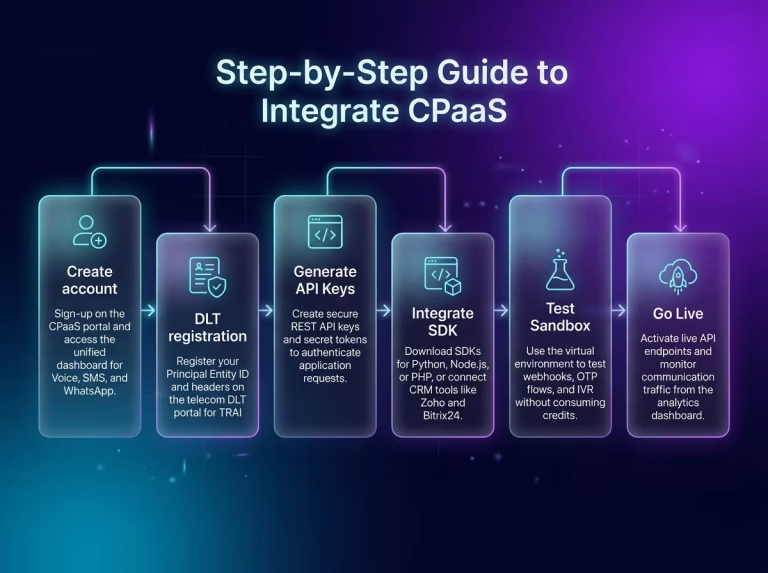
Integrating a modern platform like Bonvoice, is designed to be easy and frictionless. Your business can ensure to follow these six steps to transition from setup to your first automated communication.
- Create account: sign-up on the Communication Platform as a Service portal. With Bonvoice, you get immediate access to a unified dashboard for Voice, SMS, and WhatsApp.
- DLT registration: in order to comply with TRAI regulations, your business needs to register your Principal Entity (PE) ID and Headers on the DLT portal (Jio, Airtel, or Vodafone Idea).
- Generate API Keys: generate unique REST API keys and Secret Tokens. These securely authenticate your application’s requests.
- Integrate SDK: download the SDK for your preferred language (Python, Node.js, PHP) or use Bonvoice’s zero-code CRM connectors for platforms like Zoho and Bitrix24.
- Test Sandbox: with the virtual environment generate webhooks, OTP, IVR flows without consuming live credits.
- Go Live: check the live API endpoints and monitor real-time traffic via your analytics dashboard.
How AI in CPaaS Platform is Redefining Customer Experience (CX)
Communication Platform as a Service is a familiar term among businesses now-a-days as customer expectations are rising day by day. Everyone wants not just the service but they expect personalization too, as they need to feel valued. Almost 60% of customers switch companies after multiple bad service experiences. The days were one strategy that works for all are over. In order to solve this problem and provide good customer experience, businesses now-a-days has adopted a solution, that is AI in the CPaaS platform.
By embedding artificial intelligence into communication APIs, the CPaaS platform thus shifts from a simple delivery tool to a sophisticated engine for providing hyper-personalized customer experience.

Benefits of AI in CPaaS platform
- Hyper-personalization – delivers highly personalised deliverables that feels like customized for the specific customer.
- 24/7 intelligent service – AI powered contact centers use self service that helps to cover almost 80% of routine tasks thereby reducing manual labor.
- Seamless omnichannel communication – even if the customer switches from one channel of communication to another mode of communication, the flow should be maintained.
- Agent confidence – with the help of AI, the agents get support and advice to handle the calls effectively and avoid confusion thereby improving first call resolution rates.
- Proactive engagement – with the help of tools, the agent gets access to possible questions that may arise from a customer, like if the system is in need of maintenance or any lags.
Even though the benefits of AI in the CPaaS platform are vast, these are the main features to look out for.
How AI transforms CPaaS capabilities
A typical CPaaS platform provides basic features like APIs, SDKs and readymade applications. These features are integrated with channels like sms,email,chats and other existing platforms of the specific company. With AI inclusion along with these features, the AI impart intelligence into these data which in turn converts this raw data into actionable insights.
Natural Language Processing (NLP)
These are the basic capabilities that give the CPaaS platform the ability to listen and understand human communication. Rather than understanding what the customer is saying through NLP, the inclusion of AI helps to understand the true goals beforehand. If the customer is calling to say something like his or her password does not seem to work and they get locked out, the AI searches the intent and recognizes it beforehand. So the solution can be provided without confusion that the customer is in need of a password reset.
The other feature is sentiment analysis. With the help of this feature, the omnichannel CPaaS platform analyzes if the customer is frustrated, confused or the like. This helps the system to intelligently route the call to the right agent who can smoothly handle the call without further escalation.
Generative AI
This tool, like any large language model, helps to hyper-personalize customer experience within the CPaaS platform.
Generative AI helps in content creation. Rather than producing a raw written content to push towards the customer, with this tool the AI analyzes the past conversations with the customer and curates a highly personalized text or SMS that strikes the customer at the right place and moment, all delivered through a CPaaS API. This helps to enhance the customer experience.
Also the generative AI helps the agent to perform well. With the information on past interactions, the AI gives advice for the next best move to the agent thereby improving their average call handling time. This boosts the agent’s confidence and employee performance.
Predictive analytics and Automation
This capability helps to create a more proactive solution to the problem than just reacting to the problems. By analyzing the customer behavior, purchase history and interactions, the system predicts possible issues that may arise at time even before the customer notices it. The CPaaS platform automatically triggers a notification to the customer. This active input from the side of business is really helpful to improve customer experience and increase brand loyalty.
With the automated workflow orchestration, AI recognizes the customers intent and assigns and directs the caller to the right agent with the specific skill needed. This minimizes confusion and maximizes efficiency and problem resolution rates.
How AI in CPaaS redefines customer journey
The result of AI in CPaaS platforms can be really measured in customer satisfaction.
1.Seamless omnichannel orchestration
It maintains context across channels. The main benefit of implementing AI in the CPaaS platform is that even if the customer starts the communication via WhatsApp and switches to another channel or mode of communication, AI analyzes all the information and provides flow of communication. This ensures that the customer does not have to repeat himself to a number of people and improve customer satisfaction through ease of use.
Also the platform can intelligently shift the channel based on urgency of the matter. It ensures that no call is missed and no problem is left unheard. In cases of fraud alerts a pop up notification is triggered and alerts are sent with timely intervention.
2. Intelligent self-service
With the help of generative AI models, CPaaS products allow bots to handle multi-step queries and analyze information of customer history to improve first call resolution rates.
3. Contact center efficiency
Every interaction is analyzed methodically and ensures the quality of data. This helps the agent to trust the data without overworking themselves. Also, after every call the AI provides a summary of the call time and information shared in the call. This helps to reduce after call work time of the agent.
4. Hyper- personalized marketing
AI in CPaaS moves beyond mass campaigns to hyper-personalized messages that improves customer experience for the business. Instead of sending a regular text notification about offers and alerts, RCS can be used to send rich media which will be more appealing to the customer that gives them satisfaction. Also with predictive models, automated targeted campaigns can be done focusing on specific customer groups or areas to increase profit turnover.
How to choose the right AI CPaaS solution
For any business who puts customer first ideology, choosing the right AI CPaaS solution is important.
- API flexibility and integration – you need to look for platforms that can easily integrate with your existing applications. You cannot afford to lose the customer data for hyper-personalization.
- Language support and scalability – you need to ensure that the platform offers multi-lingual NLP support and global scalability for your business.
- Low code development tools – even if you are not a tech-based company, the platform should ensure your business a visual builder that helps to deploy complex AI workflows.
Conclusion
Every business needs to be equipped with easy access to the right service provider. Because delivering personalized experiences is the new route to success. Every business needs to scale further in their growth process and using CPaaS has become inevitable. To know more, visit our page.
Footnotes:
Unden-Farboud, Lisa, et al. Magic Quadrant for Communications Platform as a Service.”https://www.gartner.com/reviews/market/communications-platform-as-a-service“Gartner, 24 June 2024.
“AI, CX and Security: CPaaS Predictions for 2024.” “https://www.uctoday.com/unified-communications/cpaas/ai-cx-and-security-cpaas-predictions-for-2024/“UC Today, 12 Jan. 2024.
Prompts used:
What is CPaaS : definition and use cases
The use of AI in CPaaS platforms
Frequently Asked Questions
1.What is CPaaS used for?
CPaaS or cloud-based is a mode of communication where your video, WhatsApp, SMS, and voice are directly integrated to your existing applications using programmable APIs. It helps you order your building blocks of communication like voice, video and others in your software without the requirement of a backend telecom infrastructure.
2. How much does CPaaS cost in India?
In 2026, CPaaS costs are usage-based and highly competitive. Check out the pricing page to know more.
3. Is CPaaS safe and secure?
Yes, CPaaS platforms are secure as they offer number masking and two-factor authentication (2FA) to ensure sensitive customer data remains private.
4. Is CPaaS compliant with TRAI?
Yes. CPaaS providers in India operate under TRAI DLT guidelines. Platforms like Bonvoice provide automated “scrubbing” to ensure that every SMS sent matches a registered DLT template, ensuring prevention of heavy fines and message blocking.
5. What is the difference between CPaaS and cloud telephony?
Cloud telephony is a small division of CPaaS. While cloud telephony focuses specifically on call services, CPaaS is a broader, encompassing term integrating all communication channels under one interface.
6. How does CPaaS support WhatsApp API?
Yes, Modern CPaaS platforms serve as WhatsApp Business Solution Providers. They allow businesses to send rich-media alerts, and provide automated customer service on WhatsApp.
7. Which industries use CPaaS the most?
Fintech and E-commerce make use of CPaaS the most among industries.
8. How can startups use the CPaaS platform?
Yes. Startups favor CPaaS because of its scalability and low entry cost. Since it is a pay-as-you-go model, a startup can start with a small volume of messages and scale whenever needed.