

 ChatGPT
 Claude
 Perplexity
 Grok
Grok
Choosing between a local number vs toll-free number comes down to geographic strategy and who pays for the call. A local number uses a specific area/STD code to build regional trust and local relevance, with standard call rates split between caller and business. A toll-free number uses prefixes like 1800 or 1860, offering nationwide reach where the business covers 100% of the calling cost. For regional trust, businesses should choose local and in order for national scale, businesses should choose toll-free.
Modern companies depend on cloud-based phone systems to stay connected with their customers. Small brands to MNCs should select the right phone number strategy to maintain its brand value, engagement with the customer, and cost savings. In this article, we’ll see two options, local virtual phone numbers and toll free phone numbers for business. We’ll also discuss the important considerations while selecting the right phone number strategy towards the end of this article.
Quick Comparison
Let’s look at how a local vs toll-free number for business compares across key operating metrics:
|
Feature
|
Local Number
|
Toll-Free Number
|
|---|---|---|
|
Cost to Caller
|
Standard local/national rates (often covered by plan)
|
Free to the caller
|
|
Cost to Business
|
Standard virtual number subscription / bundled minutes
|
Monthly fee + pay for incoming calls
|
|
Geographic Reach
|
City/State specific area code
|
Countrywide / Nationwide
|
|
Brand Perception
|
Accessible, community-centric, high trust
|
Established, national, highly professional
|
|
Best For
|
Local shops, regional services, hyper-targeted ads
|
E-commerce, national support, BFSI, enterprise
|
|
Setup Effort
|
Instant online provisioning
|
Instant online provisioning & TRAI approval
|
Defining local and toll-free phone numbers for business
What Is a Local Number?
A local virtual number is limited to a specific geographic area or STD code (such as 011 for Delhi or 080 for Bengaluru). Unlike traditional landlines tied to physical hardwares, a virtual local number uses cloud telephony to map calls directly to your existing mobile phones, VoIP systems, or softphones no matter where your actual staff is seated.
How Call Routing Works
When a customer dials your local number, the telecom provider routes the call through the cloud platform. The platform applies your customized business logic (such as IVR menus, time-of-day routing, or call distribution) and immediately forwards the call to your agents’ devices.
Who It Suits
Local numbers excel at building local credibility. They are suitable for:
- Small retailers and storefronts
- Medical facilities and legal firms
- Regional field-service businesses
What Is a Toll-Free Number?
A toll-free phone number is a nationwide line identifiable by specific prefixes like 1800, 1860, or 1866 in India, or 800-series numbers globally. The defining feature in the debate of a toll number vs toll free line is that the receiving business pays for both incoming and outgoing call charges, removing all cost barriers for the caller.
How Call Routing Works
When a customer calls a toll-free number, the call is directed to the caller’s telecom carrier and then to the provider’s cloud platform. The exchange processes the incoming request, logs analytics, and routes the caller through your IVR or directly into an agent.
Who It Suits
Comparing an 800 number vs local number, toll-free lines project scale and corporate maturity. They are the standard choice for:
- National e-commerce platforms and delivery centers
- Banking, Financial Services, and Insurance (BFSI)
- National customer service hotlines requiring high inbound call volume
- Nationwide marketing campaigns featuring memorable vanity numbers
Cost Breakdown
When evaluating local number vs toll free pricing, business owners must account for call-charge distribution:
- Local Virtual Numbers: Typically operate on a flat-rate bundled model. You pay a low monthly subscription fee per virtual number, which often includes a bundle of inbound minutes. Inbound calls beyond the limit incur minimal per-minute rates.
- Toll-Free Numbers: Require a monthly base rental plus pay-as-you-go rates for every inbound minute, as your business covers 100% of the caller’s airtime.
TRAI Compliance for Business Numbers in India
Regulations are the most critical area to keep in mind for businesses to thrive in 2026. Because Telecom compliance in India has tightened its rules significantly to prevent spam.
- TRAI & DoT Guidelines – The Telecom Regulatory Authority of India (TRAI) and Department of Telecommunications (DoT) now require you to provide strict KYC for toll free numbers. You must provide valid business registration details and identity proof before a number is activated.
- Banking & Financial Sector (1600 Series) – as of January 1, 2026, the Reserve Bank of India (RBI) has mandated a new numbering series for the BFSI sector. All banks, NBFCs, and insurance companies must use the 1600 series for transactional voice calls (OTPs, fraud alerts, and service updates). This helps to prevent spoofing and voice scams from the banking sector.
- DLT & SMS Registration – If your toll free system sends general SMS, DLT registration is mandatory. You must register your “Principal Entity” (PE) and get header approval and a registered template in order to avoid your messages being blocked by operators.
Local vs Toll-Free: Side-by-Side
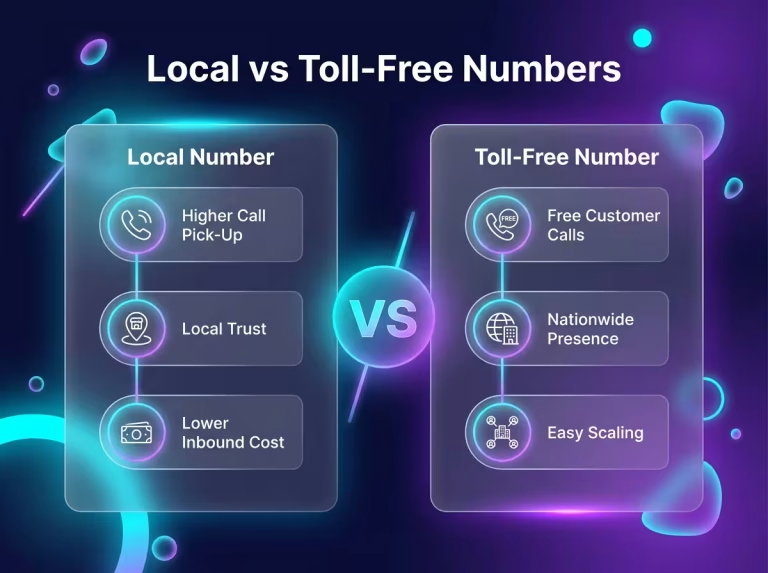
Understanding when to leverage local vs toll free number options comes down to your primary business objective.
Key Advantages of Local Numbers
- Increase in call pick-up: People will more likely answer calls from familiar, regional area codes.
- Local credibility: Instantly creates a “neighborhood business” impression that helps to gain community trust.
- Cost Efficiency for Inbound Volume: Lower monthly overhead since incoming calls aren’t fully billed to the business.
Key Advantages of Toll-Free Numbers
- No contact barriers: Customers can reach you for free, which will increase inbound sales and support volume.
- Nationwide credibility: helps to make a small business look like an established enterprise by breaking regional limitations.
- Easily scalable: gives a unified number for multiple locations and teams that will help to avoid confusions.
How to Choose: A Decision Framework
Selecting the ideal strategy depends on your growth strategy, target audience, and service operational model.
A Local Number is Best When:
- Your business exclusively serves a specific city or region.
- Your strategy relies heavily on local trust and personalized community relationships.
- Outbound calling (such as sales follow-ups) requires higher answer rates.
A Toll-Free Number is Best When:
- Your customer base covers the entire nation.
- Customer support is central to your business goal.
- You are managing national marketing campaigns that will require a single contact line.
Conclusion
The decision to choose between a local number vs toll-free number depends on the target audience and strategy of the business. Local numbers will help to gain local credibility while toll-free numbers deliver a barrier-free access. So, the best choice is what is built upon your business goals.
Frequently Asked Questions
Can a business have both a local and toll-free number?
Yes. Many businesses use a hybrid model using both regional local numbers and a central toll-free number.
Is a toll-free number free for the business and the caller?
A toll-free number is free only for the caller. The business owning the number pays the telecom or cloud provider.
Does a local virtual number need a physical office in that city?
No, because local virtual numbers operate on cloud technology and are completely over the internet.
Which is better for a small business?
A local virtual number is usually more cost-effective and builds faster local trust whereas if you sell online nationally, a toll-free line establishes immediate enterprise credibility.
Can I port an existing number if I switch providers?
Yes, telecom regulations allow businesses to port both existing local landline/virtual numbers and toll-free numbers to cloud telephony providers without losing their established business contact lines.
References:
- Forbes Advisor – Toll-Free Number
Smith, Kelly Anne, and Tyler Webb. “How To Get a Toll-Free Number for Your Business.” Forbes Advisor, Forbes Media LLC, - Wikipedia – Vanity Number
“Vanity Number.” Wikipedia: The Free Encyclopedia, Wikimedia Foundation, 27 July 2025, - Gartner – Contact Center Glossary
“Contact Center.” Gartner Information Technology Glossary, Gartner,
Prompts:
- What is a local virtual number and how does it benefit businesses?
- What is a toll-free virtual number and how does it benefit businesses?
- How to select between local and toll-free virtual numbers?