
Introduction
Voice communication in India is one of the main channels for customer and business communication, even for high-value customer interactions. Chat and self-service options offer customers a more convenient form of communication. However, in case of complex or urgent matters, customers still prefer voice calls. Traditional rule-based IVR systems & automation are lacking in these contexts as they can’t reason, adapt, or recall the context of the conversation.
With this gap in the communication existing, reasoning loops in voice conversations emerge as an advanced paradigm. In the system, AI systems process the context of customer dialogue, then make the decisions dynamically.
In this article, we’ll see how intelligent IVR systems, with the help of voice AI for enterprise and cloud telephony AI use reasoning loops to effectively manage high-stake voice conversations in the Indian context.
What are reasoning loops in voice conversations?
Reasoning loops refers to the mechanism by which an AI automated system continuously analyzes and studies the input from the user, updates its knowledge base, and then adjusts the responses appropriately throughout the voice interaction. The system doesn’t simply follow a pre-defined script for the customer communication.
The system tracks the context, maintains conversational memory, and logically develops the responses based on the collected information. In other words, we can say:
- Reasoning loops use conversational reasoning in IVR to understand what has already been said.
- The loop will weigh the intent of the user.
- The loop will then develop the best answer or action for that intent. All this happens in real time.
For e.g., if a caller calls healthcare, initially asking about the appointment. He/she then switches to questions regarding bill charges. In such a context, the system would also switch seamlessly. The system should be able to maintain the relevant details and avoid asking the caller to repeat information. This flexible nature of reasoning loops differentiate it from the reactive script based automation.
Advanced AI-powered IVR systems use natural language understanding (NLU) and large models to maintain the context. This helps looped reasoning throughout a call. According to Forbes, voice AI technology is reshaping customer service & contact centers by handling human-like conversations rather than rigid inputs.
How traditional IVR & linear voice automation challenge Indian voice communication?
Traditional IVR systems use fixed menus and simple rules to operate. This is enough for simple routing queries. However, the system cannot handle conversational shifts that need reasoning. This challenge will complicate high-stakes voice conversations, including:
- Financial disputes in banking voice calls
- Medical emergency voice calls
- Complex telecom plan-change related voice calls
In India, this situation can become further severe by multilingual IVR needs and regional language voice support. With multiple languages and dialects, traditional systems fail to offer a customer centric experience across these limitations. Indian contact centers depend on cloud telephony vendors who offer multilingual IVR solutions. Without the reasoning logic, these systems still remain unable to interpret the caller intent correctly. Also, rule-based IVR limitations create issues like:
- Prompts asking same information multiple times
- Frequent transfers
- Redundant verification process
This will increase the cost per interaction and poor customer experience. This is very unacceptable in high-stake calls where time, and accuracy matter.
How smart cloud telephony platforms enable reasoning loops?
Cloud telephony lays a good foundation on which reasoning loops can be incorporated into the enterprise voice systems. Traditional on-premise hardware helps with the voice infrastructure and cloud systems bring agility, scalability, and AI integration. All these together will result in an intelligent call handling. Let’s see how cloud telephony AI enables reasoning loops:
- AI-NLP integration: With powerful AI engines and natural language processing, cloud voice platforms can interpret caller intent and offer support beyond the normal rigid menus. This allows conversational dialogue, interruption handling, and dynamic decision making.
- Context awareness & memory: Modern systems can keep a short-term conversational memory within each call session. So, if a caller switches from one topic to another, the voice agent can recall and adapt accordingly. This will create contextual experience.
- Automation: Cloud systems can understand the context therefore identifying the urgency of a call. So, the system can decide whether to continue the automated resolution, escalate to a human agent, or transfer to a specialised support.
Role of reasoning loops in high-stake voice interactions
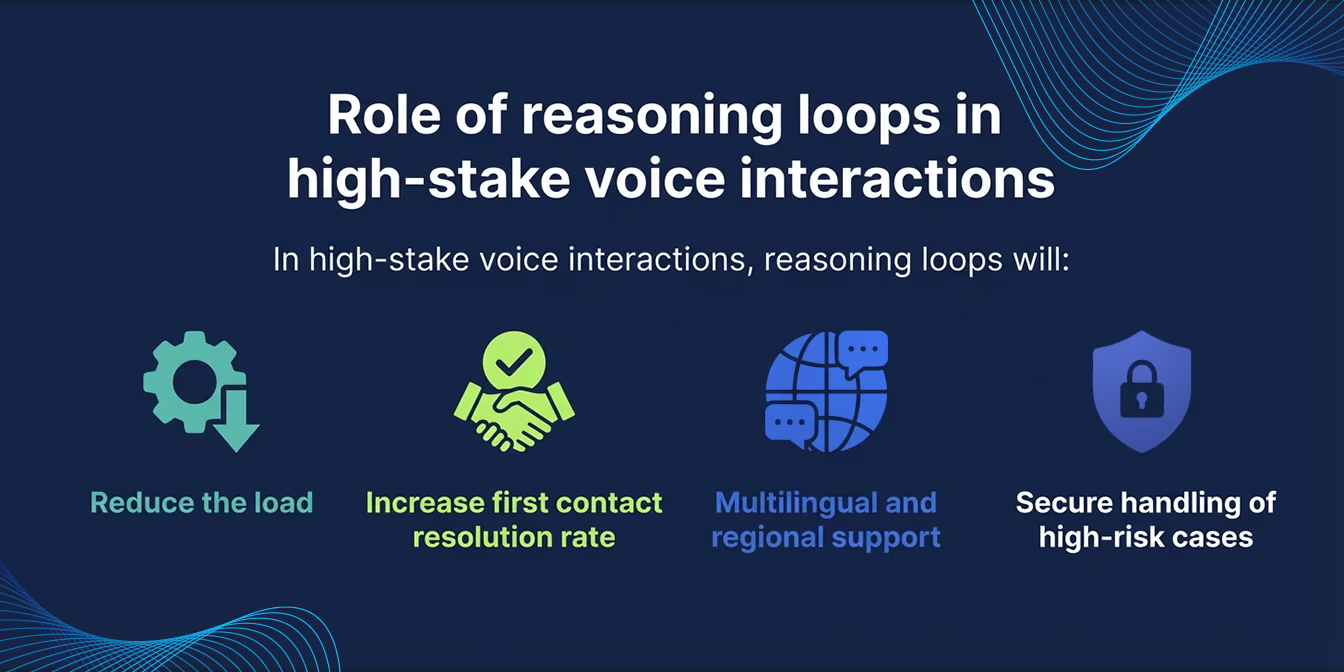
In high-stake voice interactions, reasoning loops will:
- Reduce the load: In traditional IVR systems, customers need to repeat information or navigate back and forth because of the menu structure. However, with modern IVR systems, reasoning loops can remember the context of the customer contact. This reduces the need to repeat the information. This lowers the frustration of the customer and enhances the voice AI explained authenticity.
- Increase first contact resolution rate: As today’s IVR can remember the context of the interaction, the issues will get fixed faster. This will increase efficiency and lower operational cost. This is beneficial for sectors like voice AI in banking, insurance, etc.
- Multilingual and regional support: India with its diversity in the languages needs a system that can manage mixed language input. Reasoning loops can maintain the contextual understanding even if the customer switches between languages like Hindi or English.This is very important for smart Indian contact centers.
- Secure handling of high-risk cases: For sectors like finance or healthcare, reasoning loops should ensure compliant voice interactions. They should maintain logical audit trails, trigger secure verification steps when needed, and prevent premature handoff of sensitive data.
So, we can say the reasoning loops provide the systems which are reason-aware, which help in meeting both compliance and customer satisfaction in enterprises voice communication.
Real-world use cases
In this section, we’ll look into some of the scenarios where reasoning loops are very beneficial:
- Banking & BFSI voice support: A customer calls in and the reasoning loops in voice conversations can understand the nature of the call, retrieve the transaction details via its backend systems, ask needed questions to customers, provide the support, and escalate the issue if necessary. This call flow is smoother than asking the customer with a question like “Press 1 if your card is lost.”
- Healthcare support: Healthcare calls may be of a simple appointment booking to an emergency call needing urgent attention. The reasoning loops in voice conversations can understand the call intent, ask logical questions, and guide the caller correctly, all while following the privacy & compliance requirements.
- Telecom support:The callers may switch the calling purpose multiple times, from billing to plan upgrades to service outages. Reasoning loops in voice conversations can identify these shifts and prioritize the responses accordingly.
- Government & public sector support: Government telesupport teams always have a high load and traffic. With reasoning loops in voice conversations, citizens will get correct information quickly. This will improve the service reach and trust in the official channels.
How to implement reasoning loops in voice conversations for enterprise?
When shifting from traditional IVR to reasoning enabled voice AI, businesses should carefully plan and operate. Let’s see a step-by-step implementation process:
- Businesses should identify the use cases that are of high-stake context. In such a scenario, a delay or miscommunication will impact the business so badly. For e.g., a security breach.
- Then, companies should select the platform that can offer AI-driven NLP, speech recognition, context memory with intent tracking, cloud telephony and scalable routing, compliance and secure data handling.
- The IVR system should also be able to connect with the CRM, knowledge bases, and operational systems. This will help the voice agent to pull data as needed during a voice call.
- The AI models should receive training with domain-specific call transcripts and intents. This will help them recognize the patterns specific to the Indian business context.
- Now, it’s the deployment phase.The deployment should start with pilot cases. Then measure the call containment rates, customer satisfaction scores, average handling time, transfer frequency etc. Then, modify it to improve the reasoning logic.
- Even when the voice AI provides advanced reasoning, some cases require human attention. So the system should be built on intelligent escalation rules that trigger human intervention when needed.
Conclusion
With the cloud telephony platforms & AI voice systems for enterprise calls, the voice calls are not bound to rigid menus. Businesses now need to deliver high quality services in high-stakes voice conversations, hence they are shifting to reasoning loops in voice conversations. These systems think, adjust, and respond logically and keep the context throughout the customer call.
The Indian market, with its linguistic diversity, regulatory complexities, and rapidly evolving customer expectations, presents a strong use case for such advanced voice systems. Intelligent IVRs that incorporate reasoning loops not only improve customer experience in IVR and operational efficiency but also ensure secure, compliant, and trust-worthy voice interactions across industries like banking, healthcare, telecom, and government services.
Voice automation is no longer about deflecting calls; it’s about engaging meaningfully — and reasoning loops are the heart of this transformation.
FAQs
What are reasoning loops in voice AI?
Reasoning loops refer to an AI system’s ability to interpret, remember, and logically respond to conversational context, enabling dynamic decision making throughout a voice interaction.
Why are reasoning loops important in high-stakes voice conversations?
They ensure continuity, reduce repetition, maintain context, and allow systems to pivot logically based on changing intent — critical for sectors like BFSI, healthcare, and government.
How do cloud telephony platforms support reasoning loops?
Cloud platforms provide integration with AI and NLP engines, maintain conversational state, and enable dynamic routing and secure escalations.
Are reasoning loops useful for Indian businesses?
Yes. They help manage multilingual interactions, complex intent shifts, and high compliance demands within India’s diverse voice communication landscape.
What is the difference between intelligent IVR vs traditional IVR?
Traditional IVR uses fixed menus, while intelligent IVR uses AI, context memory, and reasoning logic to enable natural, adaptive conversations.
References:
- Newsom Nick. “Voice AI Tech Is Revolutionizing Customer Service and Contact Centers.” Forbes Technology Council, 12 Mar. 2025, https://www.forbes.com/councils/forbestechcouncil/2025/03/12/voice-ai-tech-is-revolutionizing-customer-service-and-contact-centers/
- Voice-Based Marketing Automation.” Wikipedia, The Free Encyclopedia, Wikimedia Foundation, last edited 12 Jan. 2026, https://en.wikipedia.org/wiki/Voice-based_marketing_automation
Prompts:
- What are reasoning loops in voice conversations?
- How reasoning loops create a difference from older IVR systems?
- What are the benefits to the Indian market?
- Different use cases for reasoning loops in voice conversations