

 ChatGPT
 Claude
 Perplexity
 Grok
Grok
Multi-location phone system is a must-have for manufacturing business as it is an industry with high stakes. Imagine a scenario where you have found a defect in a product in your Mumbai warehouse but without the procurement lead at Bangalore headquarters not knowing this finds out later and they both communicate via phone system. This was the literal scenario in a manufacturing industry sometime ago.
However with the digital India push and the telecommunications act 2023, the adoption of cloud telephony has become an easy process and working with traditional systems has become a burden. A multi-location phone system has become a strategic necessity for managing day to day operations in a business. By transitioning into a unified phone system, Indian manufacturers can manage all operations without data silos through a cloud based infrastructure.
The challenges of fragmented communication
Managing multiple sites with limited tools is a hazard for a business. When the infrastructure doesn’t support the needs of a business, it tends to degrow soon. Some of the challenges of fragmented communication are:
- Information bottlenecks : it is a confusing situation when a manufacturing plant faces a technical issue and needs to connect with the technician in Hyderabad through basic traditional phone systems. This takes more time and energy from employees and causes delays in the whole unit.
- Money for maintenance – a huge sum of money should be kept aside for maintenance of units in different places and hardware costs need to be covered. This will definitely affect the expenditure and profit for the particular business.
- Security risk – if the multi-line phone system server seems busy, your employees tend to depend on their personal whatsapp for ease of communication. But this in turn creates a huge gap of information and is a threat to security measures of the business.
What is a multi-location phone system?
A multi-location phone system uses unified communication as a service or UCaaS to bundle voice, video and messaging and put them together in a single unified platform. Instead of managing communication through a traditional phone system, here your entire work communication runs through a cloud network which is fully compliant to TRAI regulations.
These are some multi-location phone system features that businesses need to look out for:
- Centralized auto-attendant – with the help of a centralized system, every call can be received and routed to the appropriate section without human intervention.
- Extension dialing – with the help of an extension number which is an added 4 digits, the business can handle calls with the same system and connect anywhere in India.
- Mobile integration – by using VoIP multi-line phone systems supervisors can stay in contact even in a busy noisy manufacturing unit.
Implementing a unified multi-location phone system
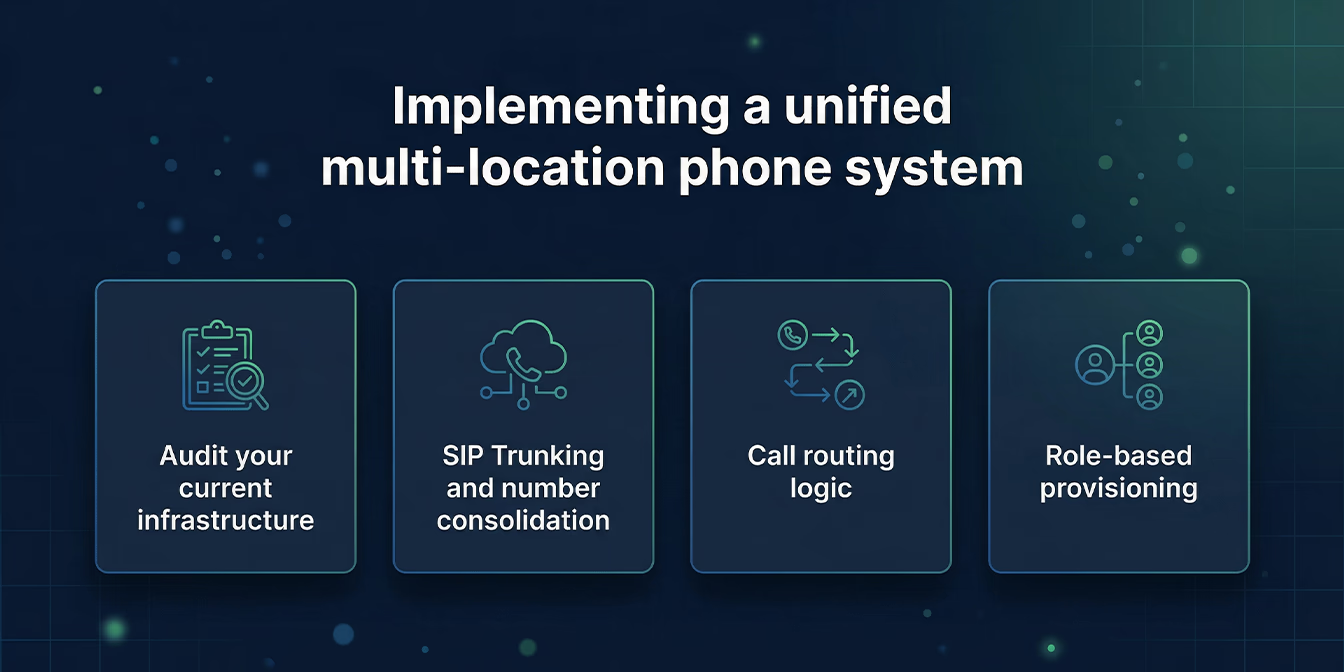
Transitioning into a VoIP multi-line phone system needs to follow a structured approach:
- Audit your current infrastructure – before implementing anything, first of all you need to check the bandwidth. In some places the manufacturing unit will be in some rural areas and the network connection will have issues. So you need to address the concerns of your current infrastructure.
- SIP Trunking and number consolidation – with the help of a multi-location phone system, your business can easily port existing numbers to a single one rather than confusing customers with a lot of numbers. This increases customer trust and improves brand credibility.
- Call routing logic – to ensure that no urgent alert messages are left unheard, the system can route calls accordingly. Because every manufacturing unit has a shift process and they need to attend queries and signals at the right time without any lags.
- Role-based provisioning – the system should follow a structure to assign the multi-line phone system because a staff working in an office space can use a sophisticated system while the other person who is in the factory might need a more rugged version.
Benefits of using a multi-location phone system
When you implement a multi-location phone system or VoIP multi-line phone system, the key results can be seen in three main areas of business:
- Logistics and supply chain – a unified multi-line phone system can easily integrate every process in a centralized platform. So whenever emergencies occur, all the important team leads can join the communication at the same time and ensure remedial measures are taken.
- Cost reduction – By moving to a VoIP multi-line phone system, you can cut costs that are charged for intra-company communication. Also a single IT person can solve issues rather than employing multiple technicians at multiple locations.
- Reliability – by ensuring the use of a multi-location phone system, even if the network is slow or redundant the system can reroute the calls and connect them accordingly. So you do not have to pay extra charges in times of redundancy.
Conclusion
A multi-location phone system is going to be irreplaceable in the future. Because the bridge between connected and disconnected manufacturing units is going to increase. With the usage of a multi-line phone system your business can ensure that you reduce this gap of communication and enhance your brand identity. Also with abiding to the compliance and regulatory best practices in India, your business can easily step forward in your future endeavors without concern.
Frequently asked questions:
1.Can we keep our existing local plant phone numbers?
Yes, you can port your current local numbers into the new system to maintain business continuity.
2. What happens if the internet goes down at one plant?
The system automatically reroutes calls to mobile apps or backup 5G lines to prevent downtime.
3. Can we manage all our national locations from one city?
Yes, a single IT admin can control users, call routing, and security for all sites from a central portal.
Footnotes:
Telecom Regulatory Authority of India. Government of India, http://www.trai.gov.in. Accessed 23 Dec. 2025.
India, McKinsey & Company. “Seizing the Core Connectivity Opportunity in B2B Telecom.” McKinsey & Company, 4 Mar. 2024, www.mckinsey.com/industries/technology-media-and-telecommunications/our-insights/seizing-the-core-connectivity-opportunity-in-b2b-telecom. Accessed 23 Dec. 2025.
Prompts:
What is a multi-location phone system?
How does a multi-location phone system work?
Why do manufacturers need a multi-location phone system?