

 ChatGPT
 Claude
 Perplexity
 Grok
Grok
Cloud telephony for retail is not a familiar word yet. The world of retail is buzzling with communication. There is always someone communicating with the other, unending inquiry calls, internal coordination calls and supplier communication. In this scenario, using a traditional mode of communication will not let your business thrive. But by using cloud telephony for retail businesses, you can see a transformation in the way things are handled in your business.
Table of Contents
Why is cloud telephony for retail necessary?
Retailers operate in a busy environment often handling multiple calls and often missing out on important details. The traditional phone system can often fall short in such a situation and is limited to fulfill these sudden demands.
- Missed calls – often during peak hours business might be buzzling with people and phone rings. You might be handling online inquiries, stock updates and delivery questions at the same time. In this scenario it is only human to miss some calls. But what if you miss an important one in the midst of this. Someone might be calling you to place a large order, someone might be calling you to inquire about their misplaced order. When you are not able to handle such situations you often miss a lead and at the same time, you might also be a vessel to bad customer experiences.
- Lack of centralized call handling system – in some small retail businesses, they might be handling all queries and updates from a single store which manages the brand in multiple locations at the same time. While this is the case, when a customer calls a particular number and gets connected to the office he or she might be truly clueless about your problem and might transfer you to departments which deal with the problem. What happens is the customer gets irritated and it leaves a bad mark on your brand reputation. So a centralized call handling system is necessary to manage this fragmented situation and clear all the confusion.
- Lack of awareness regarding previous communication – suppose a customer called about an enquiry regarding some malfunctioning with the product and got an answer. But if the problem recurs and he calls again he might be connected with a completely different agent who may not have a slight idea about what happened earlier. This leads to customer frustration as he or she has to repeat again and again to solve the issue. This is where a retail call management system becomes necessary.
What is Cloud telephony for retail ?
Cloud telephony for retail is similar to what cloud telephony services are, but it discusses more on how it is useful for this specific industry. Here, the system entirely operates over the cloud rather than through physical hardware lines.
In an office scenario, you actually get to see a large amount of space dedicated to phones and hardware but with the arrival of cloud telephony services you get to make use of that space too and remove all the clutter. Because this system works completely over the cloud and all you need is an internet connection and a device like laptop or mobile phone.
This leads to more space, no need to worry about hardware maintenance, less expenses and more flexibility. Also for businesses with multiple branches, cloud telephony is a boon. Because rather than dialing each number to get specific information all are connected via a centralized platform and everyone gets updated with the newest of information. This helps to maintain a smooth flow of communication and ease in operations.
Basic features provided by a cloud telephony platform
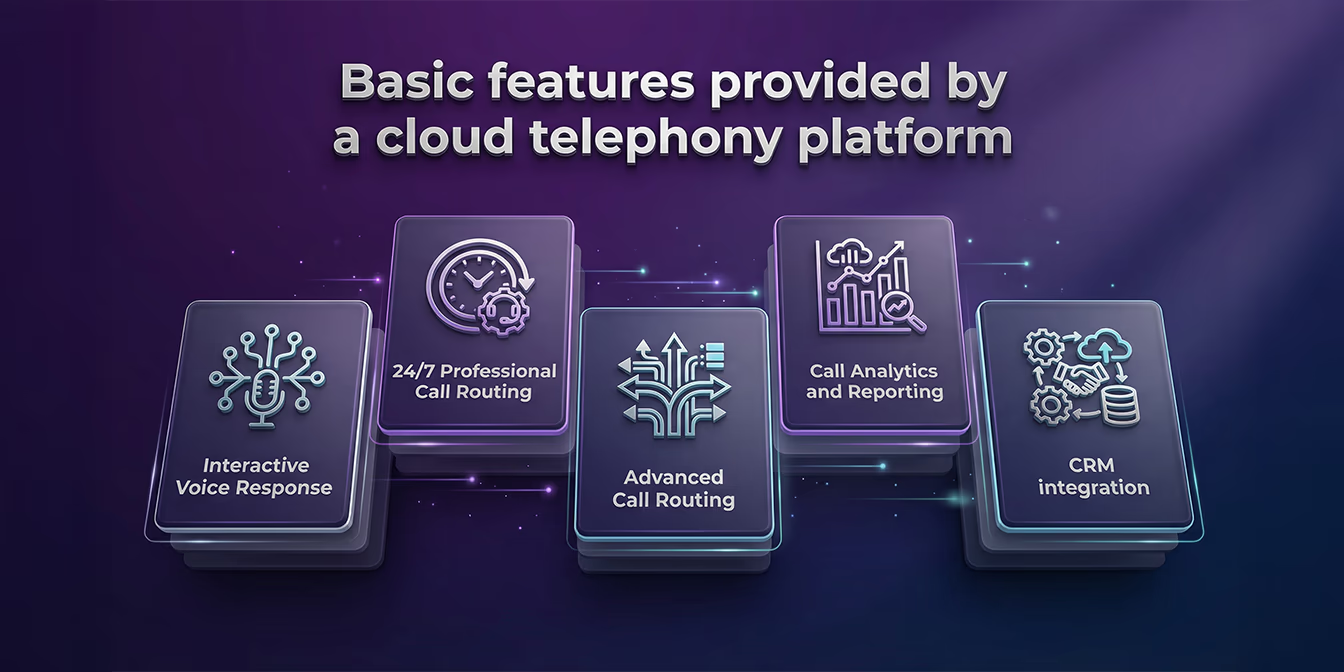
The real features that helps with making your cloud telephony for retail business successful are:
Interactive Voice Response
After acquiring a professional number the next step is to manage the calls that rush through every hour, even when you are busy. This is where IVR or Interactive voice response changes the game in your business strategy. So what is an IVR?
IVR is often termed as auto attendant, which is the automated menu that greets the callers with options like, Press 1 for sales, Press 2 for queries, Press 3 for billing etc…
For small to mid range enterprises, the major challenge they face is to handle the call volume. Often they lose customers because they couldn’t reply or take the call due to their busy phone systems which leads to customer frustration and thereby churns. Also even if the staff picks up the call they will be drained too soon of their productivity which can instead be used on their tasks effectively.
IVR handles this call volume without requiring you to hire a full-time receptionist as staff. It acts as an infinitely scalable filter.
24/7 Professional Call Routing
The most essential need of a call routing system is to handle calls effectively and the greatest benefit is that they work 24/7 regardless of the hour. This helps to give your business a feeling of standard and customer – centric.
With implementing a call routing system you can:
- Direct sales to sales : if a customer is asking a query regarding a product and its specification the system can directly route it to the sales team member.
- Support to support: if the customer has some concerns over a product or service they can be directed to the support team to solve the issue.
- After hours information : if a customer is seeking information which is after the working hours of the company or institution, the system can provide essential information like hours of operation or a link to an online FAQ before offering to take a message, solving simple queries without staff intervention.
So therefore, an effective IVR doesn’t just route calls, it screens and prioritizes them, giving your team a critical head start.
Advanced Call Routing
Through a basic call routing system we can handle all the calls without getting anything missed. But advanced call routing systems add an intelligent layer to this process by passing the call to the appropriate agent who deals with the specific section of the query. This system definitely impacts the efficiency of your business by increasing your first call resolution rate.
Intelligent call routing ensures that it uses its predefined logic to transfer the call to match the customer’s need with the agent’s capability. Imagine an IT firm, where a call related to a software issue is directed to x and a call related to network setup is directed to y. This ensures a skill based routing thereby reducing customers frustration and ensuring their ease of use. Also this feature allows the queries after your working hours to be routed to an on call manager or a voicemail box thereby ensuring every call is answered and customers expectations are met.
Call Analytics and Reporting
The difference in using a simple traditional landline system and a budget friendly call management system is in the data it provides. This helps small business enterprises to make data driven decisions and strategize accordingly.
Your phone system provides you with continuous and real time market data that you might have been overlooking. Basic call analytics and reporting provides insights like:
- Missed calls: the data of time and duration it took.
- Peak hours: shows data of when customers are trying to reach your service often.
- Call duration: shows data of what kind of calls or what issue related calls took more time.
- Agent performance: Measures the average handle time and first call resolution period of each employee.
Analysis of this data helps you to move beyond merely reacting to calls and strategize your business efficiently.
CRM integration
A crm integration is like building a smart pathway which helps to connect your crm system with other important business tools and software. As a first step the system collects customer data from all available sources and puts it in a central space. This is called the single source of truth. Without such an integration process, there will be data silos because the customer information will be scattered in different places and the employees will find it hard to deal with the problem in front of them.
For every business platform, smooth workflow needs to be ensured. In order to achieve it, the seamless flow of information removes confusion and chaos, especially in a workplace with a number of employees working on different sections. In the case of a call center or a sales team, whenever a customer calls, with the use of CRM, a screen pops up with the customer’s past history of purchase, tickets and behavior. This helps the employee to handle the calls smoothly and improve their first call resolution rates. Also this allows them to use the average handle time and improve the time efficiency.
Benefits for retail business
1. Handle High Call Volumes Smoothly
During peak hours or festive times, your customers would not have to wait for the call to be answered. The scalable hosted IVR system of the cloud telephony service provider can effortlessly manage such high call volume handling, which ensures every customer call is answered professionally without interruption of service.
2. Build a Professional Business Image
A well-designed IVR for business presents a polished, competent professional business image in front of every caller. A reliable and accurate interaction automation makes your system highly organized. This helps to increase customer confidence in your brand.
3. Enhance Customer Experience (CX)
With the help of cloud telephony services, a professional, personalized interaction can result in customer experience (CX) improvement. This proves that your business values their time by making every interaction seamless and efficient.
Conclusion
Customer centric experiences are the source of revenue for any business to thrive in a competitive market. By ensuring that your business opts for a cloud telephony for retail business, you get to stay ahead in the competition.
To know more about our cloud telephony services, visit our website and book a demo.
Footnotes:
Sayegh, Emil. “The Intersection Of Cloud And The Retail (R)evolution.” Forbes, 22 July 2022, https://www.forbes.com/councils/forbestechcouncil/2022/07/22/the-intersection-of-cloud-and-the-retail-revolution/.
Prompts:
1.What is cloud telephony for retail businesses?
2.How cloud telephony solves communication challenges in retail
3.Benefits of cloud telephony for retail businesses
4.How IVR works in retail businesses
5.Advanced call routing for retail businesses
6.How cloud telephony improves customer experience in retail