
 ChatGPT
 Claude
 Perplexity
 Grok
Grok
Table of Contents
Introduction
When we think about IVR security, the things that come to our mind are OTPs, passwords, or pins. However, they are becoming friction points rather than security nowadays. As fraud is increasing and customers demand faster service, brands are now rethinking how customer verification in IVR should work.
With this shift, there is a rise in voice authentication in IVR, where the voice of the customer itself becomes the password. With features like AI and ML, passive authentication enables secure verification. So, the customers don’t need to remember PINs or wait for the OTPs.
According to Forbes, companies encourage security models that reduce the effort of the customer, along with providing enhanced fraud prevention. This is exactly where the voice biometrics authentication is redefining secure IVR systems.
How is IVR security evolving?
Why do traditional active security methods fail?
Traditional IVR security methods depend on rule-based methods like asking customers to verify their details like DOB, account number or OTPs. These methods were effective earlier. However, in modern fraud incidents as:
- During sim swap, OTPs may be missed.
- Security questions are easily guessable.
- PINs are forgotten or shared.
- Longer verification processes may increase the call abandonment rate.
Also, with companies handling huge volumes of calls, active verification methods increases the average handling time, along with the operational cost. Thus, we can say these techniques fail to keep up with the IVR security.
How does passive authentication emerge in IVR systems?
With AI, ML and automation, AI IVR solutions strengthen IVR fraud prevention. Businesses handling sensitive customer data are shifting toward continuous & invisible authentication models. As the cloud telephony security improves, IVR platforms can now verify the callers in real time. This is possible by analysing hundreds of voice attributes without affecting the flow of the call.
Passive authentication verifies callers with the help of biometrics and behavioural signals during the call. The most prominent method is IVR voice recognition. This compares a caller’s voice against a store voiceprint. In this method, customers don’t need to pause, repeat phrases, or enter codes. Authentication will happen along with the conversation, making it more seamless.
The majority of enterprise IVRs will adopt passive biometric verification as the default authentication layer by the end of this decade, especially in banking, telecom, healthcare, and utilities.
How can voice act as a secure and reliable password?
The human voice is one of the most difficult biometric identifiers. Voice based authentication checks more than 100 characteristics like pitch, tone, etc. So, it is difficult to replicate even with the help of recorded audio. Modern voice biometrics authentication system also detect:
- Playback attacks
- AI-generated voices
- Background anomalies
Is voice biometrics secure? The answer lies in its ability to combine uniqueness with liveness detection. When voice biometrics and AI-driven fraud analytics combine, it will significantly reduce identity fraud and increase IVR security.
Comparison between active & passive security in IVR
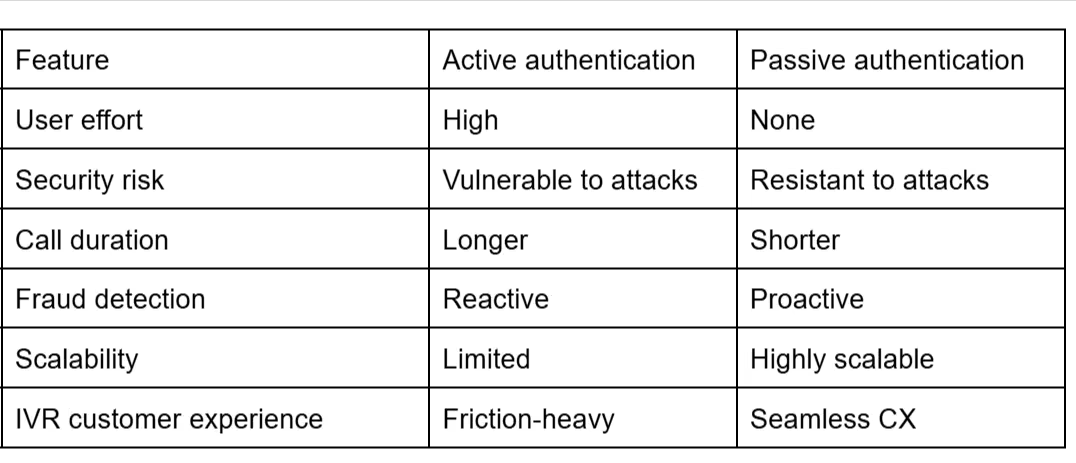
From these studies, we can see why enterprises are moving from active vs passive authentication models toward biometric-led IVR security.
How does passive authentication improve customer experience?
Speed and effort are two main deciding factors in a seamless customer experience. It is no longer about the resolution. Customer experience in IVR improves significantly when the authentication process is invisible. Some of the benefits with the passive authentication in customer experience includes:
- Fast call resolution
- Reduced customer frustration
- Natural conversational flow
- Trust and confidence
By reducing customer effort by even one step can increase loyalty significantly. With voice authentication vs OTP, passive security removes one of the biggest friction points in IVR journeys.
Real world use cases
- Banking & finance: Banks use voice biometrics for accessing accounts, checking balances, and other transaction approvals. This will reduce social engineering fraud.
- Telecom: Telecom providers can rely on enterprise IVR software with passive authentication to prevent identity misuse.
- Healthcare: Voice authentication ensures parent verification while complying with data privacy and requirements.
- Contact centres: Advanced call centre security solutions use AI to find suspicious behaviour and enable fraud detection in call centers before any major data loss.
How does Bonvoice enable scalable, secure IVR experiences?
Bonvoice, with its cloud telephony security features, AI IVR solutions, and advanced IVR automation, deliver enterprise grade protection. CX is not compromised. Some of the key capabilities of Bonvoice IVR includes:
- Voice biometrics-ready IVR
- Seamless integration with CRM and backend systems
- AI-driven risk analysis and fraud alerts
- Scalable infrastructure for high volumes of calls
Bonvoice secure IVR helps companies to modernise their security while improving customer trust and operational efficiency.
Conclusion: Future of IVR security and password less customer verification
IVR security is no longer what the customer knows, but who they are. As fraud activities evolve and customer expectations change, passive authentication becomes the most secure, scalable, & user-friendly solution. With advanced voice biometrics authentication, AI-driven fraud detection, and cloud-native IVR platforms, companies can achieve authentication without OTP, that too, without sacrificing the trust. The next era of IVR security is invisible, intelligent, and CX-first. In the future, your voice truly becomes the only password you’ll ever need.
References:
- Gartner press release on identity verification challenges
Gartner, Inc. “Gartner Predicts 30% of Enterprises Will Consider Identity Verification and Authentication Solutions Unreliable in Isolation Due to AI-Generated Deepfakes by 2026.” Gartner Newsroom, 1 Feb. 2024, https://www.gartner.com/en/newsroom/press-releases/2024-02-01-gartner-predicts-30-percent-of-enterprises-will-consider-identity-verification-and-authentication-solutions-unreliable-in-isolation-due-to-deepfakes-by-2026 - Gartner research report
Gartner, Inc. “Migrate to Passwordless Authentication to Enhance Security and Optimize UX.” Gartner, 2024, https://www.gartner.com/en/documents/5723051 - Forbes article on AI and biometric authentication
Boddis, Luke. “The Future of Authentication: Why AI and Biometrics Will Replace Passwords For Good.” Forbes Business Development Council, 5 June 2025, https://www.forbes.com/councils/forbesbusinessdevelopmentcouncil/2025/06/05/the-future-of-authentication-why-ai-and-biometrics-will-replace-passwords-for-good/
Prompts used:
- Passive and active security mechanisms in IVR security
- How does active authentication fall short?
- How does passive authentication enhance IVR security?
- Is voice authentication reliable and trustworthy?
FAQs
What is meant by IVR security?
IVR security refers to the methods used to protect the identity and sensitive data of the customer during an IVR call.
What is voice authentication in IVR?
Voice authentication in IVR uses voice biometrics technology to identify a caller’s identity with the help of his/her voice characteristics.
What is meant by passive authentication in IVR security?
It is a security method where the user verification happens in the background without the user’s effort as the user talks naturally.
How does voice biometrics authentication work?
Voice authentication creates a secure voiceprint during the registration and compares it with the caller’s live voice during future calls.
Does voice authentication prevent fraud?
Yes, voice biometrics prevent IVR fraud by detecting impersonation, repeat fraudsters and flag the suspicious call behaviors.