 ChatGPT
 Claude
 Perplexity
 Grok
Grok
Inbound and outbound calls are factors which define how a company thrives in the market. As we move forward in 2026, the rise in use of AI, Cloud telephony features has significantly improved the communication system into a customer interaction management tool. In order to further develop your business empire in the competitive market, the person should understand in detail what are inbound and outbound calls, why they are important for your business and how you can utilize them to thrive in your business.
Customer service is the key service provided by every company who needs to thrive in the business field. The success lies in how effectively and quickly you can answer these calls and solve the issues. This determines whether you retain your customers or lose them. This is where call center software benefits your business growth.
What is inbound and outbound calls?
The concept can be easily understood by looking at the person who initiates the call. This is the factor that makes inbound and outbound calls different.
- Inbound calls definition: these calls are initiated by the customer. It mainly consists of a question by the customer, technical difficulties they faced, or concerns regarding delivery updates. These calls are the essential factor for customer service.
- Outbound calls definition: these calls are initiated by the agent. This mainly consists of sales outreach or payment reminders. This is a medium through which agents reach their prospective clients.
The call center workflow
Modern business communication flows rely on a wholesome way of process as it relies on pushing customers towards a resolution at one end and pushing values, information or a product towards the client on the other end. This gives a 360 degree communication flow.
|
Type
|
Direction
|
Primary Purpose
|
|---|---|---|
|
Inbound
|
Customer → Business
|
Support, Inquiries, Resolution
|
|
Outbound
|
Business → Customer
|
Sales, Surveys, Notifications
|
What is called an inbound call?
An inbound call occurs when a customer is trying to get an answer to their query by reaching out to the business’s customer service. Here, the customer will not remain passive. The communication will rarely become cold. Instead the call will have high intent which can determine brand loyalty in future. There are a few examples of inbound calls:
- Customer Support: these mainly handle simple queries and account updates.
- Product Inquiries: these mainly deal with questions the customer might have regarding a product, its features and pricing.
- Technical Support: customers will have queries regarding software or hardware issues they face.
- Complaint Resolution: these mainly deal with dissatisfied customers who might lodge complaints and the agent should try to retain them providing solutions.
- Order Tracking: these customer queries will be regarding their delivery updates and concerns.
How inbound calls work in call centers
The call center workflow for inbound calls is highly automated in order to reduce friction:
- Customer Calls: the journey of inbound calls start with a user dialing a toll-free or business number.
- IVR Routing: the next step is when an Interactive Voice Response (IVR) system greets the caller, and asks them to select options by pressing keys.
- ACD: as the next step the Automatic Call Distribution (ACD) technology analyzes the request and assigns the call to the most appropriate available agent.
- Resolution: Then the agent uses CRM integration to see the caller’s past history and resolves the query efficiently with the information.
The key technologies used in inbound calls
- IVR: helps to filter and segment callers.
- Call routing: this helps to ensure the right department gets connected with the caller.
- Call queues: this helps to manage wait times during peak hours.
What is an outbound call?
An outbound call is a positive action taken from the side of the company by the agent. This helps the company to outreach to possible clients and convey their offers. This gives a data backed outreach system and increase in warm leads. Some examples for outbound calls are:
- Sales Outreach & Lead Generation: outbound calling helps to pitch products to potential clients.
- Payment Reminders: this will help to notify customers of their upcoming or overdue bills.
- Customer Surveys: this helps to gather feedback via calls.
- Appointment Reminders: this will significantly reduce “no-show” rates for service-based businesses.
How does outbound calling work
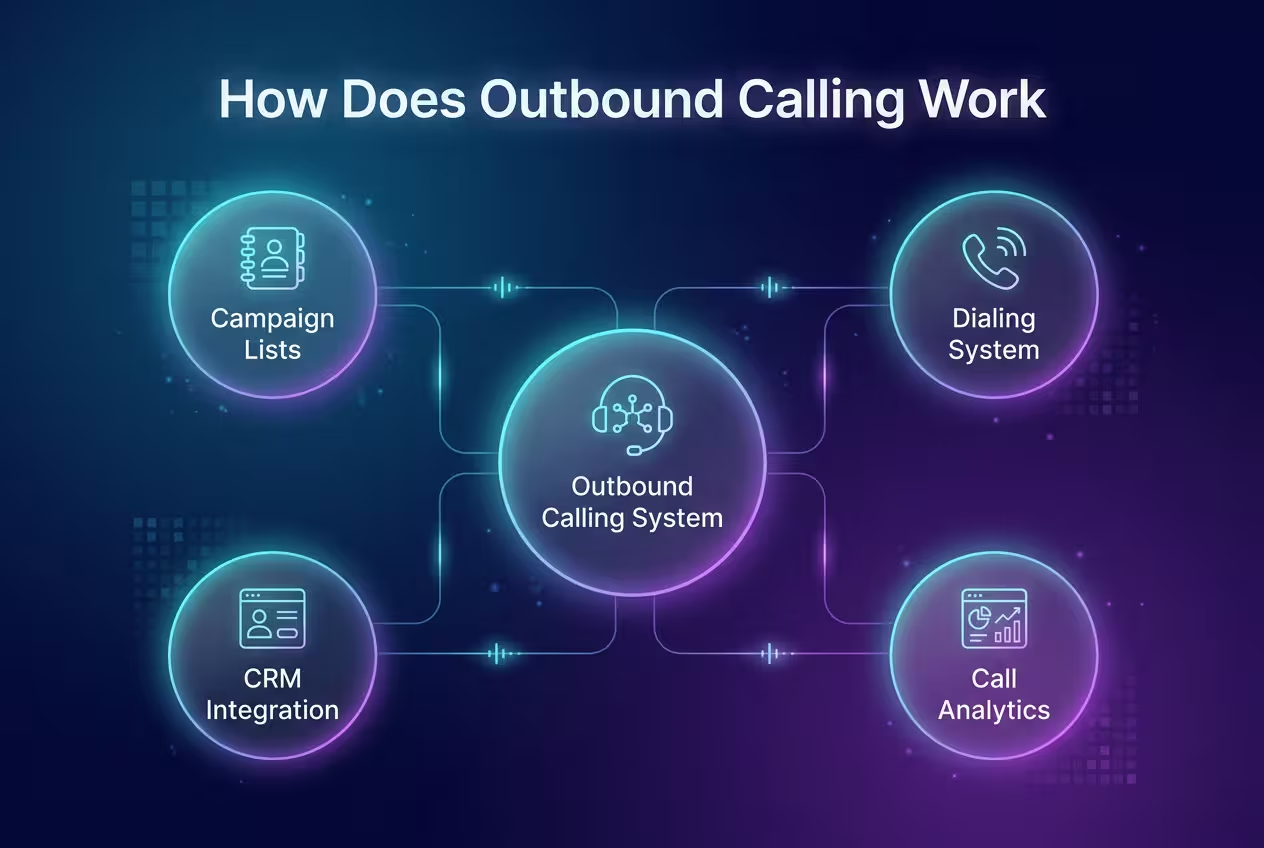
Outbound calls make use of call automation to easily engage with possible clients and maximize employee productivity:
- Campaign Lists: as outbound calling primarily concerns with sales and marketing, Managers will upload a list of contacts into the call management system.
- Dialing System: the next step is that with the help of tools like Predictive Dialers multiple numbers are dialled simultaneously, connecting agents seamlessly to clients.
- CRM Integration: Agents get to see the prospect’s profile and past historical data immediately upon connection so that they can personalize the pitch.
- Call Analytics: with this data, managers can track conversion rates and agent performance in real-time.
Difference between inbound and outbound calls
Understanding the difference between inbound and outbound calls is very important.
|
Factor
|
Inbound Calls
|
Outbound Calls
|
|---|---|---|
|
Call Initiator
|
Customer
|
Business/Agent
|
|
Primary Driver
|
Reactive (Solving a problem)
|
Proactive (Seeking an opportunity)
|
|
Tech Focus
|
IVR & Call Routing
|
Auto & Predictive Dialers
|
|
Success Metrics
|
FCR (First Call Resolution), CSAT
|
Conversion Rate, Lead Quality
|
|
Agent Skillset
|
Empathy & Problem Solving
|
Persuasion & Resilience
|
The key metrics used in tracking:
- CSAT (Customer Satisfaction): This is crucial for inbound; measures how happy the caller is after the call.
- AHT (Average Handle Time): this helps to balance speed with quality in support.
- Conversion Rate: This is the ultimate goal for outbound sales teams.
What is an inbound call center?
An inbound call center is a hub for receiving all the incoming calls related to the brand. These are the first impressions that can be generated towards your brand.
Key functions:
Modern call center services have powerful software tools that boost agent productivity and customer satisfaction.
- Interactive voice response (IVR) – by handling simple requests, this feature helps to boost agent productivity. It also collects basic details of the customer before redirecting to the available agent.
- Automatic call distribution (ACD) – this feature organizes the calls and routes it based on skill based routing rules to the best possible agent. This helps to improve customer satisfaction.
- CRM integration – this feature collects all the data from available sources and places it in a central place. The software seamlessly connects with your existing CRM platform. So when a call is received, the agent gets to see a pop up of the customer history and handle the call better.
- Auto dialer/ predictive dialer – for outbound call center services, this feature helps to automatically dial the next number to contact so that it eliminates the manual work for agents.
- Real -time analytics – with the help of a dashboard, the managers get to see metrics and adjust their employees accordingly to handle peak call volumes.
The major Industries Using Inbound Call Centers
- Banking: the sector makes use of inbound call centers to analyze fraud alerts and balance inquiries.
- Healthcare: mainly used for appointment booking and patient support.
- Ecommerce: this sector uses it for order enquiries, return and refund and order tracking updates.
- Telecom services: this sector uses it for enquiries regarding plan upgrades and network troubleshooting.
What Is an Inbound and Outbound Call Center?
In 2026, sticking to just an inbound call center software might not be useful for your business. You need to take a hybrid approach of binding both inbound and outbound call centers into hybrid contact centers. By adopting this approach, the agent can switch simultaneously to inbound or outbound calls. If the inbound calls are low, then he or she can switch to outbound calls, which will help them to outreach to more potential clients. This helps to maximize contact center infrastructure and ensures that no agent’s time gets wasted by sitting idle for long hours.
Inbound Call Center Software & Solutions
The primary goal of an inbound call center software is to solve issues and queries effectively, that were initiated by the customer. It is inherently reactive. The customers reach out to your service when they have an issue, query or confusion. So the software’s success is actually determined by how frictionless the process is. The result is increased first call resolution rates and a decrease in average handle time.
While on the other hand, the primary goal of an outbound call center software is tele-marketing, sales and collection which is initiated by the business. The result reflects in conversion rate and answer rate.
From the point of view of the customer, everything seems simple because they have to just dial the number and connect with the agent. But there is a system working behind all these to ensure the smooth flow.
A virtual call center service works by intelligently organizing the call traffic and ensuring every call is directed properly over the internet.
In the old times, every call was handled by a PBX system with complex hardware. But the risk of missed calls was insane. Manual work was tiring and people had to be constantly overworked. But with the cloud service, all these hardware were replaced by remote and secure data centers managed by the service provider. With this the cost effectiveness increased as you no longer needed to buy hardware systems. Also the work efficiency increased, as employees could access everything related to the calls from anywhere or even from their home.
When the customer makes a call, the call automatically enters the service platform which gets received by the provider’s cloud server. The call gets greeted by the IVR system which acts like a virtual receptionist directed by the inbound call center service. The call then gets analyzed by the automatic call distribution feature which analyzes the caller details, urgency and matches it with the employees equipped with the specific skill. The ACD then connects the call to the best possible agent. This is the key to a faster call center service.
Benefits of Inbound Software
Shifting to an inbound call center is a great step ahead for accelerating growth in businesses. With the help of cloud services, the one time upfront expenditure spent on hardware and maintenance can be significantly reduced. You get to estimate and plan accordingly to the operational expense. You get to choose a subscription model which boosts pay as you go or pay per use. This boosts the cost efficiency factor, which is essential for every business.
Also with cloud services, you get to scale according to growth. If you need to add extra employees suddenly, you can easily scale the service and eliminate it when needed. Also with cloud services, business owners can easily employ people to work from home which also reduces their operational costs and employees get flexibility too.
The utmost advantage of opting for a cloud service is enhanced customer experience. When the customer calls in need, if the business can efficiently handle the service without confusion, this gradually helps to increase customer trust and experience. In turn, this helps to enhance brand image and visibility.
What Is Inbound Call Tracking Software?
For the marketing team, an inbound call tracking software is of utmost advantage. They need to check which campaigns are performing well and how to strategize their next step.
- Campaign Attribution: Know exactly which marketing campaign got more leads.
- Customer Behavior: you get to analyze the path a user took before calling.
- Dynamic Number Insertion (DNI): by assigning unique numbers to different campaigns you can easily track the campaign which got more leads.
Inbound Call Center Services for Businesses
When your business starts to thrive, it will obviously get bigger in employee strength. But it will not be as easy as before to manage them all. So, with the help of an inbound call center service provider you can easily get this done efficiently.
- 24/7 Availability: your business can provide assistance all times of the day even in different time zones.
- Professionalism: you can easily access trained agents without the difficulties of hiring and training.
- Cost Efficiency: by outsourcing certain services your business can reduce fixed costs into variable costs.
Benefits of Using a Hybrid Call Center
Isn’t it beneficial for any business to adopt a system that can handle both inbound and outbound calls easily.
- Better Engagement: Your business can resolve a support issue through inbound calls and then offer a relevant product upgrade using an outbound call within the same ecosystem.
- Increased Sales: the active follow-ups regarding abandoned carts or inquiries can lead to sales increase.
- Scalable Communication: by adopting a single customer interaction platform your business can seamlessly handle everything.
How Cloud Telephony Improves Calling
Cloud telephony is a cloud based alternative for your traditional phone system. It operates entirely over the internet, which is hosted by the providers’ secure cloud servers. So unlike investing a huge amount of money in traditional hardware, by using a cloud telephony service your business can eliminate all those costs as it entirely works through the internet. Also this unified communication solution brings all your channels of communication like SMS, email etc.. under one platform. A provider like Bonvoice can help your business with:
- Automated voice calls: your business can keep AI-driven voice bots in order to handle basic queries.
- Seamless CRM integration: with an integrated CRM, your customer history can be recorded up to date.
- Global Reach: your business can reach clients worldwide with the use of local numbers.
How Businesses Can Set Up an Inbound Call Center
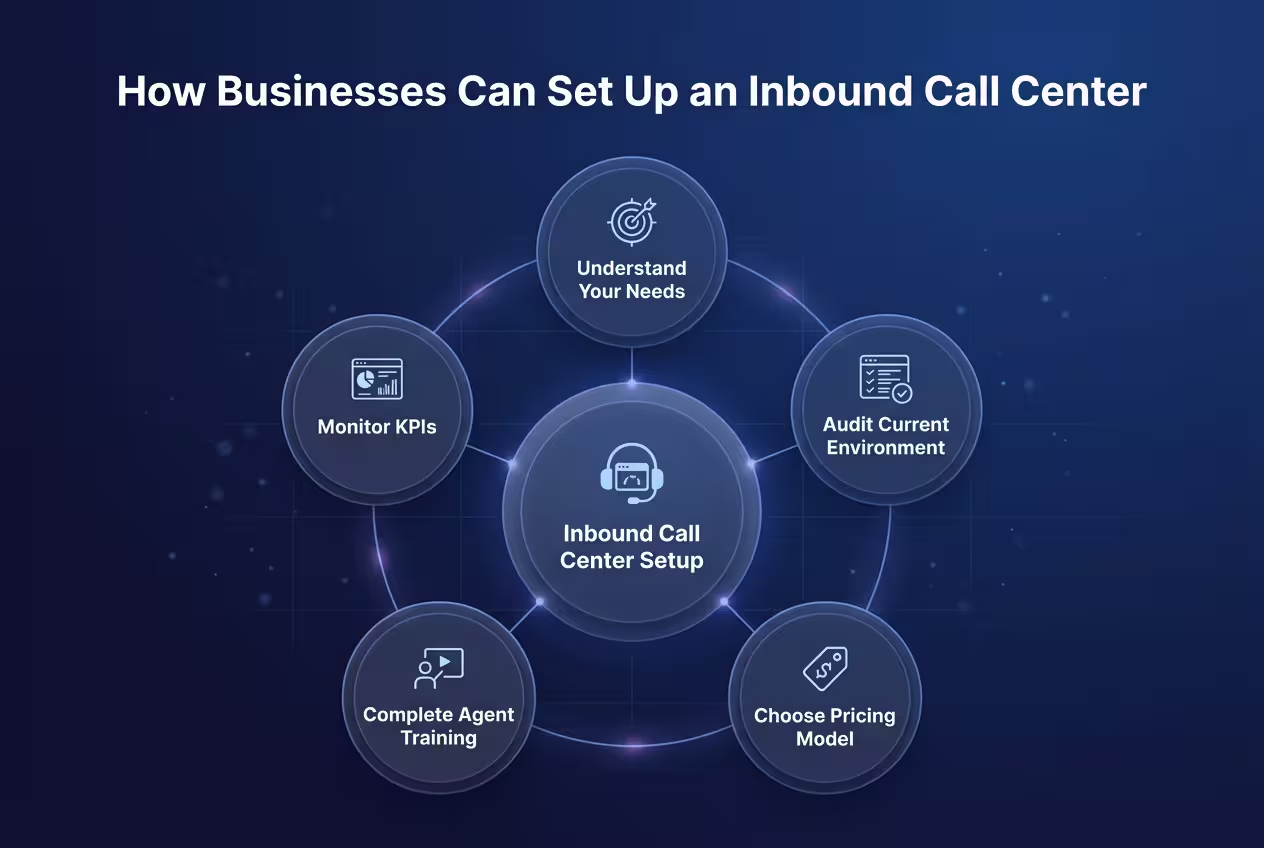
A good workforce is always key to measure your results. With an inbound call center software, you can turn your support team into a revenue generating asset.
- Understand your specific needs – define the needs and goals of the business. Identify what all features you are looking for, instead of just buying what comes first to sight.
- Audit your current environment – you need to tally your existing crm platform and other softwares for easy integration to the service.
- Choose the right pricing model – identify the cost ranges of different service providers and check or hidden fees.
- Complete agent training – give proper training to customers to use the system efficiently and make them understand how much of a help is this for them.
- Monitor KPIs from the first day – take note of the key metrics like service level and first call resolution rates. Analyze the success of migration in every step.
Conclusion
The new age workplace environment calls for work life balance. Not everyone is interested in manual labor even for tasks that can be easily automated. Also every business owner who is scaling towards growth takes notes of these features and boosts their upward growth. So depending on old systems is no longer the way to success. So, cloud services are the way to go. What is best for your business will always depend on your decisions. So, you need to conduct an audit of your requirements and match it with the right service provider to enjoy maximum benefits. Because if you are a start-up you need to set the foundation strong. But if you are a large enterprise scaling further, you need advanced solutions that will be able to meet your specific requirements.
To understand more, check out Bonvoice’s website.
Footnotes:
“A Guide To Inbound Customer Campaign Strategies.” Forbes Business Council, 24 May 2023, https://www.forbes.com/councils/forbesbusinesscouncil/2023/05/24/a-guide-to-inbound-customer-campaign-strategies/. Accessed 18 Mar. 2026.
Prompts used:
Inbound call center software
Outbound call center software
Frequently asked questions
Is there any difference between inbound and outbound calls?
An inbound call is a call from the customer and an outbound call is dialled by the agent.
What is an inbound call in a call center?
An inbound call center is a hub for receiving all the incoming calls related to the brand.
What are outbound calls used for?
They are used for marketing purposes and to reach potential clients.
What is inbound call center software?
The primary goal of an inbound call center software is to solve issues and queries effectively, that were initiated by the customer.
How do inbound call centers work?
An inbound call center service works by intelligently organising the call traffic and ensuring every call is directed properly over the internet.
What industries use inbound call centers?
It is useful for every business while Telecom, Banking, Healthcare, Ecommerce etc.. benefits mainly.
What is inbound call tracking software?
For the marketing team, an inbound call tracking software is of utmost advantage to check their campaigns performance.
Can a call center handle both inbound and outbound calls at the same time?
Yes, a hybrid call center can handle both at the same time.