
 ChatGPT
 Claude
 Perplexity
 Grok
Grok
CPaaS platforms are a familiar term among businesses now-a-days as customer expectations are rising day by day. Everyone wants not just the service but they expect personalization too, as they need to feel valued. Almost 60% of customers switch companies after multiple bad service experiences. The days were one strategy that works for all are over. In order to solve this problem and provide good customer experience, businesses now-a-days has adopted a solution, that is AI in the CPaaS platform.
By embedding artificial intelligence into communication APIs, the CPaaS platform thus shifts from a simple delivery tool to a sophisticated engine for providing hyper-personalized customer experience.
Benefits of AI in CPaaS platform
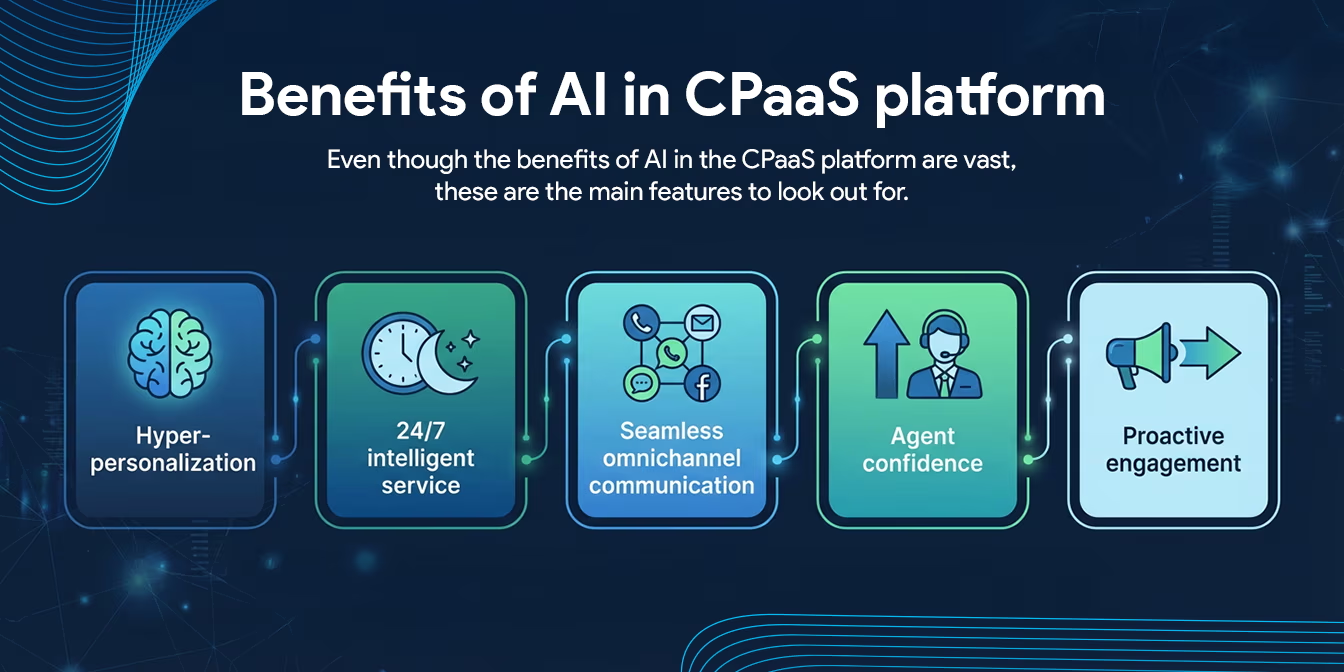
- Hyper-personalization – delivers highly personalized deliverables that feels like customized for the specific customer.
- 24/7 intelligent service – AI powered contact centers use self service that helps to cover almost 80% of routine tasks thereby reducing manual labor.
- Seamless omnichannel communication – even if the customer switches from one channel of communication to another mode of communication, the flow should be maintained.
- Agent confidence – with the help of AI, the agents get support and advice to handle the calls effectively and avoid confusion thereby improving first call resolution rates.
- Proactive engagement – with the help of tools, the agent gets access to possible questions that may arise from a customer, like if the system is in need of maintenance or any lags.
Even though the benefits of AI in the CPaaS platform are vast, these are the main features to look out for.
How AI transforms CPaaS capabilities
A typical CPaaS platform provides basic features like APIs, SDKs and ready made applications. These features are integrated with channels like sms,email,chats and other existing platforms of the specific company. With AI inclusion along with these features, the AI impart intelligence into these data which in turn converts this raw data into actionable insights.
Natural Language Processing (NLP)
These are the basic capabilities that give the CPaaS platform the ability to listen and understand human communication. Rather than understanding what the customer is saying through NLP, the inclusion of AI helps to understand the true goals beforehand. If the customer is calling to say something like his or her password does not seem to work and they get locked out, the AI searches the intent and recognizes it beforehand. So the solution can be provided without confusion that the customer is in need of a password reset.
The other feature is sentiment analysis. With the help of this feature, the omnichannel CPaaS platform analyzes if the customer is frustrated, confused or the like. This helps the system to intelligently route the call to the right agent who can smoothly handle the call without further escalation.
Generative AI
This tool, like any large language model, helps to hyper-personalize customer experience within the CPaaS platform.
Generative AI helps in content creation. Rather than producing a raw written content to push towards the customer, with this tool the AI analyzes the past conversations with the customer and curates a highly personalized text or sms that strikes the customer at the right place and moment, all delivered through a CPaaS API. This helps to enhance the customer experience.
Also the generative AI helps the agent to perform well. With the information on past interactions, the AI gives advice for the next best move to the agent thereby improving their average call handling time. This boosts the agent’s confidence and employee performance.
Predictive analytics and Automation
This capability helps to create a more proactive solution to the problem than just reacting to the problems. By analyzing the customer behavior, purchase history and interactions, the system predicts possible issues that may arise at time even before the customer notices it.The CPaaS platform automatically triggers a notification to the customer. This active input from the side of business is really helpful to improve customer experience and increase brand loyalty.
With the automated workflow orchestration, AI recognises the customers intent and assigns and directs the caller to the right agent with the specific skill needed. This minimizes confusion and maximizes efficiency and problem resolution rates.
How AI in CPaaS redefines customer journey
The result of AI in CPaaS platforms can be really measured in customer satisfaction.
1.Seamless omnichannel orchestration
It maintains context across channels. The main benefit of implementing AI in the CPaaS platform is that even if the customer starts the communication via whatsapp and switches to another channel or mode of communication, AI analyzes all the information and provides flow of communication. This ensures that the customer does not have to repeat himself to a number of people and improve customer satisfaction through ease of use.
Also the platform can intelligently shift the channel based on urgency of the matter. It ensures that no call is missed and no problem is left unheard. In cases of fraud alerts a pop up notification is triggered and alerts are sent with timely intervention.
2. Intelligent self-service
With the help of generative AI models, CPaaS products allow bots to handle multi-step queries and analyze information of customer history to improve first call resolution rates.
3. Contact center efficiency
Every interaction is analyzed methodically and ensures the quality of data. This helps the agent to trust the data without overworking themselves. Also after every call the AI provides a summary of the call time and information shared in the call. This helps to reduce after call work time of the agent.
4. Hyper- personalized marketing
AI in CPaaS moves beyond mass campaigns to hyper-personalized messages that improves customer experience for the business. Instead of sending a regular text notification about offers and alerts, RCS can be used to send rich media which will be more appealing to the customer that gives them satisfaction. Also with predictive models, automated targeted campaigns can be done focusing on specific customer groups or areas to increase profit turnover.
How to choose the right AI CPaaS solution
For any business who puts customer first ideology, choosing the right AI CPaaS solution is important.
- API flexibility and integration – you need to look for platforms that can easily integrate with your existing applications. You cannot afford to lose the customer data for hyper-personalization.
- Language support and scalability – you need to ensure that the platform offers multi-lingual NLP support and global scalability for your business.
- Low code development tools – even if you are not a tech based company, the platform should ensure your business a visual builder that helps to deploy complex AI workflows.
Conclusion
AI has surely elevated the position of the CPaaS platform. It is not a platform used just by tech based companies anymore. Every business needs to be equipped with easy access to the right service provider. Because delivering personalized experiences is the new route to success. Every business needs to scale further in their growth process and using AI has become inevitable.
For further information visit our website or book a demo.
Frequently asked questions:
1. Will AI replace agents in CPaaS interactions?
No, AI can only help to reduce the workload of human agents by handling simple queries preventing further escalation chances.
2. Can AI automatically transcribe call data?
Yes, AI can instantly translate call data into summarized versions in order to help agents to improve first call resolution rates.
Footnotes:
Unden-Farboud, Lisa, et al. Magic Quadrant for Communications Platform as a Service.”https://www.gartner.com/reviews/market/communications-platform-as-a-service“Gartner, 24 June 2024.
“AI, CX and Security: CPaaS Predictions for 2024.” “https://www.uctoday.com/unified-communications/cpaas/ai-cx-and-security-cpaas-predictions-for-2024/“UC Today, 12 Jan. 2024.
Prompts: “What is CPaaS : definition and use cases” , “The use of AI in CPaaS platforms”